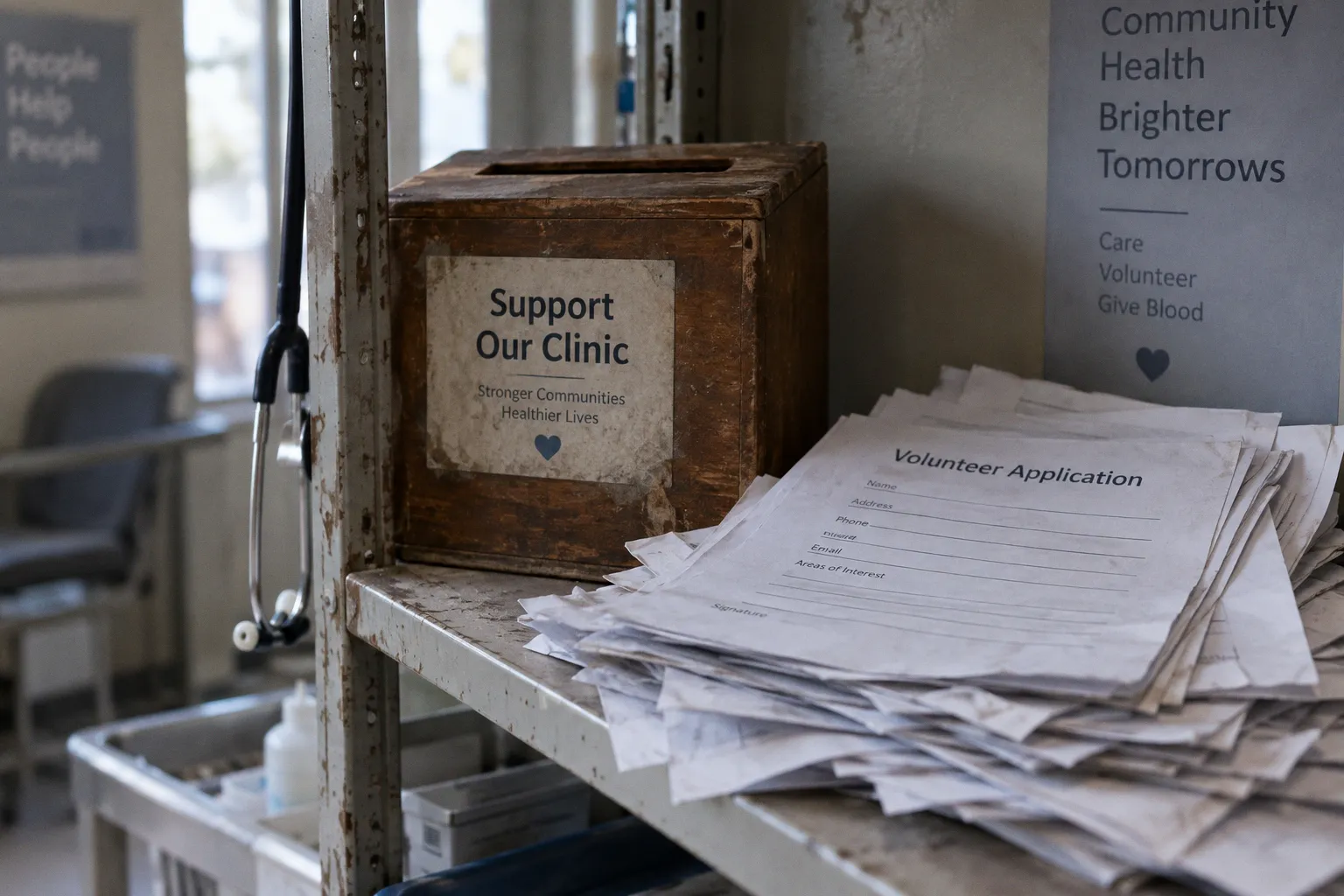
The moment an unpaid volunteer receives access to patients, restricted areas, records, supplies, or medication storage, the hospital has to make decisions about identity, safety, privacy, and institutional risk.
A useful warning can be drawn from a hypothetical pilot at a regional medical center. In this scenario, background checks were treated as a rubber stamp rather than as a documented workflow. When several candidates questioned why they had been rejected, the hospital could not reconstruct which reports had been reviewed, what notices had been sent, or who had made the final decision. The outreach team then had to repair both the records and the relationship with a community that had been invited to help.
The point is not that every volunteer is a hidden threat. It is that a charitable mission does not remove the hospital’s obligations. Medical volunteer background check requirements sit at the intersection of federal consumer-reporting law, state restrictions, healthcare sanctions, infection control, and the practical question of how an organization treats people when a screening result raises concern.
The Legal Reality: Why Unpaid Status Does Not Exempt Volunteers from FCRA
A volunteer may not receive a paycheck, but the hospital is still making a decision about whether that person can enter its facilities and interact with its patients. When the organization uses a third-party screening company to obtain a consumer report for that decision, the Fair Credit Reporting Act can apply.
The FCRA was designed around the use of consumer reports in decisions that affect a person’s opportunities. Its reach is not limited to conventional payroll employment. If a hospital obtains a report to determine whether an individual may serve in a volunteer role, it should assume that the associated disclosure, authorization, accuracy, and adverse-action obligations require the same level of care expected in an employment screening process.
That does not mean every volunteer program must use an identical package of checks. It does mean that the hospital needs to know what information it is obtaining, why it is obtaining it, who will review it, and how the candidate will be treated if the report contains potentially disqualifying information.
The basic FCRA workflow has several moving parts:
- The candidate receives a clear disclosure that a consumer report may be obtained for screening purposes.
- The authorization is obtained before the report is requested.
- The report is used for a permissible purpose and handled as sensitive information.
- If the hospital may rely on the report to deny the opportunity, it follows the pre-adverse and adverse-action procedures.
- The organization maintains records showing what was sent, when it was sent, and what decision followed.
The paperwork is not an administrative afterthought. It is the evidence that the hospital’s process was real rather than improvised.
Unpaid service does not create a legal gray zone. It creates a different form of responsibility: the hospital must protect patients without discarding the candidate’s right to a fair process.
Nonprofit status does not provide a universal shield either. Charitable-immunity rules vary, and protections that may apply in one setting do not eliminate the possibility of claims involving negligent screening, privacy, discrimination, or failure to follow consumer-reporting requirements. A hospital cannot treat volunteer status as a reason to lower its standards. In many roles, the opposite is true: the volunteer may be unpaid but still have regular contact with vulnerable people.
State law adds another layer. Depending on the jurisdiction, rules may limit how far back a report can look, restrict the use of certain records, require individualized consideration, or impose additional notice obligations. A program that recruits volunteers through a national website may also receive applications from people who have lived or worked in several states. The compliance question is therefore not only whether a report was ordered. It is whether the hospital’s screening and decision process fits the jurisdictions connected to the candidate and the role.
Navigating Federal and State Sanctions: Beyond Criminal History
A criminal-history search is one component of volunteer vetting for hospital programs. It is not the entire program.
A candidate may have no record in the county search selected by a coordinator and still appear on a healthcare exclusion list. Federal and state sanctions databases address a different question: whether the person has been excluded, suspended, or otherwise barred from participation in certain healthcare programs or activities. The Office of Inspector General’s exclusion database is a familiar example for healthcare compliance teams, but the relevant review may also include applicable state lists.
The significance of this check depends on the volunteer’s role and the organization’s operations. A volunteer who handles patient-facing materials, assists with transportation, supports a clinic, or enters areas connected to billing and federally funded services may create different concerns from someone who performs a supervised task in a public lobby. The hospital should define those distinctions in advance rather than make them up after a result appears.
Sanctions screening also has a maintenance problem. It is not enough to run a search once and assume the result remains current throughout the volunteer’s service. The organization needs a policy for initial screening, periodic re-screening where appropriate, and review when a volunteer changes roles. The frequency should be based on the facility’s risk assessment and applicable requirements, not on an arbitrary promise that every role carries the same exposure.
A defensible record usually identifies:
- The database or source searched.
- The date of the search.
- The name and identifying information used for the query.
- Any potential match requiring additional review.
- The person responsible for resolving the match.
- The final disposition and the supporting documentation.
This is where healthcare volunteer safety protocols become operational rather than aspirational. A list of databases in a policy manual does not protect anyone if staff cannot show that the searches were actually completed or that possible matches were distinguished from people with similar names.
What a criminal-history search can and cannot establish
Criminal-history information is also more complicated than a pass-or-fail label suggests. County, state, and federal sources may cover different jurisdictions and may not update on the same timetable. A name-based result can produce false positives, while an incomplete search can create false reassurance. Identity verification through an SSN trace or comparable process can help surface address history and guide the selection of jurisdictions, but it is not itself proof that a person has no record.
The hospital should avoid treating a report’s summary label as the decision. Reviewers need a process for confirming that the record belongs to the candidate, checking the status and nature of the information, and considering whether it is relevant to the specific volunteer role. That review should be consistent across candidates and documented in language that describes the decision without unnecessary speculation.
The same discipline applies to sex-offender registry searches. The check may be a standard part of a hospital’s screening package, but a potential match still requires identity verification and controlled handling. A database hit is not automatically a conclusive finding about the applicant. It is a signal that requires review under the organization’s policy and applicable law.
The Anatomy of a Compliant Screening Package for Healthcare Volunteers
There is no universal package for every hospital, charitable clinic, blood-donation drive, or community outreach program. The right scope depends on access, supervision, contact with vulnerable patients, handling of information or materials, and the length and regularity of service.
A volunteer assigned to a public reception area may not need the same review as someone supporting a clinical program. A person helping at a one-day community blood drive may move through a different onboarding process from a volunteer who will spend every week in an inpatient unit. Treating every role as identical can make the program unnecessarily burdensome in some areas and insufficiently careful in others.
A role-based package commonly includes the following elements:
- Application intake. The application should identify the proposed role, expected schedule, relevant experience, and any access the position requires. It should not ask for information the organization does not need.
- Disclosure and authorization. If a third-party consumer report will be used, the disclosure and authorization should be handled before the report is ordered and kept separate from unrelated application language where required.
- Identity verification. An SSN trace or comparable process can help confirm identity and identify jurisdictions that may need further review. It is a routing tool, not a complete background check.
- Criminal-history review. Searches may span county, state, and federal sources, with the depth tied to the position and the candidate’s residence or work history.
- Registry review. A sex-offender registry check may be included where appropriate, with procedures for resolving possible matches.
- Sanctions and exclusion screening. Federal OIG and applicable state databases should be checked when the role or the facility’s compliance program makes them relevant.
- Health and infection-control requirements. A hospital may require tuberculosis screening, immunization records, or other health documentation based on current facility policy and the volunteer’s proximity to patients.
- Role-specific training. Privacy, infection prevention, workplace conduct, emergency procedures, and boundaries around patient contact should be addressed before the volunteer begins.
- Decision records. The file should show who reviewed the information, what policy was applied, and whether the candidate was cleared, placed in a different role, or denied.
A useful way to see the distinction between the layers is to consider what each one is designed to answer:
| Screening layer | Question it addresses | Record the hospital should retain |
|---|---|---|
| Identity verification | Is the report connected to the right person, and which jurisdictions may be relevant? | Search details and identity information used |
| County, state, and federal criminal-history searches | Does available record information raise a role-related safety or compliance concern? | Reports, review notes, and disposition |
| Sex-offender registry review | Does the candidate appear on a relevant registry? | Date-stamped search and match-resolution record |
| OIG and state exclusion searches | Is the person excluded from applicable healthcare programs or activities? | Query confirmation and any follow-up |
| Health screening | Can the person safely serve in the proposed environment under facility policy? | Appropriate medical or occupational-health documentation |
| Training and access controls | Has the volunteer been prepared for the role and limited to authorized access? | Completion records and role assignment |
This structure matters in hospital volunteer compliance standards because the screening report is only one part of risk management. Access controls, supervision, and training can reduce exposure just as decisively as a database search. A volunteer who is never left alone with patients and cannot enter medication areas presents a different operational risk from a volunteer given broad access on the first day.
Fees, access, and the mission of a community program
Screening costs and health requirements can also affect who is able to volunteer. Some programs ask applicants to pay processing fees or to obtain medical documentation before placement. Even a relatively small charge may deter people with limited income, particularly when the volunteer role is unpaid and the candidate is also paying for transportation or required clothing.
That creates a tension for charitable hospitals and community outreach programs. The organization needs a consistent process, but consistency does not require ignoring barriers. A hospital may decide to absorb the cost, reimburse it after a defined period of service, work with a community partner, or offer a role with fewer screening requirements when the operational risk is lower. Whatever approach it chooses should be stated in advance and applied consistently.
The same principle applies to health documentation. Requirements should be tied to the environment and the duties, not used as a vague measure of whether a person appears committed. A blood-donation volunteer working in a public intake area and a volunteer assisting in a patient-care unit may reasonably face different requirements, provided the distinction is grounded in role risk and facility policy.
Managing Pre-Adverse Action: Protecting Your Organization and the Candidate
The most sensitive point in the process arrives when a report contains information that may cause the hospital to deny the volunteer opportunity. The FCRA does not allow the organization to treat that moment as a routine rejection email.
Before taking final adverse action based in whole or in part on a consumer report, the hospital generally provides the candidate with:
- A pre-adverse action notice.
- A copy of the consumer report being considered.
- A copy of the Summary of Your Rights Under the Fair Credit Reporting Act.
- A reasonable opportunity to identify inaccurate or incomplete information and provide a response.
The timing requires particular care. The often-repeated reference to sixty days is easy to misstate. It is not a mandatory sixty-day waiting period that the hospital must observe before making a final decision. The FCRA materials describe a period in which a consumer may request a free copy of the report from the consumer reporting agency, commonly within sixty days of receiving an adverse-action notice. That right does not mean the hospital must automatically hold the volunteer application open for sixty days.
The organization must instead provide a reasonable opportunity for the candidate to review and dispute the information before final adverse action. What is reasonable can depend on the circumstances, the method of delivery, the complexity of the report, and the organization’s process. A hospital should establish a defensible period, allow time for a dispute to reach the screening company, and avoid making the final decision while a timely dispute remains unresolved.
The sequence is important:
1. The hospital identifies information that may affect the decision.
2. It pauses the final decision and sends the required pre-adverse materials.
3. The candidate has an opportunity to review the report and dispute inaccuracies.
4. The hospital considers any response and obtains an updated result when appropriate.
5. If the organization still decides not to proceed, it sends the final adverse-action notice with the information required by the applicable process.
The hospital should not imply that a candidate is disqualified merely because a report contains an arrest, a dismissed matter, a record belonging to someone else, or information that the organization’s policy does not actually treat as disqualifying. The review must be tied to the role and to the information that can lawfully be considered.
The pre-adverse process is not a ceremonial pause before rejection. It is the point at which an organization checks whether its decision is based on accurate information and a defensible policy.
The internal record should be as careful as the communication with the candidate. Staff should preserve the report, notices, delivery records, dispute correspondence, and the final decision. They should also limit access to the information. A volunteer coordinator may need to know that an application is on hold, but not every supervisor needs to see sensitive details from the report.
Tone matters as well. A candidate may have applied because a relative received care at the hospital, because the person wants to support a blood-donation program, or because community service is part of a larger commitment to public health. None of those facts changes the screening decision. They do change the importance of communicating without accusation, unnecessary detail, or language that suggests the person’s character has been judged beyond the role-specific decision.
Mitigating Liability: Lessons from Failed Vetting Protocols
The hypothetical failed pilot described at the beginning illustrates a common pattern: the organization has a policy, but not a functioning system. Applications arrive through one channel, reports through another, and final decisions are communicated by whoever happens to be available. Months later, no one can tell which version of a form was used, whether the candidate received the report, or whether the person was denied because of a verified finding or an unreviewed database match.
That is not a problem solved by purchasing a more expensive screening product. It is a workflow problem.
The strongest volunteer risk management in hospitals usually has five practical features:
1. Roles are classified before recruitment begins. The hospital identifies which positions involve patient contact, access to protected information, contact with clinical supplies, or unsupervised movement through restricted areas.
2. The screening package follows the role. Every candidate receives the checks and training appropriate to the assignment, rather than an arbitrary bundle that changes from coordinator to coordinator.
3. One owner controls the file. A named person or team tracks authorization, searches, health requirements, training, communications, and the final disposition.
4. Potential matches trigger review, not instant rejection. The organization confirms identity, checks the reliability and status of the information, and applies the same decision framework to comparable cases.
5. The process continues after onboarding. Re-screening, incident reporting, role changes, and supervisor escalation are addressed in policy rather than left to personal judgment.
A hospital should also test its process before a real dispute exposes its weaknesses. A tabletop exercise can follow a fictional candidate from application through a possible match, a pre-adverse notice, a dispute, and a final decision. The exercise does not need to become a bureaucratic event. Its value lies in revealing practical gaps: an outdated form, an unclear handoff, a missing delivery record, or a supervisor who does not know where to send a candidate’s question.
What to do when the protocol has already failed
If a hospital discovers that a batch of volunteer screenings was incomplete, the worst response is to quietly fill in the gaps and pretend the original process was sound. The organization should determine which candidates were affected, what information was obtained, which notices were missing, and whether any volunteer received access without the required review.
Corrective action may include:
- Suspending affected placements where the role presents immediate risk.
- Repeating searches or obtaining missing documentation under a corrected process.
- Reviewing whether candidates were denied based on incomplete or inaccurate information.
- Consulting counsel about notice, remediation, and retention obligations.
- Training coordinators and supervisors on the revised workflow.
- Documenting the correction rather than overwriting the original record.
The response should be proportionate. A paperwork failure does not automatically prove that every volunteer is unsafe, just as a clean report does not prove that the process was complete. The hospital needs to separate operational risk from procedural risk and address both.
There is also a reputational dimension that compliance teams sometimes underestimate. A person who is rejected through a careful, understandable process may disagree with the outcome but still believe the hospital acted fairly. A person who receives a vague denial, cannot obtain the report, or discovers that the organization lost the relevant paperwork is more likely to view the institution as careless or dismissive.
That matters for hospitals whose work depends on local trust. Community outreach, charitable care, and blood-donation programs are built through repeated contact with neighbors. A screening process that protects patients while respecting applicants strengthens that relationship. A process that treats volunteers as disposable creates a different kind of risk, one that will not appear in a sanctions search.
The screening report is only the visible part of a safe volunteer program. The real protection lies in the structure around it: role design, documentation, review, communication, and follow-through.
The lesson from a failed pilot should not be that hospitals must screen everyone more aggressively. It should be that screening must be purposeful and repeatable. The organization needs to know what risk it is addressing, what information is relevant, and what procedural safeguards apply when the answer is uncertain.
Medical volunteer background check requirements are therefore less about assembling the longest possible list of searches than about building a process that can withstand a question from a candidate, a supervisor, a regulator, or a patient. Unpaid status does not remove the hospital from the reach of consumer-reporting law. A criminal-history search does not replace sanctions screening, identity verification, health precautions, or supervision. And a potentially disqualifying report does not eliminate the candidate’s right to a fair chance to correct inaccurate information.
A reliable program makes those principles visible in the records. It gives volunteers a clear path into service, gives staff a clear path through uncertainty, and gives patients the protection they were promised when the hospital opened its doors.