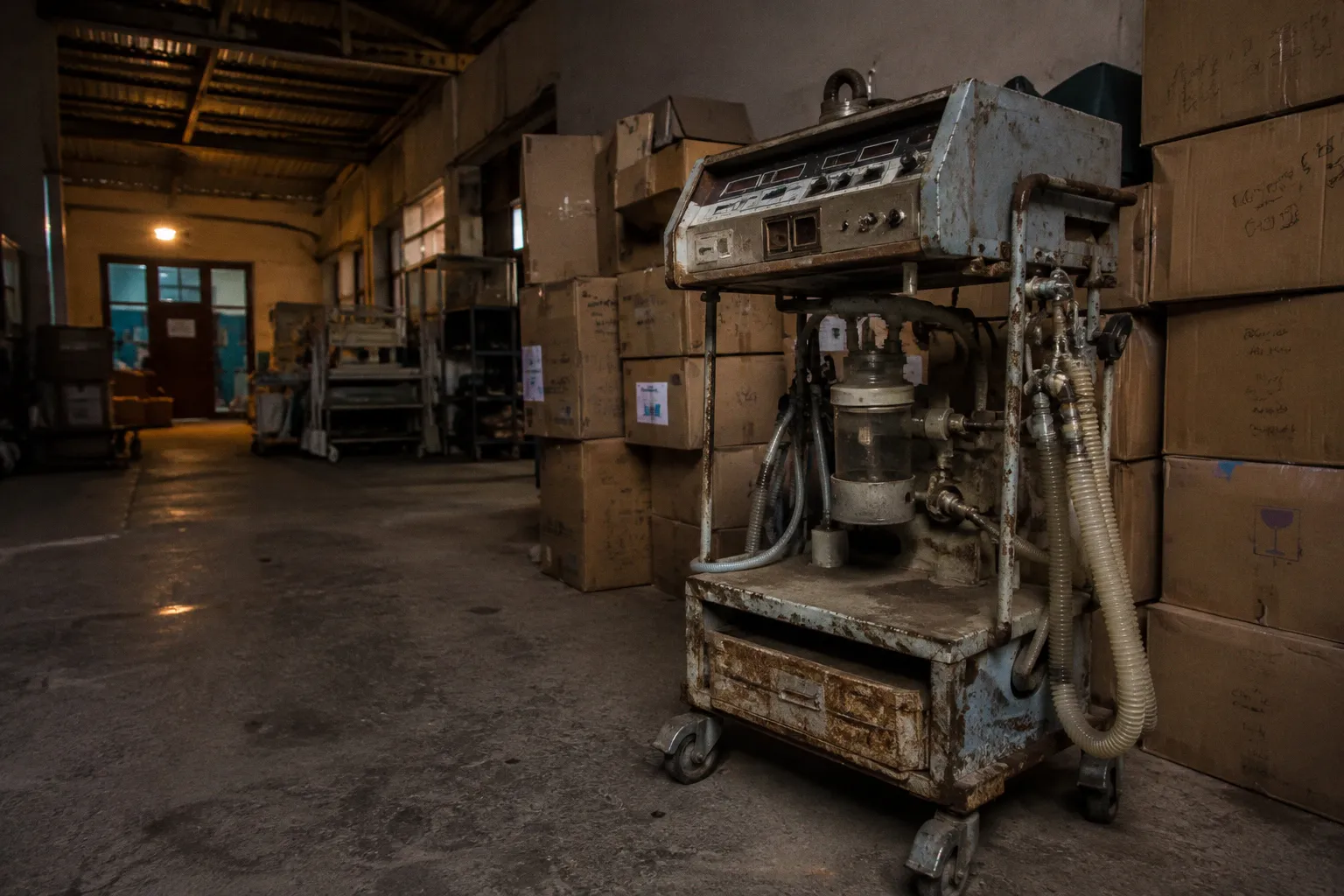
Yet the conveyor belt of well-meaning cargo barely slows down. Hospital procurement offices in wealthy nations continue to offload retired ventilators, ultrasound carts, and anesthesia monitors onto charitable logistics networks under the comfortable label of in-kind medical equipment donation, and the receiving end absorbs the wreckage. The equipment arrives in shipping containers, gets photographed for the annual report, and then gathers dust in a back room because nobody on the donor side bothered to ask what voltage the receiving hospital runs, whether the staff speaks the language of the instruction manual, or whether replacement parts exist within a thousand kilometers.
This is not a story of villainy. It is, in many ways, a story of administrative convenience dressed up as humanitarian impulse. The donor writes off the depreciated value of obsolete inventory, claims a tax receipt, and clears warehouse space. The receiving institution, often underfunded and understaffed, is expected to be grateful for machinery that cannot be plugged in without a transformer the size of a suitcase. The mismatch is so consistent, and so well documented, that calling it an unintended consequence strains credulity. It is, more accurately, the predictable outcome of a supply chain that begins with what the donor wants to discard rather than what the recipient actually needs.
Up to 70% of donated medical equipment sits broken or idle in the clinics it was meant to serve. That is not generosity — it is logistics malpractice wearing a humanitarian label.
Voltage, Plugs, and Dust: The Gambia Oxygen Concentrator Debacle
The Gambia case reads like a parable for the entire field. Around the year 2000, a referral hospital received a donation of oxygen concentrators — devices that pull ambient air and concentrate it for patients with respiratory failure. The shipment looked reasonable on paper. The devices came from a major manufacturer, were still within their nominal service life, and carried the usual regulatory markings of a serious medical device. Within weeks, the equipment began to overheat and fail.
The post-mortem was almost embarrassingly simple: every unit shipped with North American voltage and frequency specifications (110 volts at 60 hertz), while the Gambian hospital's electrical infrastructure ran on 220 volts at 50 hertz. Without step-down transformers — which nobody on the donor side had thought to include, and which were not readily available in the local market — the machines either refused to run or burned out their internal components within a handful of cycles. The hospital had effectively received a row of expensive space heaters.
The Gambia episode is not an outlier. It is one of the most-cited illustrations of how in-kind medical equipment donation mistakes compound when technical due diligence is treated as optional. Climate compounds the problem further. A device rated for a temperate, humidity-controlled hospital corridor can degrade rapidly in a coastal clinic where salt air corrodes connectors, monsoon humidity condenses on circuit boards, and airborne dust clogs internal filters faster than any maintenance schedule can address. Manufacturers publish operating envelopes — temperature range, humidity ceiling, altitude tolerance — and these specifications are not decorative. Ignoring them is not a small oversight; it is a decision to ship equipment into an environment engineered to destroy it.
Consider the practical cascade: a single voltage mismatch doesn't just disable one machine. It consumes the receiving hospital's scarce electrical capacity, diverts biomedical staff time into futile troubleshooting, and erodes institutional trust in future shipments. The next container that arrives — potentially loaded with genuinely useful supplies — faces skepticism from administrators who have already allocated scarce floor space to a previous batch of non-functional inventory. The damage from donating medical equipment to charity hospitals without basic technical verification radiates outward through the entire procurement culture of the receiving institution.
The Ndogbati Verdict: Underutilization and the Training Deficit
If the Gambia case exposed the electrical mismatch problem, a post-donation survey at Ndogbati Protestant Hospital in Douala, Cameroon exposed a different and more stubborn dimension of the same failure. Roughly one-third of donated medical supplies at that institution were sitting unused — not because the hardware was defective, but because the surrounding ecosystem could not absorb it. Staff had not been trained on the specific models delivered. Consumables required for routine operation — reagent kits, proprietary tubing, calibration gases, single-use electrodes — were either unavailable locally or priced beyond the operating budget. Manuals arrived in languages no one on the ward spoke. In several cases, the equipment itself worked; the support system around it simply did not exist.
This is the paradox of donating medical equipment to hospitals without ecosystem planning: the cost of making a device functional often exceeds the cost of the device itself, and that cost is silently transferred to the recipient. The donor's spreadsheet records a successful transfer of assets. The receiving hospital records a depreciation line and a backlog of troubleshooting tickets no one in-house is qualified to close. The discrepancy between those two ledgers is, in effect, the hidden invoice of unmanaged charity.
The Ndogbati findings carry an additional implication that many donor organizations have been reluctant to confront. Underutilization is not a binary state — equipment that is "technically functional but operationally stranded" occupies a worse position than equipment that has clearly failed. Broken devices can at least be documented, written off, or stripped for salvage. Partially functional equipment generates a false signal: it appears in hospital inventories as operational capacity, distorting planning decisions and resource allocation. When a regional health authority counts installed devices as a proxy for clinical capability, the Ndogbati-style underutilization gap means the official picture overstates real capacity by a significant margin.
The Spare Parts Economy: What Uganda's 1,400-Device Audit Reveals
The most detailed field accounting of this pattern comes from biomedical engineering volunteers who inventoried two Ugandan public hospitals, item by item, and counted more than 1,400 devices. Of those, 51 were repaired on-site — a fraction that sounds modest until you consider the estimated value of that repair work: roughly $102,000 in avoided replacement costs. The remaining devices — autoclaves, infusion pumps, infant warmers, defibrillators, laboratory analyzers — were not necessarily broken beyond repair. Many had failed for reasons that a trained technician with the right part could have addressed in an afternoon. The bottleneck was upstream: no spare parts supply chain, no service manual, no local distributor willing to stock components for a brand discontinued from the donor country's formulary years earlier.
The implication is uncomfortable for the entire philanthropic medical logistics sector. When a donor ships a piece of equipment without securing a reliable path to consumables, training, and technical documentation, they are not making a charitable investment. They are exporting future maintenance debt to a facility that has no balance sheet to absorb it. In sub-Saharan Africa, where region-wide estimates suggest as much as 80% of medical devices are acquired through donations, that debt compounds quickly and invisibly. The installed base is overwhelmingly foreign-manufactured, and the parts ecosystem follows the donor country's market, not the recipient's geography.
The economics of spare parts deserve closer scrutiny because they expose the core structural flaw. A ventilator that cost $12,000 new might be donated when its market value has depreciated to near zero. But the replacement flow sensor for that specific model might cost $400 — if it can be found at all — and the shipping logistics to get it into a rural sub-Saharan hospital add another layer of cost, delay, and customs friction. Multiply that scenario across hundreds of devices from multiple manufacturers and multiple donor countries, each requiring different consumables, different calibration protocols, and different service intervals, and you begin to understand why biomedical engineers at the receiving end describe their job less as "maintenance" and more as "archaeology."
| Case study | Location | Failure mode | Documented loss or waste |
|---|---|---|---|
| Oxygen concentrator voltage mismatch | Referral hospital, The Gambia (c. 2000) | North American 110V/60Hz units shipped into a 220V/50Hz grid; no step-down transformers included | All donated units failed within weeks |
| Post-donation utilization audit | Ndogbati Protestant Hospital, Douala, Cameroon | Training gaps, consumable-cost barriers, language mismatch on manuals | 33% of donated supplies underutilized |
| Two-hospital biomedical inventory | Two public hospitals, Uganda | Missing spare parts and absent maintenance documentation | 1,400+ devices inventoried; 51 repaired, ~$102,000 in value salvaged |
| WHO regional estimate | Low- and middle-income countries, broadly | Infrastructure mismatch, training gaps, missing technical support | 40%–70% of donated equipment non-operational |
| Sub-Saharan supply share | Sub-Saharan Africa, broadly | Donations dominate the installed base, with weak follow-through | Up to 80% of medical devices acquired through donations |
The compliance test for a medical donation is not whether the box arrived. It is whether the device is still working when no one from the donor is watching.
From Surplus Dumping to Sustainable Partnership: The Compliance Gap
The WHO has been unusually blunt about this. Its original 2002 guidelines on medical equipment donations — and the revised 2010 guidelines on medicine donations — lay out a deceptively simple test: a donation should meet a genuine need, function in the recipient environment, come with the consumables required for operation, and arrive with a maintenance commitment the receiving institution can realistically honor. The document is not a regulatory code; it carries no enforcement mechanism. But it is a remarkably clear statement of what medical supply donation best practices should look like in this corner of global health.
In practice, compliance is the exception. Charitable organizations and hospital foundations, often stretched thin on staff and under pressure to demonstrate tangible output for their boards, continue to treat the physical shipment of hardware as the deliverable. The recipient consultation, the site assessment, the voltage and climate check, the training plan, the three-year consumables budget, the end-of-life plan for the device — all of that is treated as a follow-up, a next step, a to-be-determined. Meanwhile, the United States alone generates roughly 2 million tons of medical supply waste annually, a figure that underscores how much healthcare infrastructure treats equipment as disposable inventory rather than as long-term clinical assets. That domestic disposable mindset carries directly into the way surplus equipment is packaged and sent abroad: the logic of the loading dock, not the logic of the ward.
The ethical gray area is not whether donations should happen. They should, and when properly planned they can dramatically expand clinical capacity in places the market will not reach. The gray area is the gap between the photo opportunity at the loading dock and the technician in the receiving hospital who will, five years from now, be trying to find a replacement circuit board for a model the manufacturer stopped supporting in 2009. Closing that gap requires a shift in what counts as success. It means measuring an in-kind donation not by what left the warehouse but by what is still functioning on the ward when the grant cycle ends — the standard that should anchor any honest set of hospital in-kind donation guidelines.
Several organizations have begun to operationalize this shift, albeit slowly. Some donor programs now require pre-shipment site assessments that document the recipient's voltage, climate zone, and existing equipment inventory before a single device is packed. Others have moved to a hybrid model: rather than shipping entire devices, they fund the procurement of equipment locally or regionally, ensuring that the supply chain, warranty, and service network are built into the purchase. The logic is straightforward — a locally purchased device arrives with a local parts distributor, a local technician trained on that model, and a warranty that does not require transatlantic shipping to exercise. The unit cost is higher than "free surplus," but the total cost of ownership — which is the only honest accounting frame — is often dramatically lower.
The Lingering Question
For all the documentation, the case studies, and the revised WHO guidance, the central question remains unresolved. If between 40% and 70% of in-kind medical equipment donations fail at the point of use — a figure that has been public knowledge for more than two decades — why does the flow continue at its current scale and composition? Is it ignorance, inertia, or the simple administrative convenience of writing off depreciated assets while claiming a humanitarian dividend?
The data does not flatter any of those explanations. The Gambia's voltage mismatch, Cameroon's underutilization audit, and Uganda's 1,400-device inventory all point to the same institutional bottleneck: donation programs designed around the donor's surplus rather than the recipient's specifications. The warehouse gets cleared, the tax receipt is filed, the annual report shows a line item for "medical equipment donated." The receiving clinic absorbs the consequences quietly, because pushing back against a well-funded international partner is not a viable institutional strategy for a hospital that cannot afford its electricity bill.
Until the architecture of charitable medical logistics is rebuilt around the receiving end — its electrical grid, its training capacity, its spare-parts market, its climate, its language — the warehouses of well-funded hospitals will continue to fill with equipment that never quite works, and the clinics that need it most will continue to absorb the depreciation. The full cost of unusable healthcare equipment donations is not on any single balance sheet. It is, for now, a discrepancy the sector would prefer not to audit too closely.