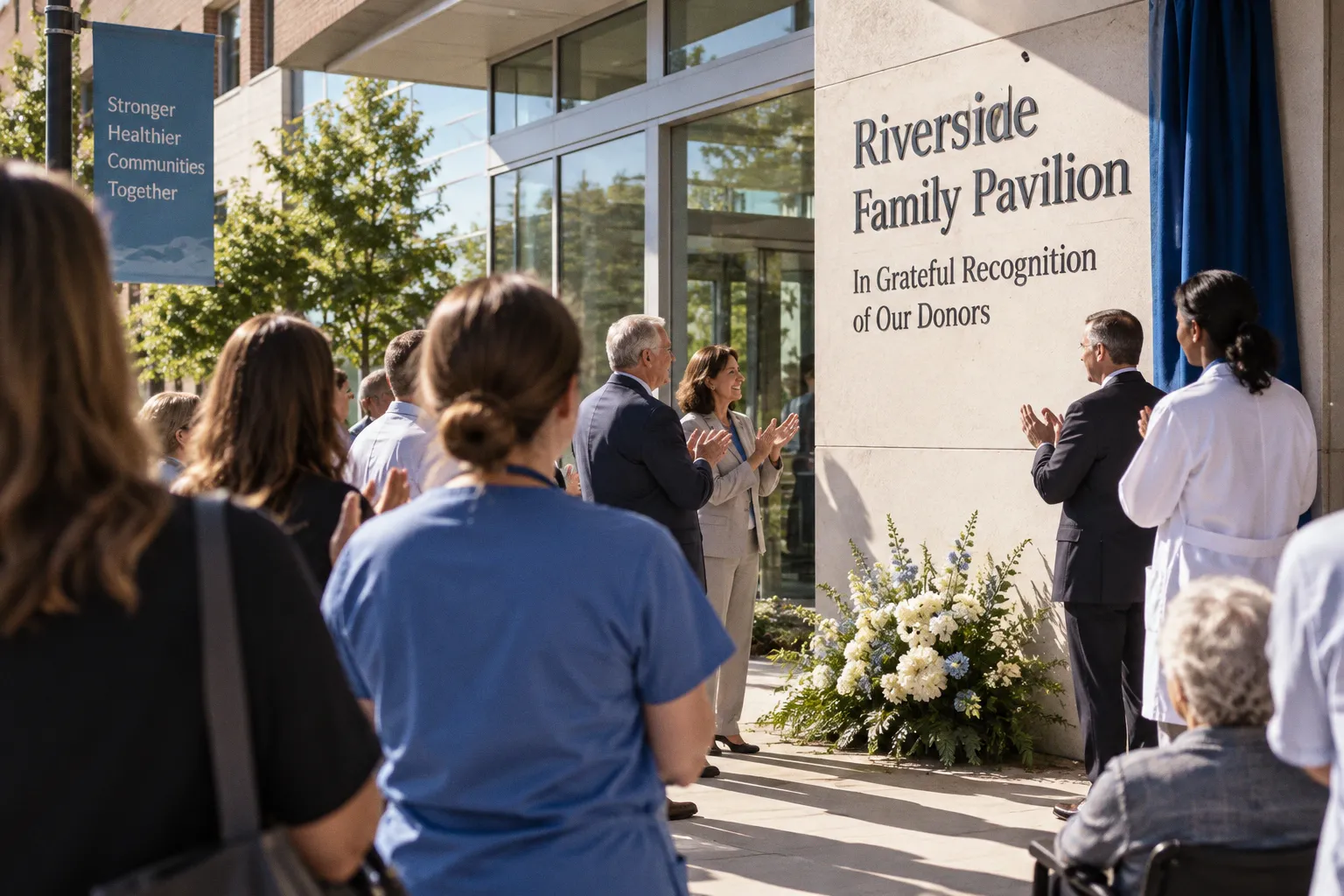
A hospital naming gift does more than place a family name on a wall. At its strongest, it gives a medical institution durable financial groundwork: money invested for future use, a program protected through changing budgets, or a physical space supported by a donor whose commitment extends beyond a single campaign.
That is the promise behind hospital donor endowment naming rights. A donor may help name a new building, patient room, clinic, staff office, endowed fund, or major clinical program. The institution receives capital for care and continuity; the donor receives a visible and lasting connection to the neighborhood the hospital serves. But the arrangement is not simply a naming ceremony followed by permanent recognition. It is a negotiated partnership with financial obligations, reputational risks, governance rules, and a long operational life.
In the quiet hours of a hospital shift, the name on a door can seem like a small detail beside medication rounds, transport calls, and a crowded emergency department. Yet the funding behind that name may determine whether a service can recruit staff, replace equipment, expand access, or continue supporting patients after a campaign has ended.
What hospital naming rights actually fund
Naming rights are usually attached to one of two broad forms of philanthropy: a physical asset or a long-term fund.
A physical naming opportunity may involve a new hospital building, a lobby, a café, a patient room, a staff office, a treatment area, or another defined space. The donation helps finance construction, renovation, equipment, or the broader capital campaign. Recognition is connected to the space, and the donor’s name becomes part of the daily geography of care.
An endowment works differently. The original gift, known as the principal, is invested rather than spent all at once. The hospital or its foundation uses a portion of the investment returns to support an agreed purpose. Depending on the fund, that purpose may include a clinical program, research, a staff position, patient relief, education, or general operations.
The distinction matters because the donor is not purchasing a permanent advertising placement. The institution is taking on a continuing obligation to administer the gift and honor the agreement, while the donor is usually making a substantial commitment to the hospital’s future rather than only to its present construction needs.
At Madelia Health Foundation, for example, the minimum gift to name a new hospital building is set at $1 million or 50% of the total construction or renovation cost, whichever is higher. The minimum gift for naming an endowment is $100,000. These figures show how sharply the financial expectations can differ between a building and a fund.
Other institutions use a much wider ladder of opportunities. Tallahassee Memorial HealthCare lists naming options that begin at $5,000 for spaces such as patient rooms or staff offices and rise to $1 million or more for major hospital areas, including lobbies and cafés.
There is no universal price list for hospital naming rights. Each institution sets its own thresholds according to the size of the facility, the cost of the campaign, the visibility of the space, the intended duration of recognition, and the level of support required to sustain the related service.
A name on a hospital door is the visible surface of a much deeper agreement: who funds the work, how long the support lasts, and what the hospital can responsibly promise in return.
The difference between a named space and a named endowment
For donors, the most important early decision is not which name will appear on the plaque. It is whether the gift should create visibility now, financial resilience later, or both.
A named room or office offers immediate recognition. Patients, staff, visitors, and community partners encounter the donor’s name as they move through the building. This can be meaningful when the space has a clear connection to the donor’s family, profession, neighborhood, or experience of care.
A named building or major public area carries greater prominence and usually requires a much larger contribution. It may sit at the center of a capital campaign, where the institution is raising money for construction or renovation. These gifts can help a hospital turn architectural plans into usable care capacity, but they often come with strict funding milestones. A naming agreement may not become active until the donor has fulfilled the required pledge.
An endowed fund is less visible in its financial mechanics, but often more durable in its practical value. The principal remains invested, and only part of the annual returns is distributed. That structure can support a program over many years, including periods when annual fundraising becomes more difficult.
Consider the difference:
| Naming opportunity | What the gift primarily supports | How recognition appears | Main operational question |
|---|---|---|---|
| Patient room or staff office | A defined interior space, renovation, or campaign | Plaque, room designation, or donor display | Does the space remain in use if the hospital restructures the floor? |
| Lobby, café, or major public area | Capital construction, renovation, or high-visibility campaign needs | Prominent signage and institutional recognition | Does the donor’s contribution meet the institution’s threshold for a central space? |
| Hospital building | A substantial share of construction or renovation costs | Building name and long-term public identification | Has the donor fulfilled the required financial commitment? |
| Endowed fund | Long-term support for a program, chair, research area, or operations | Fund name in reports, communications, and program materials | How will investment returns be distributed and monitored? |
| Named clinical program | A defined service or intervention | Program name across public and internal materials | Can the hospital sustain the program if clinical priorities change? |
The right fit depends on the donor’s intention. Someone seeking a visible family legacy may prefer a physical space. Someone more concerned with continuity of care may favor an endowment that quietly pays for the work year after year.
How the agreement is built
The public-facing part of a naming partnership may be a ceremony, a wall inscription, or a line in an annual report. The groundwork happens earlier, through conversations between the donor, the hospital foundation, clinical leaders, finance staff, and legal advisers.
A serious agreement usually clarifies several practical points.
The exact asset or fund
The agreement should identify what is being named and how that asset is defined. A building is easier to identify than a clinical program, which may change scope over time. A patient room may be renovated, repurposed, or absorbed into a redesigned unit. An endowed fund may support one named program initially but require a fallback purpose if that program is discontinued.
The more specific the language, the easier it becomes to protect both sides from confusion later. The donor should know what recognition is being offered. The hospital should know what it must maintain, report, and communicate.
The amount and payment schedule
A headline pledge is not necessarily the same as money already received. Hospitals may accept multi-year commitments, but the naming arrangement can depend on whether the donor has paid the full amount, reached a defined percentage, or satisfied agreed milestones.
This is particularly important in capital campaigns. If construction begins before all pledges are collected, the institution must understand the risk of unpaid commitments. A naming policy may therefore require a minimum payment before recognition is installed, with the remaining balance due according to a written schedule.
For donors, the schedule is more than an administrative detail. It determines when the name appears, when the fund becomes active, and what happens if circumstances change.
The duration of recognition
Many donors assume that a named hospital asset will carry a name forever. That is not a safe assumption. Some organizations offer recognition for the useful life of a facility or program. Others use term-limited naming rights, especially when a hospital may be renovated, relocated, merged, or substantially restructured.
Term limits can feel less romantic than promises of permanence, but they may be more honest. A hospital is not a static monument. Services move, buildings age, and clinical models shift. A carefully drafted term can protect the institution’s flexibility while still giving the donor a meaningful period of recognition.
The use of investment returns
For an endowment, the agreement should explain how the principal is protected, how returns are calculated or distributed, and whether the hospital may use a portion of the income for administration or related expenses. It should also describe what happens when investment performance is weak.
The point of an endowment is not to spend the original gift quickly. The principal is preserved and invested so that a portion of the annual returns can support the intended purpose over time. That arrangement creates resilience, but it does not eliminate financial uncertainty. Markets fluctuate, and the amount available for a program may vary.
A donor who wants predictable annual spending should ask how the institution sets its distribution policy. A hospital foundation that wants dependable support should ensure that the stated purpose can withstand years when returns are lower than expected.
Why endowments can matter more than the plaque
A named space is visible. An endowment is structural.
When a hospital receives a large unrestricted or purpose-specific gift and spends it immediately, the benefit may be concentrated in a building project, equipment purchase, or short-term expansion. An endowed fund can continue generating support after the campaign banners come down and the opening-day photographs are filed away.
That long horizon is particularly valuable for services that are essential but difficult to fund through episodic appeals. A hospital may need ongoing resources for patient assistance, staff education, research, community outreach, or a specialized program whose costs do not disappear after the first year.
Endowment income can support:
- A clinical program that needs recurring operating funds rather than a one-time purchase.
- A named chair or leadership position that strengthens recruitment and expertise.
- Patient relief efforts that help cover urgent needs outside standard reimbursement.
- Research or education tied to the hospital’s long-term mission.
- Operational priorities that allow frontline services to remain stable during difficult budget cycles.
The arrangement also asks the hospital to maintain discipline. The fund must be invested, reported, and used according to its purpose. If the agreement is too narrow, the hospital may struggle to use the money when medical practice changes. If it is too broad, the donor may feel that the original intention has been diluted.
The best agreements leave room for clinical reality without erasing the donor’s purpose. A fund created to support maternal health, for instance, may need language broad enough to cover changes in prenatal care, delivery services, postpartum support, and related community interventions.
The risks that sit behind a lasting name
Naming rights can strengthen a hospital’s finances, but they also expose the institution to risk. The larger and more visible the gift, the more carefully the hospital must examine the relationship.
One concern is reputational harm. A donor’s public conduct, business practices, or legal troubles may change after a building is named. If the name remains attached to a hospital, the institution can be perceived as endorsing or defending the donor.
Northumberland Hills Hospital’s donor recognition policy gives the Hospital Board and Foundation Board the right to revoke a named asset if the relationship threatens the hospital’s reputation or if the donor fails to meet financial obligations. That kind of clause does not make a naming agreement meaningless. It acknowledges that a healthcare institution has responsibilities to patients, staff, and the surrounding community that extend beyond one fundraising relationship.
A second risk is the donor’s failure to complete a pledge. A hospital may have announced a name, ordered signage, or built a campaign around a commitment that later becomes difficult to collect. Agreements therefore need clear remedies, including the possibility of removing recognition if the financial terms are not met.
A third risk is institutional change. Hospitals merge. Buildings are sold or repurposed. Departments are consolidated. A program that made sense when the gift was signed may no longer exist in its original form. Term limits, replacement recognition, and successor-purpose clauses give both sides a way to navigate those changes without turning every future decision into a dispute.
Clauses that deserve plain-language attention
Before a donor signs, the central terms should be understandable without a legal interpreter standing beside the table. The agreement should address:
1. Payment obligations: the full amount, due dates, accepted forms of payment, and consequences of nonpayment.
2. Recognition period: whether the name lasts for a defined term, the useful life of the asset, or another stated period.
3. Placement and presentation: where the name appears and who controls the design, size, and wording of signs or public materials.
4. Program changes: what happens if the named service moves, changes scope, or closes.
5. Reputational protection: the circumstances under which the hospital can remove or suspend recognition.
6. Investment and reporting: how an endowment is managed and how the donor receives updates.
7. Fallback use: the alternative purpose for funds if the original purpose can no longer be carried out.
8. Confidentiality and publicity: whether the donor’s identity, gift amount, family connection, or personal story may be shared publicly.
These are not hostile provisions. They are the practical architecture of trust. A hospital that avoids difficult questions at the beginning may leave staff and donors with harder questions later, when a building has opened, a program has changed, or a pledge has gone unpaid.
Choosing between visibility, flexibility, and continuity
Donors often arrive with a deeply personal reason for giving. A parent received care in a particular unit. A family has lived in the same neighborhood for generations. A company wants to support the workforce that sustains its community. A foundation wants to strengthen a service that local patients cannot easily access elsewhere.
Those motives can lead to different forms of naming.
A physical space may be the strongest choice when the donor wants a public, place-based legacy. It creates a visible marker in the hospital’s daily life and can help connect future patients with the story of the institution’s support.
An endowment may be better when the donor’s priority is continuity. It can generate support after a construction campaign ends and can be structured around a clinical or community purpose rather than a particular room.
A named program may sit between the two. It can carry a donor’s name in public communications while directing money toward an active service. But because programs evolve, the agreement needs enough flexibility to remain useful without losing its original meaning.
The financial threshold also matters. The examples available from hospital foundations show a broad range: some room and office naming opportunities begin at $5,000, while major public spaces may require $1 million or more. At Madelia Health Foundation, a named endowment begins at $100,000, while naming a new building requires at least $1 million or half of the construction or renovation cost, whichever is higher. These are institutional policies, not industry-wide rules.
For a donor considering a major gift, the question is not simply how much recognition a contribution can buy. It is what kind of care the contribution can keep standing when the original donor is no longer in the room.
The strongest legacy gift is not the one with the largest lettering. It is the one whose purpose still helps a patient after the campaign has disappeared from public view.
The hospital’s responsibility to the community
Naming rights are often discussed as a donor benefit, but the hospital carries the heavier public responsibility. Its leaders must decide whether the gift advances the mission, whether the recognition is proportionate, and whether the relationship will remain defensible to patients and staff.
That responsibility becomes especially important when the named asset is central to the hospital’s identity. A lobby, emergency department, women’s health center, or community clinic is not merely real estate. It is a place where people arrive frightened, exhausted, or uncertain about what care will cost. The institution must ensure that philanthropy supports dignity rather than turning access to care into a display of wealth.
Clear donor recognition policies help establish that boundary. They can set minimum gift levels, approval processes, naming durations, design standards, and removal provisions. They also help prevent inconsistent promises, in which one donor receives permanent recognition while another is offered a short-term arrangement for a similar contribution.
The policy should be understood by more than the fundraising team. Clinical leaders, board members, communications staff, finance officers, and community representatives all need to know how naming decisions are made. Otherwise, the visible name may move faster than the institution’s ability to explain the relationship.
This is where hospital philanthropy becomes a form of community medicine. The money supports care, but the agreement shapes how the community experiences the institution: who is recognized, which services are protected, and whether the hospital appears accountable to the people who depend on it.
A thoughtful path for donors and foundations
The first conversation should focus on purpose, not signage. Donors can begin by asking what problem they want to help solve and whether that problem requires a building, a program, a fund, or flexible support.
A practical sequence looks like this:
1. Define the intended legacy. Decide whether the priority is a place, a service, a patient population, research, staff development, or long-term operating strength.
2. Understand the hospital’s approved opportunities. Ask which spaces and programs are available, what minimum gifts apply, and whether the naming policy is public.
3. Separate the pledge from the recognition. Clarify when the name is installed, what happens if payments are delayed, and whether the institution can announce the gift before it is fully funded.
4. Study the endowment mechanics. Review how the principal is invested, how annual distributions are set, and what reporting the donor will receive.
5. Discuss change before it arrives. Ask what happens if a program closes, a building is renovated, or the hospital joins another health system.
6. Read the reputational provisions carefully. Removal clauses protect the hospital, but they also define the limits of the donor’s expected recognition.
7. Build a fallback purpose. A well-written alternative allows funds to continue supporting related care instead of becoming trapped by outdated language.
8. Bring in independent advice. Large gifts may involve tax, estate, investment, and family-governance questions that the hospital cannot answer on the donor’s behalf.
Foundation officers can strengthen the process by presenting more than one route to impact. A donor who arrives asking to name a room may discover that an endowed patient relief fund would address the same concern more consistently. Another donor may want an endowment but learn that a capital gift is the immediate intervention needed to open a service.
The conversation should remain grounded in the hospital’s real shift: its staffing pressures, its patient flow, its neighborhoods, and the work that must continue when annual appeals slow down.
A legacy measured in continuity
Hospital donor endowment naming rights sit at the intersection of memory and infrastructure. They give families, foundations, and companies a way to attach their names to a place of care, but the most meaningful part of the arrangement is not the inscription. It is the support that continues underneath it.
A successful naming partnership leaves the hospital stronger, not merely more decorated. It provides capital without surrendering institutional judgment, creates recognition without promising what cannot be guaranteed, and gives a donor a meaningful role in the hospital’s future without confusing philanthropy with ownership.
The name may be printed on glass, carved into stone, or listed in a foundation report. What matters most is whether the gift helps the next patient move through the hospital with less delay, whether a clinical team has the resources to stay resilient, and whether a neighborhood service remains open when the need is greatest.
That is the durable promise of a well-built endowment: not permanence as a slogan, but continuity as a practice.