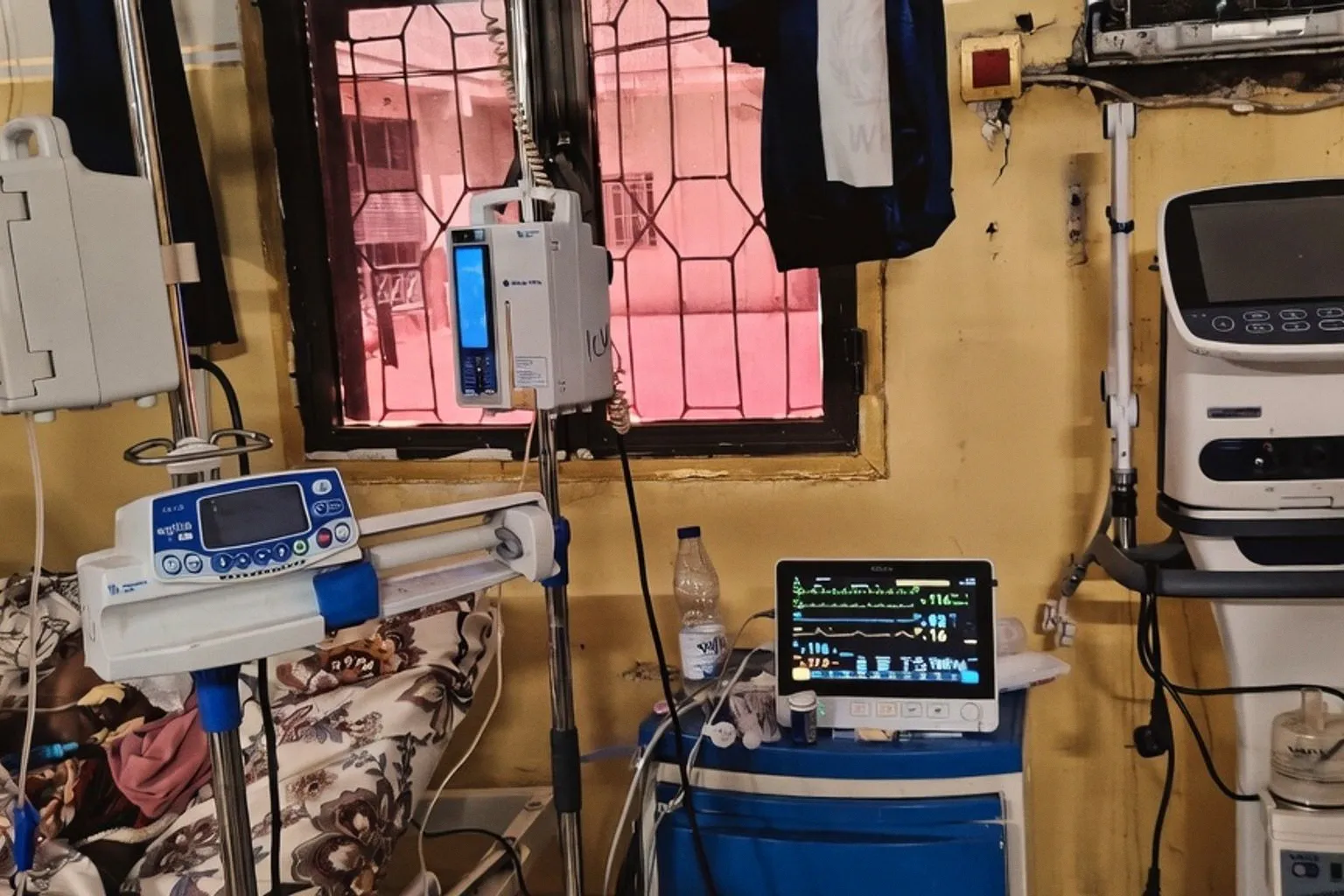
A war-damaged ICU, a SHARE grant, and the thin line between capacity and collapse
According to the WHO's Eastern Mediterranean Regional Office, targeted interventions through the Sudan Health Assistance and Response to Emergencies (SHARE) Project — backed by the World Bank Group and implemented by PANCARE — have brought the intensive care unit at Sennar Teaching Hospital back into operation for the first time since the war disrupted its core services.
The mechanics of restoration
Before the intervention, five patient monitors were out of service, the oxygen supply was inadequate, and infection prevention and control systems had visible gaps. These unglamorous deficiencies — the kind that never earn a press conference — had effectively closed the ICU, forcing critically ill patients to be referred elsewhere at moments when every delay tilts the odds toward mortality.
The SHARE response focused on immediate fixes: restoring the five monitors, delivering oxygen concentrators, tightening IPC supplies, and embedding continuous on-site training. The ICU reopened in March 2026 with a planned capacity of nine beds, five of which were operational at the time of the WHO report. Within its first month, 27 critically ill patients were admitted for treatment or stabilization — cases that would previously have required transfer to another facility.
The arithmetic around the island
The restoration is real, but the surrounding arithmetic is bleak. According to the WHO statement, only 48% of health facilities across Sudan's twelve accessible states are fully functional, 15% are partially functional, and 37% are non-functional. That ratio — half a system — turns every working ICU into both a relief and a bottleneck, a pocket of compliance inside a wider compliance collapse.
For clinicians and patients on the ground, the implication is uncomfortable: critical care in a conflict zone exists as a sequence of donor-enabled islands rather than a continuous service. When monitors fail again, oxygen runs thin, or a partner agency's funding window closes, the same beds that today absorb 27 admissions a month become a holding area for the next shipment.
The question the metrics don't ask
The Sennar case is not an isolated restoration. It is a template. Funders increasingly frame their support in surgical terms — monitors restored, oxygen supplied, training embedded — as a measurable return inside collapsed systems. The SHARE project lead, Dr Naseeb Qirbi, framed the work as proof that focused investment in essential hospital services translates into tangible improvements in access to life-saving care. The ICU director, Dr Omima Abdalla, called the support transformative for patient care and for widening the scope of services at the hospital.
That language is appealing, and it is also where the oversight gap begins. It quietly recasts life-saving equipment as a deliverable commodity, counted in beds opened and admissions logged, while the deeper discrepancy — why half the country's health facilities cannot operate after more than three years of conflict — remains unaddressed in the project's own metrics.
For donors, hospital partners, and outreach programs watching the field, the takeaway is narrower than the announcements suggest: capacity restoration works when it is targeted, but it survives only as long as the next tranche, the next shipment, and the next administrative cycle. Anyone tracking charitable hospital supply chains should ask not only what was delivered, but who guarantees it stays delivered when the project clock runs out.