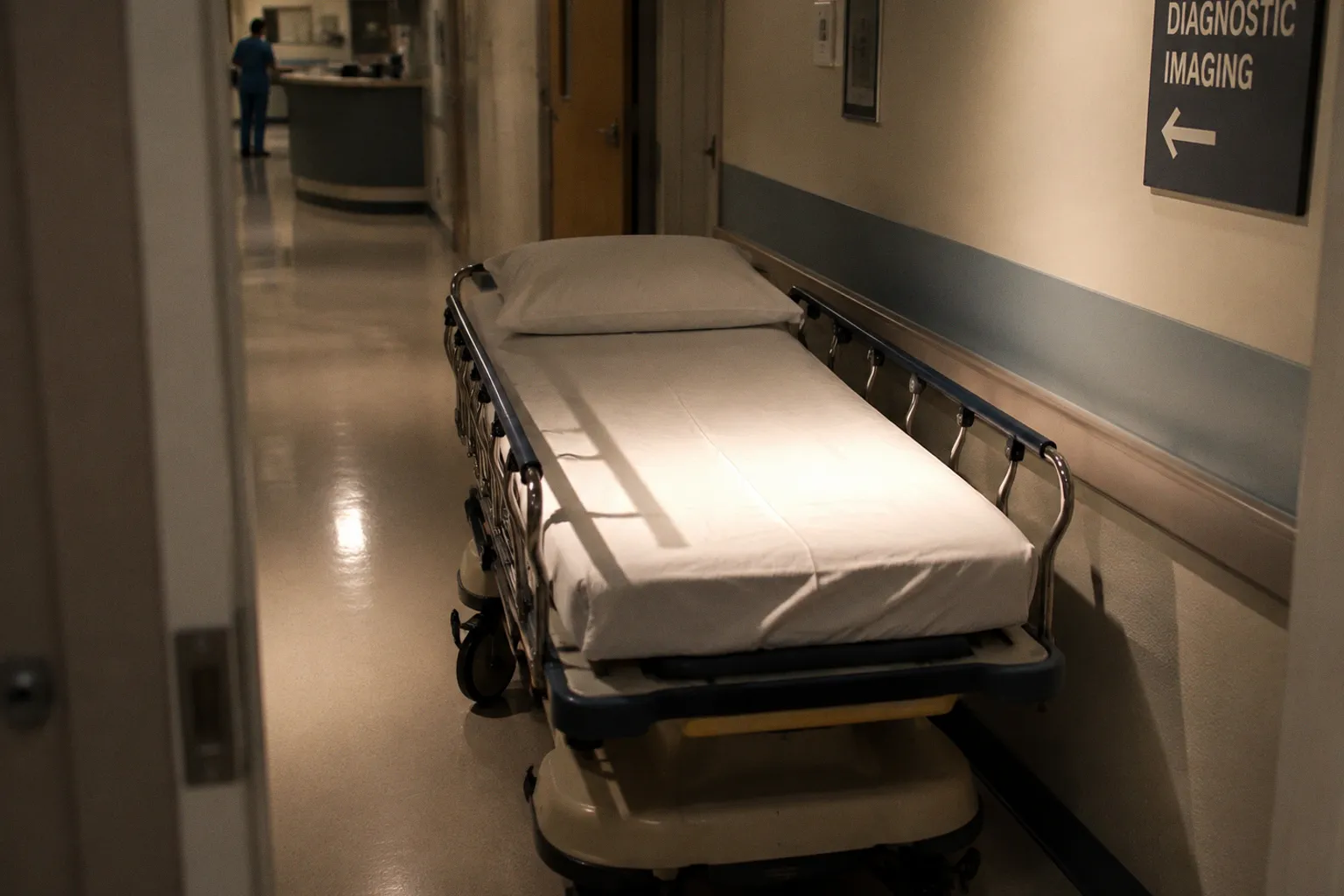
A CT scan can begin as a clinical necessity and end as a financial crisis. The order may come from an emergency department physician who is trying to rule out internal bleeding, a community clinic that has found a suspicious mass, or a primary-care doctor who needs an MRI before treatment can move forward. The scan itself may take less than an hour. The bill can follow a family for months.
For uninsured and underinsured patients, the first question is not always whether a hospital can perform the imaging. It is whether the hospital has a route to make that care affordable. At nonprofit hospitals, that route is usually the Financial Assistance Policy, or FAP: a written program that can provide full charity-care waivers or reduced charges for medically necessary services, including diagnostic imaging.
The phrase charity hospital sliding scale diagnostic imaging sounds technical on paper. In practice, it is a chain of human decisions: whether the hospital screens a patient before sending an account to collections, whether the application reaches the right financial-assistance office, whether household income is documented clearly, and whether the scan is covered under the facility’s policy rather than billed separately by another provider.
The policy behind the scan
Tax-exempt nonprofit hospitals are not expected to handle financial assistance informally, case by case, with every patient receiving a different answer at the billing desk. Under Section 501(r) of the Internal Revenue Code and related Affordable Care Act requirements, eligible nonprofit hospitals must maintain a written Financial Assistance Policy.
That policy should describe:
- Which patients qualify for free or discounted medically necessary care.
- How household income and family size are calculated.
- Which services are included, such as CT scans, MRIs, X-rays, or mammograms.
- What documents the hospital accepts to verify eligibility.
- How patients can apply and how long they have to do so.
- How the hospital limits charges for eligible patients.
- What screening must occur before extraordinary collection actions begin.
The policy is not a promise that every scan will be free. It is a formal doorway into assistance, and the doorway has a threshold. A patient may qualify for a 100% waiver at one hospital, a partial discount at another, or no discount under a particular facility’s income scale. Two hospitals in the same city can have noticeably different rules.
That is why the hospital’s own policy matters more than a general statement that it is a charity institution. The name on the building does not tell you whether an MRI is covered, what income range applies, or whether physician interpretation fees are included alongside the facility charge.
A plain-language summary of the FAP should be available through the hospital. Patients can also ask the billing or financial-assistance office for the full policy and the application. The request does not need to wait until a large bill has arrived. In many cases, the financial-assistance process should begin as soon as the need for medically necessary care becomes clear.
A charity-care policy is not a favor offered at the edge of the billing system. At a nonprofit hospital, it is part of the hospital’s obligation to make necessary care financially reachable.
Nonprofit hospital or federally qualified health center?
The same neighborhood may contain several kinds of safety-net providers, and their assistance programs do not operate identically.
A nonprofit hospital that qualifies under Section 501(r) must maintain a written FAP, publish information about it, and follow specific rules around billing and collections. A federally qualified health center, or FQHC, operates under Health Resources and Services Administration requirements and generally uses a sliding fee discount schedule for patients with incomes up to 200% of the Federal Poverty Guidelines.
The distinction becomes particularly important when diagnostic imaging is performed away from the clinic. A community health center may help a patient access an order for an X-ray or CT scan, but its discount card does not automatically cover an off-site radiology provider. The imaging facility may require its own application, and a separate radiologist may issue a separate professional bill.
The care pathway can therefore contain several financial doors:
1. The clinic or hospital outpatient department that schedules the scan.
2. The facility that owns or operates the imaging equipment.
3. The radiologist who interprets the images.
4. An emergency physician, surgeon, or other clinician who reviews the result.
A financial-assistance approval for one part of that chain may not erase every charge connected to it. Before the appointment, ask which entities will bill separately and whether each participates in the hospital’s assistance policy.
How the income thresholds shape assistance
Most charity-care programs use the Federal Poverty Level, or FPL, as the starting point for eligibility. The calculation is generally based on household income and household size, although the exact definitions and documentation requirements come from the hospital’s policy.
The broad pattern is familiar:
| Household income range | Common assistance pattern | What it may mean for imaging |
|---|---|---|
| At or below 100% FPL | Full discount or nominal charge at many FQHCs | The patient may owe little or nothing under the center’s schedule |
| Up to 200% FPL | Often eligible for 100% charity-care waiver at nonprofit hospitals | A medically necessary CT, MRI, X-ray, or mammogram may be fully waived if covered by the policy |
| Between 200% and 400% FPL | Sliding-scale discount is commonly available | The patient may receive a reduced charge rather than a full waiver |
| Above the hospital’s published range | Assistance may be limited or unavailable | Other payment plans, negotiated rates, or local programs may be needed |
These ranges are not universal guarantees. They are a map of how many programs are structured. Some hospital systems extend free care and discounted care well beyond the basic thresholds. Others use narrower income bands or apply different rules to residents, nonresidents, emergency services, or elective outpatient procedures.
For reference, 200% of the Federal Poverty Level for one person in the 48 contiguous states is listed as $31,920 for 2026. That figure is only useful when paired with the correct household size, location, and policy year. A family of four will be evaluated against a different guideline than a single adult, and Alaska and Hawaii use different federal figures.
What counts as household income?
The application may ask for recent pay stubs, tax returns, benefit statements, unemployment documentation, bank records, or a written explanation of irregular income. A patient who works seasonal shifts, relies on cash-based work, receives disability benefits, or recently lost employment may not fit neatly into a standard payroll record.
This is where an application can stall. The patient knows the household cannot absorb a $2,000 or $5,000 charge, but the paperwork appears to ask for a stable income that no longer exists. The financial-assistance office should be told about the change directly. A recent job loss, reduction in hours, eviction, separation, or interruption in benefits can alter the financial picture even when an older tax return suggests a higher annual income.
A strong application makes the household situation legible:
- Identify every person included in the household calculation.
- Report current income rather than relying only on older records.
- Explain recent changes in employment or benefits.
- Include a short written statement when a requested document does not exist.
- Keep copies of every form, attachment, and delivery confirmation.
The goal is not to produce a perfect financial portrait. It is to give the hospital enough information to apply its written policy to the patient’s actual circumstances.
The 120-day protection after the bill arrives
A diagnostic bill can feel like a countdown, but federal rules provide a period during which a nonprofit hospital must take specific steps before pursuing extraordinary collection actions. The minimum window is 120 days from the first post-discharge billing statement.
During that period, the hospital cannot move directly to extraordinary collection actions or report an unpaid balance to credit bureaus without screening for charity-care eligibility. The rule does not mean that a patient should ignore the statement. It means the bill is also an opening to request assistance, not simply a demand for immediate payment.
Some hospital systems offer longer application windows. A number of facilities allow patients as long as 240 days after the initial bill to submit a financial-assistance request. The policy for the specific hospital controls, so the safest approach is to apply as early as possible rather than treating the federal minimum as a deadline to aim for.
The protection matters because hospital accounts often move through several departments. A patient may receive a first statement, then a revised statement, then notices from a billing contractor. Staff changes, returned mail, and separate account numbers can make the process feel fragmented. Keep the original bill and note the date it was received. When calling, record the name or identification number of the representative, the date, and the documents the hospital says it still needs.
The first bill is not the end of the care encounter. For an uninsured patient, it should be the moment the financial-assistance process becomes visible.
Building a subsidized CT scan application that can move
The application itself is usually less complicated than the surrounding logistics. The difficulty is that it may arrive while a patient is recovering, working an unstable shift, arranging transportation, or trying to understand a medical diagnosis. A practical approach is to break the process into a sequence that can survive those conditions.
1. Ask for the policy before discussing a payment plan
When a billing office offers a monthly payment plan, ask first for the hospital’s Financial Assistance Policy and application. A payment plan may spread the charge across several months, but it does not answer whether the patient qualifies for a complete waiver or a reduced rate.
Use clear language: ask whether the account can be screened for financial assistance and whether the CT, MRI, X-ray, or mammogram is a covered medically necessary service under the policy.
If the scan has not yet occurred, ask the scheduling department to connect you with financial counseling. Some hospitals can pre-screen patients before outpatient imaging. Others may require the scan to be ordered or completed before final assistance can be determined.
2. Identify the billing entities
Ask whether the appointment will generate:
- A hospital facility charge.
- A professional radiologist fee.
- A separate emergency department or physician charge.
- A contrast-material or outpatient service charge.
- Any fee from an outside imaging group.
This question is especially important when a nonprofit hospital sends patients to an independent radiology center. The hospital’s charity program may not automatically apply to that outside entity. The application may need to be filed separately, and the discount rules may differ.
3. Gather the documents the policy names
The exact list varies, but commonly requested materials include proof of income, identification, household information, and evidence of current financial circumstances. If the patient has no income, the application may request a signed statement or documentation from someone who provides support.
Do not delay the entire application because one document is unavailable. Contact the financial-assistance office and ask what substitute documentation it accepts. A written explanation is more useful than silence, particularly when the missing record reflects the patient’s real situation rather than carelessness.
4. Submit through a trackable route
Applications may be accepted online, by mail, in person, or through hospital registration staff. Whichever route is used, preserve evidence that the application was submitted.
A practical file may contain:
1. The original application.
2. Copies of income and household documents.
3. The hospital’s plain-language FAP summary.
4. The date and method of submission.
5. Confirmation emails, fax receipts, or a stamped copy.
6. Every bill and collection notice received afterward.
If the hospital later says that no application was received, this record can shorten the search and prevent the patient from starting over.
5. Ask what happens to the account while the application is pending
The hospital should explain whether the account is placed on hold, whether payment is expected during review, and whom to contact if a collection notice arrives. Do not assume every representative can see the application status. Ask for the financial-assistance department directly when possible.
If the account is sent to a collection agency while eligibility is under review, tell both the agency and the hospital that a financial-assistance application is pending. Keep the language factual and provide the submission date.
6. Read the decision, not just the balance
An approval letter may specify a percentage discount, an effective date, covered accounts, and excluded services. A remaining balance does not necessarily mean the application failed. It may mean that the patient received a partial reduction or that one bill was covered while another was issued by a separate provider.
Compare the decision with the hospital’s policy. If the result appears inconsistent with the income information submitted, ask for a reconsideration or appeal under the hospital’s process. The FAP should explain how patients challenge a decision and what additional documentation may be accepted.
Why a “free scan” is not always one bill
Diagnostic imaging is rarely a single line item in the way a patient experiences it. The patient enters an imaging department, lies still beneath a scanner, and leaves with an appointment or a result. Behind that brief encounter are facility operations, clinical staff, equipment, image interpretation, contrast medication in some cases, and physician oversight.
A charity-care policy may cover the hospital’s facility charge but not an independent radiologist. Or it may include both, provided the radiology group has a formal relationship with the hospital. The policy may also distinguish between emergency imaging, medically necessary outpatient imaging, screening services, and procedures that require prior authorization.
That distinction does not make the assistance process impossible. It means the patient should ask precise questions before assuming that an approval applies everywhere:
- Is the imaging facility owned by the nonprofit hospital?
- Is the radiologist employed by the hospital or contracted separately?
- Will the application cover professional interpretation?
- Does the policy apply to imaging ordered by a community clinic?
- Are contrast materials and related outpatient charges included?
- Does the program cover only medically necessary diagnostic imaging, or also screening studies?
- Is prior approval required?
For patients seeking a sliding scale MRI at a charity hospital, these questions can prevent a common shock: the hospital charge is reduced, but a separate interpretation bill arrives weeks later. The same issue can arise with CT scans ordered through an emergency department or with mammography performed at a hospital-affiliated facility.
Looking beyond the federal minimum
A hospital’s published threshold is a floor for understanding the program, not necessarily the highest level of support available in that region. Some major health systems have adopted much broader policies. NYU Langone Health, for example, is reported to provide 100% free care up to 600% of the Federal Poverty Level and sliding-scale discounts up to 800%. Atrium Health is reported to offer 100% discounts up to 300% FPL.
These expanded thresholds change the conversation for working families who earn too much for the most familiar charity-care cutoff but still cannot manage the full cost of an MRI or CT scan. Housing, transportation, childcare, medication, and lost wages can consume income long before a hospital bill arrives. A household just above 200% FPL may still be financially exposed, particularly when a diagnosis requires several appointments or repeated imaging.
The threshold is only one part of the policy. Some systems also offer separate assistance for uninsured patients, catastrophic medical expenses, or patients whose income has recently changed. Others may cap charges at Amounts Generally Billed, meaning eligible patients should not be charged more than the amounts generally billed to insured patients for the same care.
A hospital’s financial counseling office can explain the available path, but patients should also read the policy summary themselves. It is easier to ask a focused question when the patient knows whether the program uses gross income, net income, annual income, or a different measure defined in the hospital’s rules.
The larger pressure on charitable care
Hospitals describe charity care in individual stories: a patient whose cancer was found through imaging, a parent who avoided delaying a scan, a neighbor who received treatment after losing insurance. Those stories are real, but the structure beneath them is uneven.
KFF analysis of hospital cost reports found that charity-care expenses accounted for 1.4% or less of operating expenses for half of U.S. hospitals in 2020. Across facilities, the reported share ranged from 0.1% to more than 7%. That wide spread reflects different patient populations, state policies, hospital missions, insurance patterns, and methods of reporting.
For frontline staff, the pressure appears in ordinary places. A registration worker explains the same application for the fourth time during a busy shift. A nurse tries to make sure a patient understands that financial counseling is separate from clinical scheduling. A community health worker searches for proof of income while the patient waits for a ride home. The hospital’s assistance policy may be written in formal language, but its success depends on whether people can navigate it while sick, frightened, or exhausted.
This is why the groundwork matters. A policy that exists only on a website but is not explained at registration will miss patients. A program that offers a discount but does not clarify separate radiology fees will leave families exposed. A long application with no practical help can function like a locked door, even when the formal eligibility rules are generous.
For patients and advocates, the most useful intervention is often direct and persistent: request the written policy, identify every billing entity, submit the application early, keep the paper trail, and ask for review when the decision does not match the documented circumstances.
What patients can reasonably expect
Financial assistance is not identical across nonprofit hospitals, and eligibility is never automatic. But patients seeking nonprofit hospital diagnostic fee assistance can expect the hospital to have a written process, explain its income thresholds, provide a plain-language summary, and screen for eligibility before taking extraordinary collection actions.
They can also expect the process to distinguish between a medically necessary scan and a general promise that imaging will be free. A charity clinic radiology financial-aid program may require its own application. A hospital approval may not transfer to an outside facility. A partial discount may still leave a balance, and the balance should be reviewed against the policy rather than accepted blindly.
The most effective application is not necessarily the one with the most pages. It is the one that clearly connects the patient’s current household circumstances to the hospital’s rules, identifies every account involved, and arrives with enough documentation for a financial counselor to act.
A CT scan or MRI is a clinical intervention, but access to it is also a logistical intervention. The patient needs an order, a place on the schedule, transportation, clinical follow-up, and a financial route that does not collapse after the result is delivered. Nonprofit hospitals have built formal assistance systems to create that route. Whether those systems reach the neighborhood depends on the patient knowing they exist and the institution doing the patient-facing work to make them usable.
In the quiet after a shift, when the waiting room has thinned and the billing phones are still ringing, that is the measure that matters: not whether a policy is neatly filed, but whether a person who needs the scan can actually cross the distance between medical necessity and care.