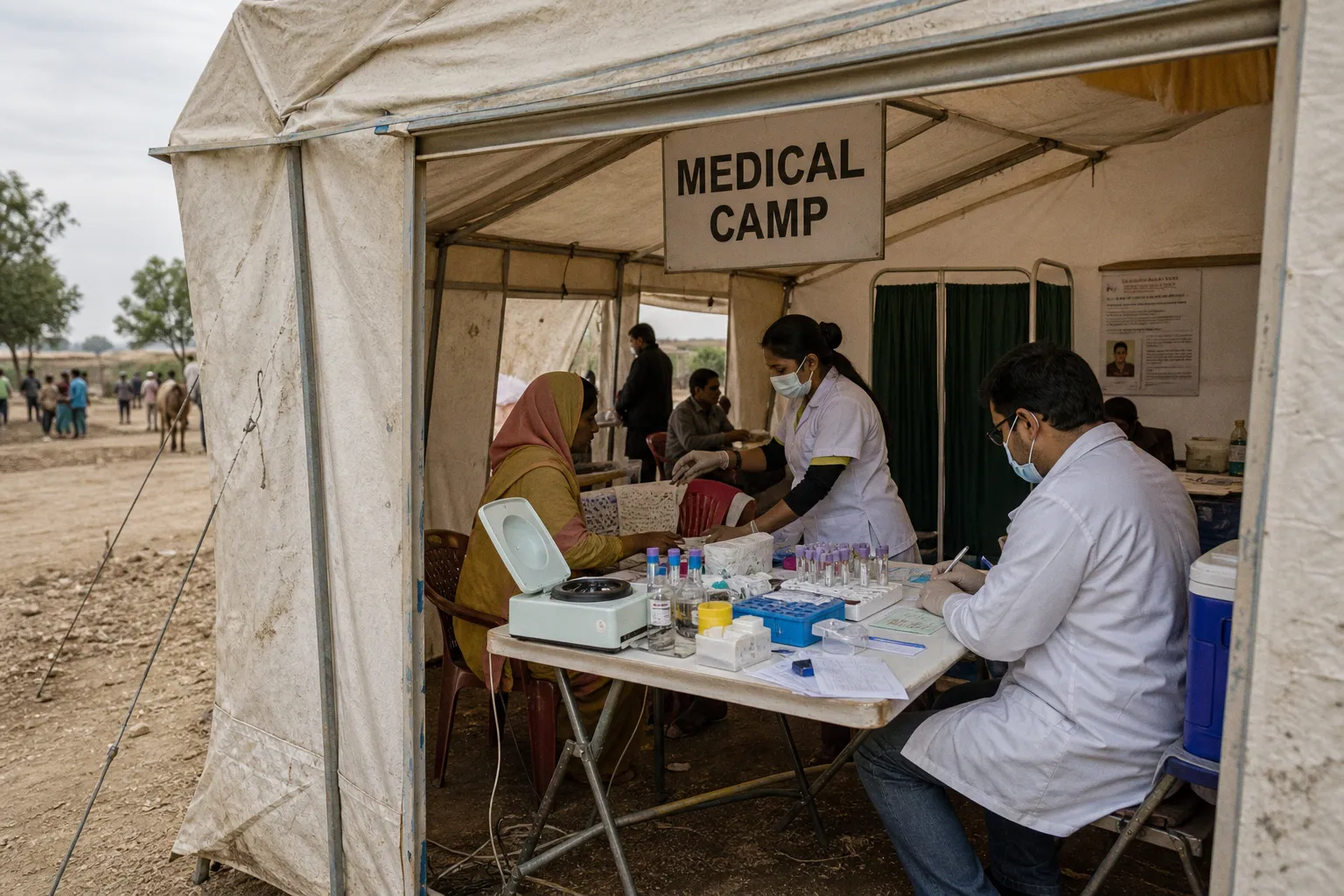
Mobile Medical Camps: How Field Clinics Reach the Last Mile
When the Road Stops, the Clinic Begins
The static Primary Healthcare Centre sits just beyond that walk — ten kilometres of broken road and a river crossing away — but on a Tuesday morning, when the rains have softened the path to mud, the distance becomes a wall. The child will not be seen by a clinician today. She will drink water, wait, and hope.
This is the quiet geography that mobile medical camps are built to cross. Field clinics do not compete with hospitals or fixed PHCs; they exist precisely because those institutions remain out of reach for millions of people who live beyond a workable radius of any permanent facility. The promise of a mobile medical camp is logistical before it is clinical: bring the examination table, the pharmacy shelf, the privacy curtain, and the trained hands to wherever the road ends and the neighborhood begins.
A mobile medical camp is not a stripped-down hospital on wheels — it is a deliberately minimal system designed to do essential work where no building exists.
Strategic Site Selection and Deployment Criteria
Choosing where a field camp sets down is one of the most consequential decisions in community outreach, and it rarely happens in an office. It happens after a community health worker has walked the village, listened to the auxiliary nurse-midwife, and mapped which hamlets have lost their bus route. Operational guidelines for Mobile Medical Units (MMUs) consistently target populations residing more than five to ten kilometres from the nearest static PHC — a threshold that reflects a hard reality: when the round-trip travel time exceeds what a sick person, a pregnant woman, or an elderly caregiver can sustain, that facility functionally does not exist for them.
The site itself must answer three practical questions before the vehicle ever arrives. Is the ground solid and level enough to park a van or set up a tent safely? Does the location sit near a recognizable gathering point — a schoolyard, a panchayat building, a temple courtyard — where patients already feel safe walking in? And can the team reach the site, conduct the camp, and depart within a single shift without violating local environmental or municipal rules? A camp that answers yes to all three will see patients. A camp that skips the third will spend its first hour apologizing to a traffic officer.
The best site is not the most visible — it is the one the community already treats as a meeting place.
Frontline organizers often layer these criteria onto a simple weekly ritual: a morning call between the driver, the field coordinator, and the local ASHA or community health worker. They discuss the previous camp's turnout, the weather, any cultural calendar conflicts (a wedding day, a market day, a funeral), and the distance the team can realistically cover before sundown. That call is the real deployment algorithm. Everything written in operational manuals flows from these short conversations.
Essential Staffing Ratios for Field Medical Teams
A mobile medical camp is only as resilient as the people inside it, and the baseline team composition reflects a careful compromise between what is ideal and what is possible. Humanitarian operational guidelines specify that a standard MMU team includes at least one medical doctor, one nurse, and one health educator or counsellor. That three-person core is the irreducible minimum: it provides diagnosis, clinical follow-through, and the patient-facing conversation that turns a prescription into a course of treatment a person actually understands.
In practice, the ratio bends. A camp focused on antenatal screening will often trade the health educator for a second nurse trained in maternal assessment. An immunization drive may add a cold-chain handler whose sole job is maintaining the temperature log on vaccines — a role invisible in the team diagram but absolutely critical in the field. A general screening camp in a tribal or rural belt might carry a pharmacist on rotation days so that the doctor is not spending half the shift counting tablets.
What the staffing ratio does not require is also worth saying clearly. A basic primary-care mobile camp does not need a surgeon on site. The clinical scope is deliberately limited to what a general physician or nurse practitioner can handle safely with the equipment the van carries: screenings, basic diagnostics, antenatal checks, blood pressure monitoring, blood draws, wound care, referrals, and patient education. When a case exceeds that scope — and it will, every week — the team's most important job is to recognize the boundary and arrange transport to a higher facility. Knowing when to stop is the mark of a good field clinician.
Spatial Design and Clinical Workflow Zones
Inside the vehicle or tent, the geography of care has to be invented from scratch. There is no waiting room, no corridor, no triage desk bolted to a wall. Every zone has to be created by the team when they arrive and folded back into the vehicle when they leave. That is why mobile clinic design manuals insist on distinct operational zones, even in a converted van: a defined intake area where patients register and their basic history is taken, an examination zone with privacy partitions for the clinician's work, sound insulation so that one patient's story is not overheard by the next, and secure medical storage where drugs, vaccines, and records stay locked between shifts.
The privacy partition is not a luxury. In a small village, a woman sitting behind a curtain while the doctor asks about reproductive health or domestic stress is making a different decision than she would make in an open courtyard. The curtain creates the minimum threshold of dignity that allows honest answers. Without it, the camp collects polite nods and leaves the real problems untouched.
Privacy partitions are the smallest piece of equipment in the van and the largest determinant of whether a patient tells the truth.
Workflow inside the camp follows a quiet choreography. Patients arrive and are logged at intake with their basic demographic and presenting complaint. They move to a vitals station where the nurse records blood pressure, temperature, weight for children, and any quick flags. From there they enter the examination zone with the doctor, who decides between treatment on the spot, a referral, or follow-up at the next visit. On the way out, they pass the pharmacist or dispensary window, receive their medication and counseling, and exit through the same doorway. The whole loop is designed to take fifteen to twenty minutes per patient when the camp is running smoothly, and double that when a complex case demands longer conversation. Building that rhythm is the real skill of running a field day.
Vehicle Logistics and Regulatory Compliance Standards
The vehicle is the camp's first patient. If it does not start, does not arrive on solid ground, or fails to deploy its interior within a reasonable window, the entire intervention collapses before a single stethoscope touches a chest. That is why field clinic manuals devote serious attention to driving protocols, vehicle maintenance schedules, setup and breakdown procedures, and the unglamorous rules about where the van may legally park.
Setup and breakdown are timed and rehearsed. A well-trained team can convert a parked van into a working clinic in twenty to thirty minutes, with the doctor already setting up instruments while the driver stabilizes the levelers and the nurse arranges the intake table. Breakdown at the end of the shift is a mirror image: clinical waste sealed, sharps disposed of in puncture-proof containers, drugs returned to locked storage, the examination zone wiped down, partitions folded, and the vehicle pre-checked before the return drive. None of this is optional, and all of it falls under compliance with local environmental and biomedical waste regulations that vary by jurisdiction.
Compliance does not stop at the parking brake. In the United States, mobile clinic services billed to Medicaid under fee-for-service methodology use Place of Service code 15 — a small administrative detail that signals to payers and regulators alike that the encounter happened in a recognized mobile setting rather than at a fixed address. Other jurisdictions have their own licensing requirements for mobile clinics, and the field operator is expected to meet them. The premise that mobile health clinics operate outside any regulatory framework is a misconception; the reality is that they operate under a layered set of rules spanning vehicle roadworthiness, biomedical waste handling, clinical scope of practice, and billing integrity.
A parked van on a dirt lot is still a regulated clinical environment. Compliance travels with the vehicle.
Financial Considerations for Mobile Clinic Infrastructure
The conversation about cost is the conversation about scale. A basic converted van outfitted with an exam table, a blood draw station, refrigeration for cold-chain items, and the privacy and storage partitions described above typically falls in the range of ten thousand to forty thousand US dollars for vehicle modification, depending on how specialized the equipment integration becomes. That figure does not include the vehicle itself, the clinical staff salaries, or the recurring cost of drugs and consumables — it covers the physical conversion that turns a commercial van into something resembling a clinic.
For charitable and public-health operators, this range matters because it determines what is achievable without grant-scale funding. A community health nonprofit serving a cluster of villages can often raise the modification cost for one or two vans through a combination of local donations, hospital partnerships, and CSR funding. The recurring cost of fuel, driver salary, nurse salary, and a basic formulary is what determines whether the camp runs weekly or monthly. The math is honest: a well-equipped van sitting idle is more expensive per patient served than a modest van running a regular circuit.
High-end custom heavy-duty mobile surgical trailers sit at the other end of the cost spectrum and are usually the territory of large humanitarian organizations, military medical units, or specialty outreach programs. They are not what most readers picture when they hear the words "mobile medical camp," and they should not be confused with the modest, practical vehicles that handle the bulk of routine community outreach.
The Groundwork Behind the Tent
What stays with a reporter who has spent time shadowing a field team is not the equipment list or the workflow diagram. It is the small proof that groundwork matters. The community health worker who walked the village last week and told the grandmother the camp was coming. The nurse who remembered the child's name from the previous visit. The driver who chose a level patch of ground under the neem tree because it offered shade for the waiting line. These are the interventions that no operational manual captures, and they are the reason the tent in the schoolyard is more than a logistical exercise.
Mobile medical camps function because someone decided that the distance between a village and a clinic was not an acceptable barrier to care, and then kept showing up until the distance closed. The workflow, the staffing ratio, the spatial zones, the vehicle compliance, the budget — all of it serves that single decision. When the road stops, the clinic begins, and the people who built that bridge are the quiet infrastructure of resilience in every neighborhood they serve.
The camp does not end when the van drives away. It continues in the memory of every patient who was treated like a neighbor, not a number.