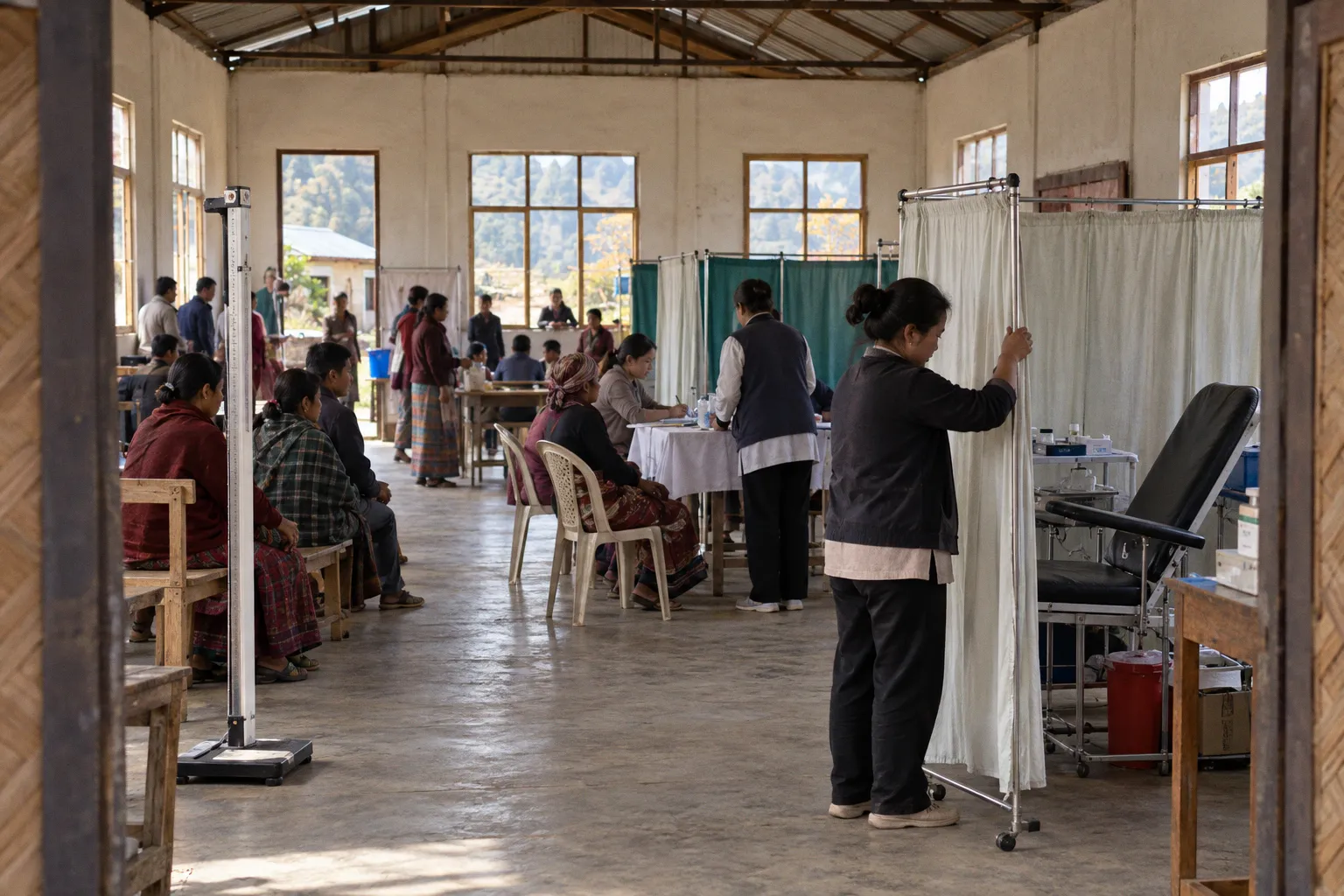
According to E-Pao, the District Health Society of Senapati has staged a community health outreach and free screening camp inside the Emesiiphro Community Hall — a building that, for the families gathered there, is already doing double duty as a shelter. For residents who arrived with little more than what they could carry, a clinic held on their own doorstep strips healthcare of its usual friction: no fare to find, no outpatient queue to join, no working day surrendered.
Meeting the patients where they already are
The decision to run the camp inside a displacement shelter, rather than at a district hospital or primary health centre, is the practical heart of the intervention. Displaced households are the population that formal healthcare misses most often — people without stable transport, without the paperwork that speeds registration, without the slack in their week to travel into town. Holding the clinic in the same hall where families are sleeping collapses several of those barriers at once, and lets health workers move through the room rather than calling patients out one by one.
Awareness as the second front
A health awareness programme running alongside the screening carries its own quiet weight. In a setting where basic questions about symptoms and self-care might otherwise go unasked, a short, grounded session held in the same familiar room can shape what residents do once the volunteers have packed up. For charitable hospitals and community outreach groups reading the Senapati report from elsewhere, it underlines a familiar principle: trust in a health system is built by being physically present in a neighborhood before anyone is asked to walk through a hospital door.
What the follow-up will tell us
E-Pao's account confirms the event but stops short of the figures community-medicine readers will want next. How many residents were screened, which conditions surfaced most often, and whether a referral pathway back to a hospital was lined up for positive findings — those are the details that decide whether the Emesiiphro camp is a one-day encounter or the opening move in a longer continuum of care. For a displaced population, that distinction is the whole story.