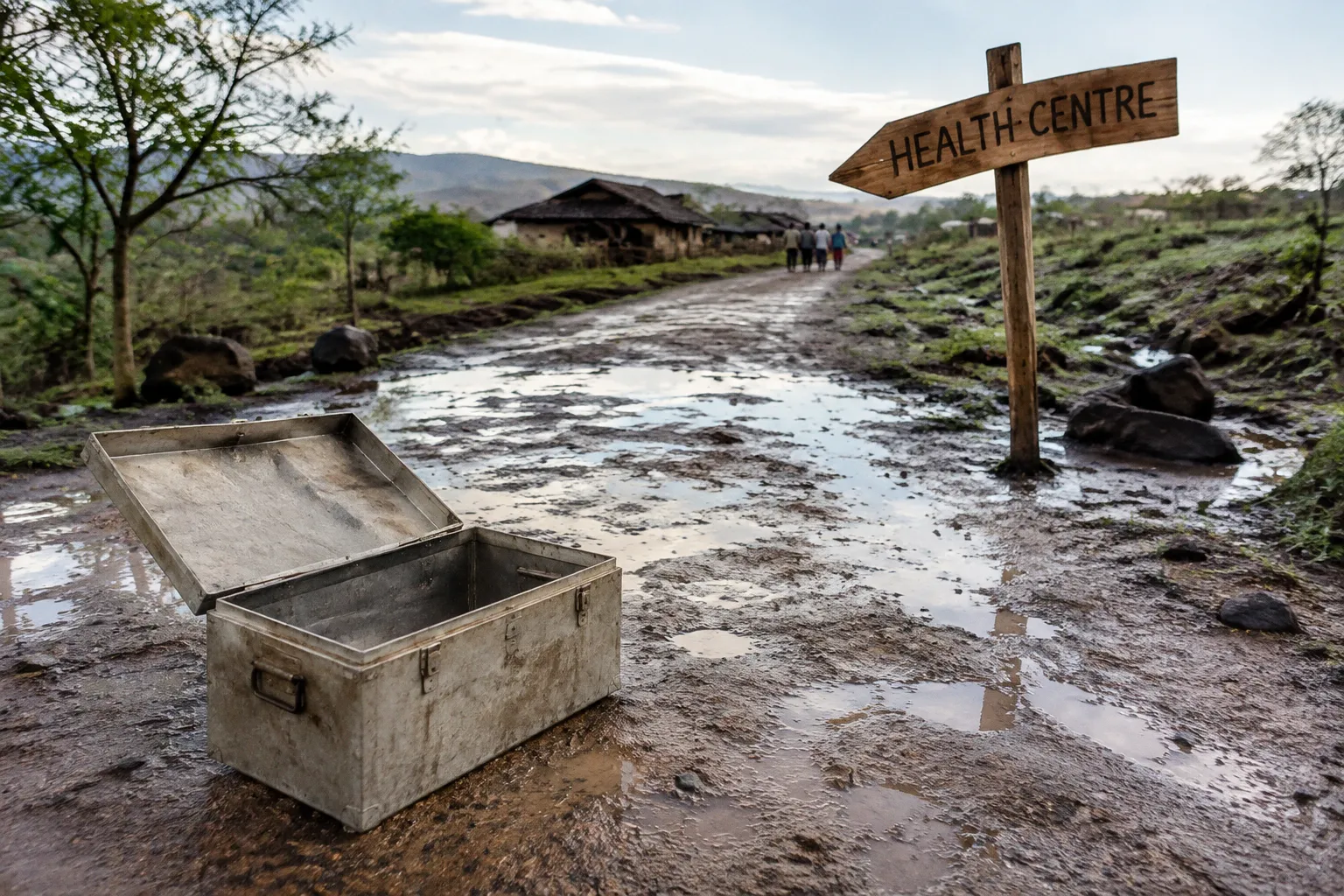
A temporary medical camp can reach people who would otherwise remain outside the formal health system. It can identify malnutrition, untreated chronic disease, hearing and vision problems, infectious conditions, or severe mental-health needs. But the same camp can also expose the weakness of the system behind it: too few doctors, incomplete data, no interpreter, no reliable referral route, and no one clearly responsible for what happens after the vehicles leave.
This is the central contradiction in tribal healthcare outreach planning. The camp is treated as evidence of access, while the patient’s actual access to diagnosis, treatment, transport, medicines, and follow-up remains unresolved. A registration desk and a blood-pressure reading are visible. The logistical failure that follows is not.
The fallacy of one rural healthcare model
The first mistake is usually made before the medical team reaches the community. Administrators take a rural outreach model that worked, or appeared to work, somewhere else and transfer it to a tribal setting with minimal alteration.
The template tends to be familiar:
1. Select a location.
2. Announce a free health camp.
3. Arrange a visiting team.
4. Screen as many people as possible.
5. Dispense basic medicines.
6. Refer serious cases to a higher-level facility.
7. Close the event and report the attendance figure.
On paper, this resembles healthcare delivery. In practice, it can become an attendance exercise with clinical consequences.
Tribal communities are not a single operational category. Differences in language, diet, settlement patterns, livelihood, local authority, religious practice, and relationship with government institutions can determine whether a health camp is trusted, understood, or even usable. Treating these communities as interchangeable is not merely a cultural oversight. It produces bad logistics.
A camp planned around a central village may be inaccessible to smaller settlements. A screening schedule designed for a single morning may conflict with seasonal work, market days, festivals, or local obligations. A consent form may be technically compliant but practically meaningless if the patient cannot read the language in which it is presented. A referral notice may assume that the family can pay for transport or take several days away from work.
The problem is often described as low uptake. That description is convenient because it places the apparent failure on the community. A more accurate interpretation is that the service was designed without enough attention to how the community actually moves, communicates, earns, decides, and seeks care.
A camp can be free at the point of screening and still be unaffordable at every stage that follows.
The same problem appears in clinical priorities. A standardized rural health camp may focus heavily on blood pressure, diabetes, antenatal care, or common infectious disease. Those services may be appropriate, but the program can miss the local burden that determines whether the intervention has any value. If childhood malnutrition is widespread, screening without nutrition rehabilitation is a partial response. If untreated mental illness is common, a brief consultation without sustained treatment access is closer to detection than care.
One tribal health screening camp in Jawhar taluka, Maharashtra, examined 124 children and identified severe acute malnutrition in 45 of them—approximately 36%. That is not a marginal finding to be filed under outreach outcomes. It is a warning that the camp has entered a setting with a substantial baseline burden and that the post-camp system must be prepared for it.
The administrative temptation is to report the number screened. The ethical obligation is to ask what happens to the 45 children afterward.
Vacancy rates are not an administrative footnote
The second failure is human capacity. Outreach plans often assume that the medical workforce exists because the staffing chart exists. Those are not the same thing.
Across ten Indian states with substantial tribal populations, 84% of specialist doctor positions and 33% of general practitioner positions in public healthcare facilities remain vacant. Those figures do not describe an inconvenience at the margin. They describe a system in which the people expected to receive referrals may be entering facilities that lack the personnel needed to provide them.
A mobile camp can temporarily import expertise. It cannot manufacture the permanent workforce required for continuity.
This creates a predictable bottleneck:
- A visiting team identifies a condition.
- The patient receives a referral.
- The receiving facility lacks the specialist, equipment, or appointment capacity required.
- The family makes repeated journeys or stops pursuing care.
- The original camp is recorded as completed.
The paperwork is closed. The clinical episode is not.
Vacancy data also complicate the language of partnership. Outreach programs are often described as collaborative efforts between community workers, district hospitals, visiting specialists, and local authorities. That may be accurate in a formal sense. Yet collaboration without capacity can become a way of distributing responsibility without assigning accountability.
The visiting team can say the patient was referred. The primary facility can say the patient did not return. The district office can say the camp was conducted according to plan. The patient is left between these statements, which is where many referral systems quietly fail.
A serious outreach plan therefore needs to distinguish between three types of medical work:
| Function | What the camp can often provide | What requires continuity |
|---|---|---|
| Detection | Basic screening, clinical examination, initial risk identification | Repeat assessment when findings are uncertain or progressive |
| Immediate care | Limited treatment, first-line medicines, basic counselling | Monitoring side effects, treatment adjustment, and adherence support |
| Referral | A written recommendation or appointment request | Transport, specialist capacity, records transfer, and confirmed attendance |
| Public health action | Vaccination promotion, health education, community messaging | Follow-up coverage, disease surveillance, and response to missed patients |
| Child nutrition response | Identification of severe acute malnutrition | Rehabilitation, food support, household assessment, and repeat measurements |
| Mental-health support | Initial assessment and recognition of distress or illness | Confidential treatment, continuity, crisis response, and stigma-sensitive follow-up |
The distinction matters because the most visible part of outreach is usually the least difficult part to count. Screening numbers are immediate. Treatment adherence is delayed. Referral completion is fragmented across institutions. The reporting system naturally favors what can be photographed, tabulated, and announced.
That is not a neutral choice. It shapes program design.
The data problem begins before the field team departs
Planning errors are often blamed on poor execution, but many are embedded in the information used to design the camp.
Tribal public health officials have reported barriers involving denied data access, inconsistent request procedures, and outdated epidemiological information from central agencies. Without current and granular data, planners are forced to work with broad assumptions. They may know that a district has a high tribal population, but not which settlements have missed immunization schedules, where malnutrition is concentrated, which roads become unusable seasonally, or how many patients abandoned treatment after a previous referral.
That is not a minor data-quality issue. It is a governance failure.
A camp cannot be targeted effectively when the system does not know whether the problem is absence of services, inability to reach them, cost, language, distrust, medicine shortages, or a referral pathway that ends at a locked door. These causes require different responses. A larger camp does not solve all of them.
The absence of data also encourages an administrative fiction: that the population is stable and the intervention can be repeated in the same form each year. In reality, settlements change, roads deteriorate, local health workers move, outbreaks shift priorities, and household finances fluctuate. A program that relies on old epidemiological information can be operationally neat and clinically obsolete.
There is a further concern. Data collection during outreach is often treated as a one-way extraction. The camp gathers names, symptoms, diagnoses, and contact details. But the community may not receive usable information about what was found, what it means, or where the records will go. If personal health data are collected without a clear follow-up process, the exercise risks becoming a compliance ritual rather than a care system.
The relevant questions are uncomfortable but straightforward:
- Who owns the patient record after the camp closes?
- Which facility is responsible for contacting a patient with an abnormal result?
- How are duplicate registrations identified across repeated camps?
- Can the patient access the record in a language and format they understand?
- What happens when a phone number is unavailable or shared by several households?
- Is consent meaningful when the alternative is no care at all?
- Who reviews cases that were referred but never completed?
If the answers are vague, the program has not solved the information problem. It has merely moved it from the registration table to the district office.
Cultural and linguistic disconnects are operational failures
Program administrators sometimes treat cultural adaptation as an optional layer added after the clinical plan has been finalized. That is backwards. Communication determines whether the clinical plan functions at all.
A patient who misunderstands a diagnosis may not take the medicine incorrectly because of negligence. They may have received instructions in a language that does not adequately describe dosage, duration, side effects, or danger signs. A family may not accept a referral because the explanation conflicts with prior experiences of hospitals, fees, discrimination, or unexplained procedures. A woman may not speak openly with a male provider in a public camp setting. A mental-health consultation may be rejected because the service is associated with stigma, spiritual failure, or social exposure.
None of these problems can be corrected by printing more posters.
The language used by outreach teams also matters. Terms such as compliance and non-adherence imply that the patient has failed to follow an instruction. Sometimes that is true. But the instruction may have been impractical from the beginning. A patient cannot comply with a prescription if the medicine is unavailable locally, cannot comply with a referral if transport is unaffordable, and cannot comply with follow-up if the facility provides no appointment system or reliable opening hours.
This is where legal and ethical categories overlap. A service may satisfy a formal requirement to provide information while failing the more substantive requirement of informed participation. It may obtain a signature without establishing understanding. It may issue a referral without creating a realistic route to treatment.
Community health workers are central to resolving this gap, but they should not be used as decorative intermediaries. Their role must include practical authority: explaining care in local languages, identifying households that did not attend, clarifying whether a referral is possible, and feeding local observations back into program design.
Traditional healers also require a more serious approach than either romanticization or dismissal. They may be trusted sources of advice and early recognition. They may also be part of a patient’s actual care pathway, whether hospital administrators approve of that pathway or not. Ignoring them does not remove their influence; it simply prevents the formal health system from understanding where patients go first, what advice they receive, and why they may delay hospital care.
Coordination does not mean endorsing every practice. It means recognizing the real ecology of care and designing safeguards within it.
Mental-health camps reveal the limits of the event model
Mental-health outreach is where the single-day camp model becomes particularly difficult to defend.
A camp can identify distress, psychosis, depression, substance-use problems, trauma, or cognitive symptoms. But assessment is only the beginning. Mental-health care depends on privacy, trust, repeated contact, medication continuity where appropriate, crisis planning, and a pathway that does not expose the patient to avoidable stigma.
A study conducted during a mental-health camp in a central Indian tribal district found an 85% treatment gap among attendees. Patient-side factors, including stigma and lack of awareness, accounted for 76% of the barriers to sustained care. The figures point to a familiar administrative error: treating the patient’s failure to continue care as the primary problem while underestimating the conditions that make continuation difficult.
The treatment gap is not simply a matter of persuading more people to attend. Attendance has already occurred. The failure appears afterward, when the patient has to translate a one-time consultation into an ongoing relationship with a provider who may be distant, unavailable, or culturally unfamiliar.
Mental-health outreach also exposes the limits of the standard consent process. A person may agree to be screened in a busy camp because they do not understand how the information will be used, because a family member is answering on their behalf, or because refusing seems socially difficult. Confidentiality becomes harder to protect when consultation spaces are improvised and records are handled by rotating teams.
The solution is not to abandon mental-health camps. It is to stop calling the camp the intervention. The intervention is the pathway around it: trained local workers, defined escalation procedures, access to clinicians, repeat contact, and a mechanism for identifying patients who disappear from care.
Without that pathway, the camp can increase awareness of illness without increasing the community’s ability to treat it. That is an ethically awkward form of success.
The most dangerous outreach metric is the one that counts discovery but not abandonment.
Post-camp care is where the policy becomes real
The defining difference between a medical event and a healthcare program is what happens after the event.
A temporary camp can be useful when it is embedded in a continuous system. It can reduce travel for basic screening, identify patients early, support public immunization drives, provide preventive counselling, and connect underserved households to primary care. But it cannot carry the full burden of chronic disease management, specialist access, rehabilitation, mental-health treatment, maternal care, and child nutrition on its own.
The post-camp pathway needs named functions rather than general assurances. Someone must review abnormal findings. Someone must contact patients who need follow-up. Someone must arrange transport or coordinate with the receiving facility. Someone must confirm whether the referral was completed. Someone must return to households where treatment stopped.
Otherwise, “follow-up” becomes an administrative word with no operational owner.
A workable pathway might include:
1. Risk classification at the camp. Patients should leave with a clear distinction between routine advice, urgent review, and referral requiring a defined timeframe. A generic note to visit a hospital is not a pathway.
2. Local record retention. Relevant findings must be transferred to the responsible primary-care team, not stored only in the files of the visiting organization.
3. Community-based tracking. Health workers should be able to identify patients who did not attend a referral appointment, particularly children with severe malnutrition or patients with serious mental-health symptoms.
4. Receiving-facility confirmation. The referral system should record whether the patient arrived, whether the necessary service was available, and whether another appointment was required.
5. Medicine continuity. Patients should not be given a short supply with no realistic method of obtaining the next one.
6. Program review based on outcomes. The evaluation should include completed referrals, treatment continuation, repeat nutritional measurements, and unresolved cases—not only attendance and number of consultations.
This approach is more demanding than a publicity-friendly camp report. It is also the minimum needed to distinguish care from detection.
Financial access creates another layer of friction. In the United States, approximately 25% of nonelderly American Indian and Alaska Native adults are uninsured, the highest uninsurance rate among racial demographics in the country. That statistic illustrates a broader point: even where a community receives screening, administrative eligibility and payment systems can determine whether care continues. A patient may be clinically identified and financially excluded at the same time.
The form of exclusion varies by country. It may involve insurance, transport, documentation, medicine costs, lost wages, or the requirement to travel to a distant facility. But the effect is similar. A free camp can become the front door to a service the patient still cannot enter.
Community-led integration is not a ceremonial add-on
The strongest response to common tribal health camp logistical failures is not a more elaborate temporary event. It is integration with people and institutions that remain after the camp has left.
Community health workers can help identify local priorities, map households, interpret symptoms in context, prepare residents for referrals, and track patients over time. Their knowledge is not a substitute for specialist care. It is the infrastructure that allows specialist care to reach the right people and remain connected to them.
That requires investment and authority. If community workers are expected to recruit attendees, translate, counsel families, track referrals, and report outcomes without adequate training, compensation, or access to clinicians, the program is shifting its liability downward while preserving its appearance of participation.
Local leadership also needs to be involved before the itinerary is fixed. The question is not merely whether a village leader will announce the camp. It is whether local representatives can challenge the design: the location, timing, staffing mix, screening priorities, privacy arrangements, and referral assumptions.
Traditional healers and local organizations may be part of this process where appropriate. The objective should not be to create a symbolic circle of stakeholders around a predetermined plan. It should be to identify where the formal system is likely to fail and repair those points before patients are recruited into it.
This is particularly important when the available epidemiological data are incomplete. Community knowledge cannot replace surveillance, but it can reveal patterns that centralized datasets miss: households avoiding facilities, seasonal migration, local disease terminology, inaccessible routes, informal caregiving arrangements, or previous promises that were never fulfilled.
The ethical standard should be simple: do not ask the community to trust a system that has not demonstrated what it will do when the screening is over.
What a credible outreach plan would look like
A credible tribal healthcare outreach program would not necessarily be larger. It would be more explicit about its limits.
It would state which conditions can be managed at the camp and which require referral. It would identify the receiving facilities and confirm that they have the staff and equipment to accept the expected caseload. It would budget for transport, communication, medicines, repeat visits, and data management rather than treating them as secondary expenses.
It would also publish performance measures that expose failure instead of hiding it. For example:
- How many patients with abnormal findings completed a referral?
- How many children identified with severe acute malnutrition received rehabilitation and repeat assessment?
- How many mental-health patients remained in care after the initial consultation?
- How many patients could not be contacted or reached?
- Which medicines were unavailable after the camp?
- Which villages were missed and why?
- How many cases were referred to facilities with no available specialist?
These measures will produce less flattering reports. That is precisely their value.
Outreach planning should also distinguish between community health outreach planning pitfalls that are correctable through better preparation and failures caused by structural scarcity. A local team cannot solve an 84% specialist vacancy rate by improving its registration process. Nor can a visiting clinician compensate for outdated public-health data or a referral hospital that lacks the necessary service.
Good planning makes these constraints visible. Bad planning turns them into patient-level explanations.
The camp is not the system
The appeal of the mobile medical camp lies in its clarity. It arrives, provides something tangible, and leaves behind a count. In places where formal healthcare is distant or understaffed, that visibility matters. But visibility can become a substitute for accountability.
The recurring tribal healthcare outreach planning mistakes are not mysterious. Standardized models are applied to communities that are not standardized. Staffing shortages are treated as background conditions. Data are collected without reliable access or continuity. Cultural and linguistic barriers are recast as patient reluctance. Referrals are issued without transport, capacity, or follow-up ownership. Severe needs are discovered in settings that have not been equipped to manage them.
None of this makes outreach pointless. It makes unsupported outreach insufficient.
The defensible model is not the largest camp or the one with the most impressive attendance figure. It is the one that knows what it can provide, builds around local workers and knowledge, preserves a usable record, and remains responsible for the patient after the vehicles depart.
The unresolved question is therefore not whether tribal communities need medical camps. They do. The harder question is whether institutions are willing to measure the part of healthcare that begins when the camp is gone—and accept what that measurement may reveal.