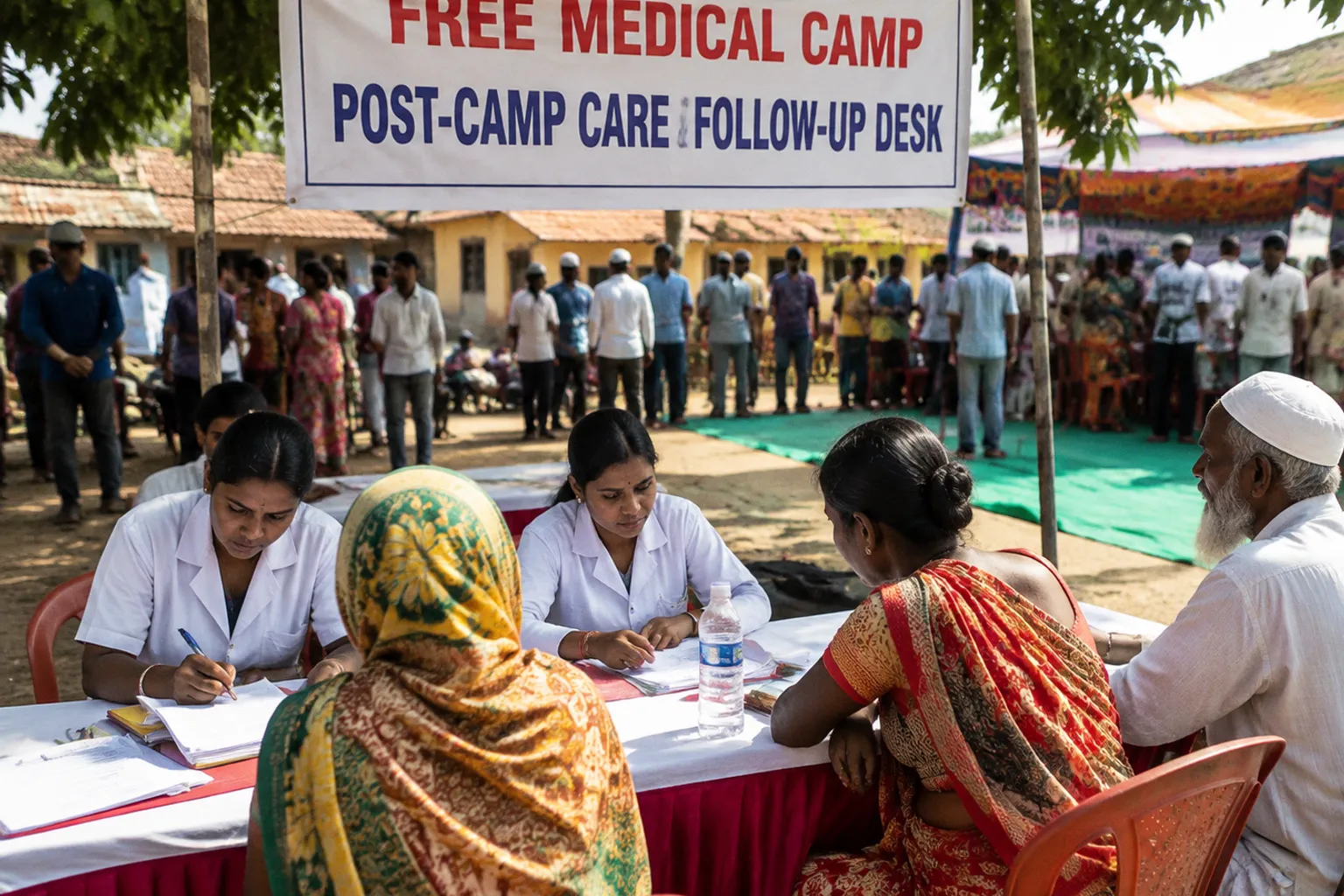
The 72-Hour Cliff: Why Camp Screenings Disappear Into the System
By day three, the medical team has driven back to the district headquarters. The camp coordinator's WhatsApp status returns to normal. And somewhere in the dusty catchment area, the 58.7% of attendees who walked in with a chronic condition have already begun the slow drift back into untreated disease.
The uncomfortable arithmetic of medical outreach has always been this: a one-off camp converts acute screening into a chronic obligation the moment a patient walks off-site with a slip of paper and a thirty-day strip of tablets. Most organizers know this. Few build for it. The frameworks exist — buried in the operational guidelines of specific non-profit networks and in the gazetted rules of national medical councils — but they sit beside the question rather than answering it. The post-camp care gap is not a mystery. It is a documented compliance failure dressed up as logistical inconvenience.
A diagnostic event without a downstream protocol is not healthcare. It is screening theater — and the patient always pays the curtain call.
The Chronic Disease Burden That Camps Pretend Is Acute
The misconception begins with how outreach medicine markets itself. Mobile camps are pitched as interventions: a weekend of free check-ups, a dignified gesture toward underserved populations, a photograph-friendly exercise in corporate social responsibility. The clinical reality is grimmer and statistically inconvenient.
A mixed-methods analysis of a rural health camp in Maharashtra, published in early 2024, found that chronic diseases accounted for 58.7% of observed morbidities across 209 patient encounters. Not acute infections. Not seasonal ailments. Chronic, progressive, lifelong conditions — hypertension, diabetes, respiratory disease, the routine deteriorations of bodies that have never had continuous primary care. The single most common complaint at that camp was not something a weekend clinic could resolve; it was the kind of pathology that requires monthly refills, quarterly monitoring, and a clinician who knows the patient's name.
This finding inverts the implicit logic of camp-based outreach. Acute presentations justify camps. Chronic ones demand something camps were never designed to provide: continuity. The ethical weight of pulling a hypertensive patient off the street, recording their blood pressure, dispensing four weeks of amlodipine, and then driving away — without a verified handover to a local facility — is substantial, and it is the weight that most camp organizers do not acknowledge in their post-event press releases.
What the Rules Actually Say: A Tale of Two Jurisdictions
Regulatory frameworks for medical camps are not absent. They are simply uneven, jurisdiction-bound, and largely ignored in jurisdictions where enforcement is theoretical. Two contrasting examples illustrate the spectrum.
| Compliance Requirement | Sathya Sai International Organization Guidelines | Medical Council of Malawi |
|---|---|---|
| Patient record retention | Minimum 5 years | Not explicitly specified in sourced materials |
| Post-camp summary report deadline | Within 1 week, to regional/national medical directors | Within 2 weeks, to Council and Ministry of Health |
| Follow-up plan requirements | Implicit in record retention and reporting | Explicit plan required for patients on medication or post-surgery |
| Minimum staffing threshold | Not specified in sourced materials | 5 or more medical practitioners or dentists |
| Reporting scope | Internal organizational hierarchy | External regulatory and ministerial bodies |
The table exposes an asymmetry that has real downstream consequences. The Malawian framework is more demanding — it mandates a structured follow-up plan for patients started on medication or referred for surgery, and it routes that plan through both the regulator and the ministry. The Sathya Sai guidelines are retention-focused: they preserve data without explicitly mandating what happens to the patient the data describes. One system archives. The other attempts to track.
The difference between archiving a record and ensuring a patient returns for care is the difference between compliance and continuity. Most camps achieve only the former.
Neither framework, however, addresses the harder question: who verifies that follow-up actually occurred? Reports are filed. Records are retained. Whether Mr. Patil in remote Latur actually took his metformin for the next eleven months is a verification problem that no administrative template solves. This is the bottleneck at the heart of medical outreach logistics — and it is the one that funders rarely fund and reporters rarely investigate.
Designing Referral Pathways That Survive the Drive Home
A referral slip is a hopeful object. It is a small rectangle of paper that asks a patient with low health literacy, limited transport money, and no prior relationship with the formal health system to navigate a secondary care facility several districts away. The structural absurdity is rarely discussed.
Effective referral pathways are not invented at the exit desk. They are negotiated weeks before the camp opens. Three design principles distinguish pathways that function from those that merely exist on paper:
- Pre-registered receiving facilities. The secondary or tertiary hospital named on the referral slip must have been contacted, briefed, and ideally confirmed in writing before the camp day. A phone call on the morning of the camp does not constitute a pathway; it constitutes a hope.
- Subsidized or free downstream care. A referral that requires a patient to pay out of pocket at a private facility is not a referral in any operational sense. It is a redirection to a closed door. Camps serving underserved populations should partner only with public facilities or non-profit hospitals capable of absorbing the referred caseload without charging the patient.
- Named handoff personnel. A referral is a transfer of clinical responsibility. If no individual clinician at the receiving end has been told to expect the patient, the patient becomes an unannounced arrival at a triage desk, triaged accordingly — which usually means turned away or lost.
The pre-camp work is unglamorous. It does not photograph well. It does not generate the kind of metrics that donors display in quarterly reports. It is, however, the entire substance of post-camp continuity, and skipping it is the single most common reason referral pathways collapse into paperwork.
The Community Health Worker as the Only Continuous Asset
There is one category of healthcare personnel that does not leave when the camp drives away. Frontline community health workers — ASHAs and ANMs in India, lay health workers in sub-Saharan Africa, promotoras in Latin America, village health volunteers across Southeast Asia — remain embedded in the catchment area after every mobile intervention has folded its tents. Their role in bridging the post-camp care gap is not supplementary; it is structurally irreplaceable.
Three functions make community health workers (CHWs) the connective tissue of any sustainable outreach program:
- Identification and pre-screening. Before a camp arrives, CHWs know who in the village has been missing medications, who has defaulted from TB treatment, who needs a blood pressure check badly enough to justify walking to the camp site. They convert a passive screening event into an active case-finding operation.
- Medication adherence monitoring. A thirty-day strip of lisinopril handed to a patient on day one is a one-month reprieve at best. Whether the strip is taken correctly, refilled, and monitored for side effects depends almost entirely on a household-level follow-up that only a community-embedded worker can perform.
- Bidirectional feedback. CHWs surface what the camp did not see — the patients who never showed up, the side effects that emerged after the team left, the household members who should have been screened but were not. Without this feedback loop, the camp's organizers learn nothing about their own effectiveness.
The ethical implication is direct: a camp that does not invest in CHWs before it arrives is, in effect, designing for discontinuity. It is treating follow-up care as someone else's problem, and in underserved populations, that someone else does not exist.
Operationalizing the Exit Desk: The Last Honest Moment
Every camp has an exit point. It is usually a folding table near the gate, staffed by a volunteer, where attendees receive their discharge summary, their next refill date if relevant, and a referral slip if secondary care is required. This is the Exit Feedback Desk in the operational literature, and it is the single most under-engineered component of most outreach events.
What an Exit Desk actually does, when it functions:
- Collects structured patient feedback on the camp experience (often ignored by organizers in the rush to pack up).
- Issues referral slips with pre-validated receiving facility information.
- Records the patient's intended follow-up plan in a register that can later be cross-checked against CHW reports.
What an Exit Desk usually does, in practice:
- Hands out slips to anyone vaguely symptomatic.
- Skips the feedback step entirely.
- Closes two hours before the camp officially ends, because the volunteer has a bus to catch.
The discrepancy between the documented function and the observed function is the operational signature of the post-camp care gap. The mechanisms exist. The execution is perfunctory. The patient — who has now been told three different things by three different volunteers in two different languages — leaves with whatever piece of paper made it into their hand.
The Exit Desk is the camp's last chance to convert a screening into a continuum. In most camps, it is the part of the program that closes earliest and is staffed last.
The Verification Problem Nobody Wants to Fund
Here is the question that sits underneath every section of this analysis and that no regulatory framework, however well-drafted, currently answers: how do we know the follow-up happened?
Not in aggregate. Not in the form of a six-month post-camp satisfaction survey sent to a self-selected subset of attendees who happen to own phones. At the level of the individual patient with the individual chronic condition, how do organizers verify that the referral was honored, the medication was refilled, the surgery was completed, the patient is alive twelve months later?
The honest answer is that most outreach programs do not verify this. They verify that the camp happened. They verify that reports were filed within the mandated window — one week for Sathya Sai-affiliated camps, two weeks for camps operating under Malawian regulatory oversight. They verify that records were archived for the required five years. They do not verify the outcome, because outcome verification is expensive, slow, and produces the kind of data that funders find uncomfortable.
A camp that files its report on time has satisfied compliance. A camp that can prove its patients received continuous care has satisfied ethics. The two are not the same, and conflating them is the foundational sin of medical outreach accounting.
Until outcome verification becomes a funded line item — until someone is paid to call Mr. Patil in month three and ask whether he is still taking his metformin — the post-camp care gap will persist as a structural feature of the model, not a bug in its execution. The patients will continue to drift. The records will continue to be archived. And the press releases will continue to claim continuity that the operational data cannot substantiate.
The unresolved question is not whether free medical camps are valuable. They are. The unresolved question is who is accountable for the patient after the camp has gone home — and whether the accountability survives the drive back to headquarters.