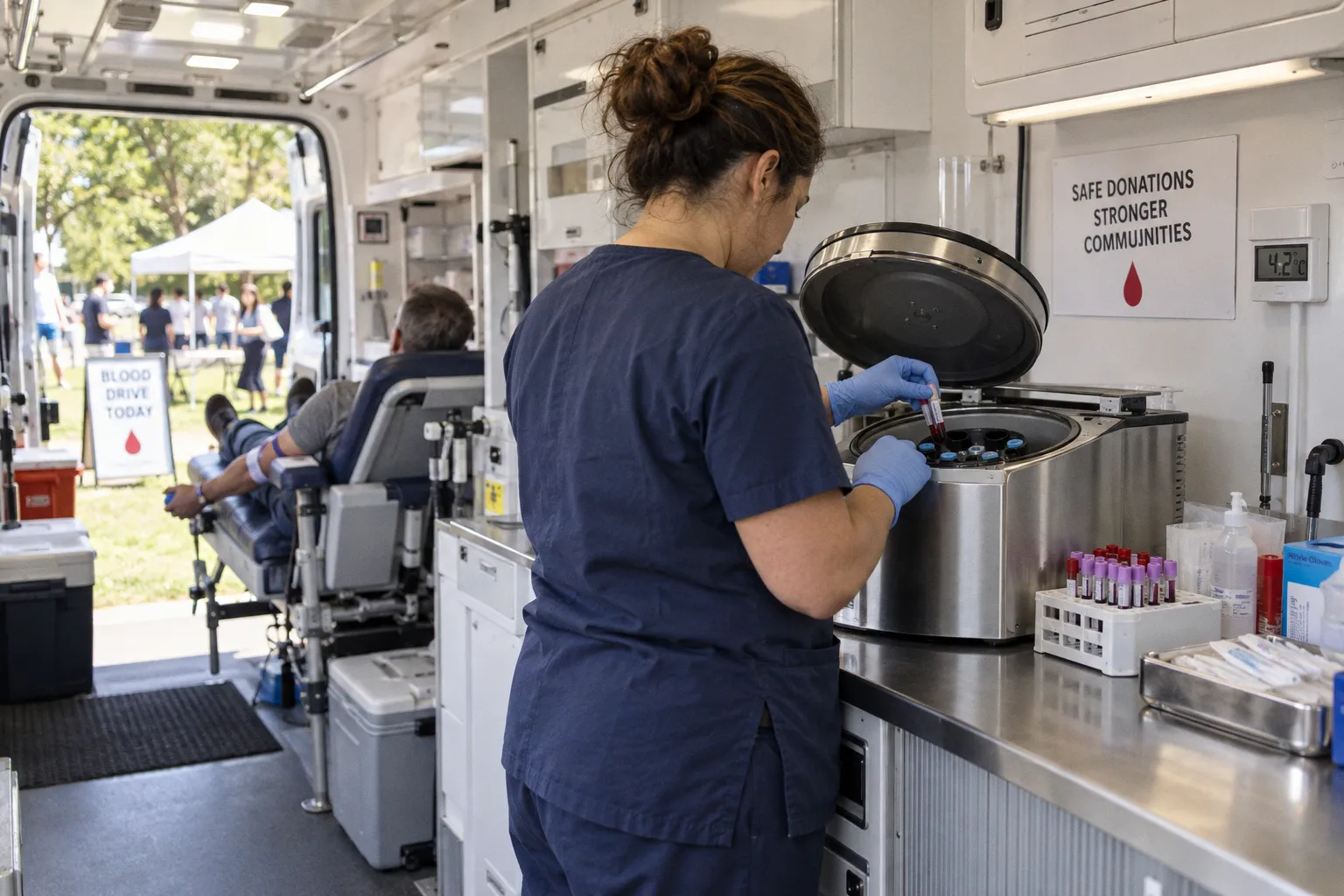
The public sees a parked vehicle, a row of donor chairs, a registration table, and perhaps a queue that moves with reassuring efficiency. What is less visible is the controlled logistics required to make field collection medically equivalent to a permanent blood center: donor eligibility screening, infection control, equipment calibration, component labeling, emergency response, and a cold chain that cannot be negotiated with traffic, weather, or an optimistic event coordinator.
That is the central contradiction in mobile blood collection. The site is temporary, but the compliance burden is permanent. A blood drive mobile unit cannot treat safety as something that begins when the first needle is inserted. It begins with how the space is divided, how supplies are handled, how records are reconciled, and whether a unit of blood remains within its required temperature range after collection.
Mobile blood drives account for nearly half of community blood collections in some settings, and in certain locations more than half. They are not a decorative supplement to the blood supply. They are a major production channel. That makes their apparent informality slightly misleading—and their operational discipline considerably more important.
The five-zone workflow: sterility by separation
The most useful way to understand mobile blood drive safety is not to start with the donor chair. Start with the floor plan.
Mobile collection sites are arranged into five distinct zones:
1. Registration — donor identification, records, consent, and administrative intake.
2. Screening — eligibility assessment and confidential health questions.
3. Collection — venipuncture, donation, labeling, and immediate handling of the unit.
4. Post-donation — observation, refreshments, and recovery after donation.
5. Laboratory and shipping — preparation for testing, transport, and integration into the blood bank supply chain.
This division is not interior design. It is infection control made physical. Every unnecessary crossing between zones creates another opportunity for a discrepancy: a mislabeled unit, a contaminated surface, an incomplete record, or a donor who leaves without adequate observation.
In a permanent blood center, walls and fixed workstations do some of this organizational work automatically. A mobile unit has to recreate it inside a constrained environment, often while moving through a sequence of locations. The vehicle may be a sophisticated bloodmobile, a temporary field collection room, or a combination of both. The format changes. The obligation does not.
The collection area must remain controlled while the public-facing parts of the operation continue around it. Registration cannot become a storage surface for sterile materials. Screening cannot be treated as a rushed conversation in a noisy corridor. Post-donation recovery cannot be reduced to handing someone a drink while staff immediately turn to the next donor.
That is where administrative assumptions become dangerous. A high-throughput drive is often praised for moving people efficiently. But speed is not the same as quality. In transfusion medicine, the faster a workflow becomes, the more deliberately its handoffs must be designed.
Single-use supplies are not a substitute for process discipline
Mobile collection sites use single-use sterile supplies, including nitrile gloves that are changed between donors. A full collection day at a mobile unit may require roughly 100 to 200 pairs of gloves, depending on staffing and activity. That figure is not merely a procurement detail. It illustrates how quickly a field operation consumes controlled materials.
The glove is the visible part of the precaution. The less visible question is whether staff maintain the same discipline when the schedule falls behind. Are used materials removed without passing across clean surfaces? Are collection areas reset between donors? Are supplies protected from unnecessary handling? Does the team know exactly which materials belong in which zone?
A sterile consumable reduces one category of risk. It does not correct poor sequencing, weak supervision, inadequate hand hygiene, or ambiguous responsibility. A mobile donation center equipment safety plan therefore has to cover more than the condition of needles and tubing. It must account for the entire movement of people, materials, records, and collected blood.
A mobile blood drive is temporary in location, not in accountability.
The five-zone model also helps explain why field collection should not be judged by appearance. A compact unit can look crowded and still operate safely if its workflow is controlled. Conversely, a spacious event site can be unsafe if screening, collection, recovery, and shipping are allowed to blur into one improvised room.
The relevant question is not whether the operation looks clinical enough. It is whether the process prevents the wrong thing from reaching the wrong place.
Cold-chain logistics: the blood does not pause when the vehicle does
Once blood has been collected, the operation shifts from donor-facing care to logistics. This is where the language of charity can conceal the language of inventory.
Blood components are biological products with defined storage requirements. Mobile collection teams must maintain continuous temperature monitoring, not simply place units in a cooler and hope the journey remains uneventful. The required ranges are specific:
| Blood component | Required storage range |
|---|---|
| Red blood cells | 1–6°C |
| Platelets | 20–24°C |
| Frozen plasma | At or below −18°C |
These ranges are not interchangeable. Red blood cells, platelets, and frozen plasma have different storage conditions because their clinical usefulness depends on preserving different biological properties. A cold-chain failure can therefore create more than a general quality concern. It can make a component unsuitable for its intended use.
The operational challenge is obvious but often underestimated: a mobile unit is exposed to movement, loading and unloading, power dependencies, door openings, external temperatures, and delays between collection and laboratory processing. Temperature monitoring must continue through those transitions. A unit that leaves the donor chair in acceptable condition can still be compromised later in transport or storage.
The quality system has to identify who is responsible at each handoff:
- Who verifies the storage equipment before departure?
- Who monitors temperature during collection?
- Who reviews alarms or excursions?
- Who authorizes release, quarantine, or disposal of affected units?
- Who reconciles collected units against records and shipping documentation?
If the answer is simply that the team follows procedure, the procedure is incomplete. Compliance is not a mood. It is an auditable allocation of duties.
Mobile blood collection requirements also extend to equipment calibration and maintenance. Refrigeration, monitoring devices, transport containers, scales, and collection equipment cannot be treated as generic hardware. They are part of the clinical system. A device that displays a reassuring number is not necessarily a device that has been verified to display the correct number.
This is one reason blood banking standards are so detailed. The risk is rarely located in a single dramatic failure. It accumulates in small gaps: an undocumented reading, a delayed response to an alarm, an unreviewed excursion, a label that is corrected informally instead of through a controlled process. The final discrepancy may appear at the laboratory, but its origin can be several steps earlier.
The field site is part of the blood bank
There is a persistent administrative temptation to regard a mobile drive as an outreach activity and the permanent center as the real medical operation. That distinction is convenient and wrong.
The field site is part of the blood bank’s supply chain. The same expectations for identification, traceability, testing, handling, and release must follow the unit from the donation chair onward. The fact that collection happens in a vehicle, a community hall, or a temporary clinic does not turn the blood into a lower-stakes product.
This is particularly important when blood drives are organized at workplaces, schools, public venues, or community facilities. A venue may provide electricity, parking, and foot traffic. It does not provide a validated transfusion-medicine infrastructure. The collecting organization remains responsible for creating the controlled environment.
That responsibility includes sanitation. Blood drive site sanitation protocols are not limited to wiping down a chair at the end of the day. Surfaces, waste pathways, hand hygiene supplies, sharps disposal, staff movement, and the separation of clean and used materials all form part of infection control. The process must work not only for the first donor of the morning, but also for the final donor after hours of repetitive activity.
Emergency readiness and donor safety in mobile units
Donor safety is sometimes described as though the main hazard were the needle. In practice, the more immediate concern may be a vasovagal reaction: dizziness, fainting, nausea, or a drop in blood pressure during or after donation.
Mobile blood units are equipped with donor chairs capable of switching to the Trendelenburg position, with the head lower than the legs. This allows staff to respond quickly when a donor develops symptoms and helps restore blood flow to vital organs while the team manages the reaction.
The equipment matters. So does the choreography.
A chair that can change position is useful only if staff recognize the reaction promptly, know how to operate it, and have enough space to respond without creating a second hazard. The post-donation zone must support observation rather than function as a symbolic exit corridor. A donor who looks pale, unsteady, or confused should not be moved through a congested area simply because the next appointment is waiting.
Emergency readiness in mobile collection has several layers:
- Staff must be competent in recognizing and responding to vasovagal reactions.
- The donor chair must be operational and accessible.
- The immediate area must allow safe positioning and observation.
- Supplies and escalation procedures must be available.
- Records must capture the event so that future eligibility and care decisions are informed by it.
The point is not to dramatize routine donation. Most donations do not become emergencies. The point is that a safe system is designed around foreseeable complications rather than surprised by them.
Screening is a clinical control, not a queue-management exercise
Eligibility screening is another place where public convenience can collide with medical responsibility. The screening process protects both the donor and the recipient. It identifies circumstances in which donation could create an avoidable risk, and it supports blood safety screening before a collected unit enters the broader inventory.
In a crowded mobile setting, screening can be pressured by noise, privacy limitations, and the understandable desire to keep the line moving. Those pressures do not reduce the need for accurate answers. They increase the need for a controlled process.
A rushed screening interaction can generate several problems at once:
- The donor may misunderstand a question or omit relevant information.
- Staff may fail to document a deferral consistently.
- Sensitive information may be overheard.
- A discrepancy may appear later between the donor record, collection label, and laboratory documentation.
The answer is not to make screening theatrical or excessively bureaucratic. It is to protect its purpose. Confidential questions require sufficient privacy. Eligibility decisions require trained staff. Deferrals require clear communication and accurate records. The donor is not a unit of throughput, and the collected blood is not automatically a usable commodity.
That last distinction is worth making plainly. A successful venipuncture does not guarantee a clinically usable product. The unit still has to be correctly identified, handled, stored, tested, and released under the applicable quality system.
Regulatory compliance: the paperwork is part of patient safety
Official descriptions of mobile collection often emphasize flexibility, access, and community participation. Those benefits are real. They are also incomplete without the less photogenic architecture of compliance.
Organizations operating blood collection facilities must meet standards established by regulators and professional bodies. In the United States, the FDA inspects registered blood facilities at least every two years. That minimum inspection frequency does not mean a facility is safe only on inspection day. It means the organization must sustain a quality system between inspections, including documentation, corrective actions, equipment control, staff competency, and traceability.
The AABB’s 2nd edition of the Fundamental Standards for Blood Collection and Transfusion takes effect on January 1, 2026. Its framework addresses quality systems, equipment calibration, and staff competency requirements. The significance is not confined to the date printed on the standard. It reflects a broader reality: blood collection is being managed as a complex clinical supply chain, not as an informal act of community goodwill.
That distinction matters because public-facing messaging tends to compress the operation into a simple moral equation: donate, help someone, repeat. The medical system has to be less simple. It must account for consent, eligibility, adverse events, infection control, labeling, storage, testing, transport, and eventual use.
Compliance is strongest where nobody is watching
A blood drive can appear orderly while still having weak internal controls. Rows of chairs and matching uniforms prove very little. A credible quality system leaves evidence:
- Staff competency is documented rather than assumed.
- Equipment calibration is current and traceable.
- Temperature records are reviewed, not merely generated.
- Deviations trigger investigation and corrective action.
- Donor reactions are recorded and evaluated.
- Collected units can be reconciled from the field site to the laboratory.
- Supplies are controlled and stored to prevent contamination or mix-ups.
This is the difference between compliance as performance and compliance as infrastructure.
The more distributed the collection model becomes, the more important that infrastructure is. A permanent center can bring staff, equipment, records, and laboratory functions under one roof. A mobile operation distributes those functions across locations and handoffs. Each handoff is a potential bottleneck, and every bottleneck needs a defined owner.
In blood logistics, the dangerous sentence is often not “the equipment failed.” It is “someone assumed the next team had checked it.”
This is also where the ethical dimension becomes unavoidable. Blood is donated voluntarily, but once collected it enters a regulated medical system. It cannot be treated as an unlimited resource merely because demand is high. A unit must be handled according to standards even when inventories are under pressure. Scarcity does not suspend compliance; it tests whether the institution believes its own rules.
Scaling community impact without scaling confusion
Mobile drives exist because fixed blood centers cannot be everywhere donors are. Field collection brings donation closer to workplaces, schools, community organizations, and public events. It can convert geographic convenience into a larger donor network and help blood banks reach communities that would not regularly travel to a permanent facility.
That access is strategically important because blood supply depends on repeatable participation, not occasional publicity. A mobile drive can create a local point of contact for donor registration, return visits, and public education about whole-blood donation, blood safety, and the different demands placed on red cells, platelets, and plasma.
But access is not automatically efficiency. A poorly planned drive can create congestion, idle staff time, inadequate recovery space, or a mismatch between the number of scheduled donors and the unit’s actual capacity. It can also place pressure on screening and collection teams to prioritize volume over process reliability.
The operational metrics that matter are therefore more complicated than the number of people who signed in. A serious assessment would also examine:
- How many scheduled donors completed screening?
- How many were deferred, and were deferrals recorded correctly?
- How many collected units were accepted into inventory?
- Were there donor adverse events?
- Were temperature ranges maintained throughout collection and transport?
- Were all units and records reconciled without discrepancy?
- Did the site remain compliant during peak periods, not only during quiet intervals?
A drive that attracts a large crowd but generates preventable wastage is not an uncomplicated success. Nor is a drive that produces impressive promotional photographs while overloading a collection team. Community outreach has value, but the blood supply is ultimately governed by what survives the entire chain from donor eligibility to clinical release.
Platelets, organ donation, and the limits of the mobile model
The public often treats all donation activity as interchangeable. It is not.
Plateletpheresis, for example, is not routinely available on all mobile blood collection buses. Apheresis typically requires equipment and space more commonly found in permanent blood centers. That does not make platelet donation less important. It means the collection model has to match the component and procedure.
The same principle applies to organ and corneal eye donation. Registration networks, eye banking standards, hospital referral protocols, consent processes, and tissue handling involve different timelines and controls from a mobile whole-blood drive. The common thread is not identical equipment. It is traceability and ethical governance.
A donor network becomes clinically meaningful only when the system can connect willingness to a safe, documented pathway. Registration without follow-through is a database entry. Collection without correct handling is a discarded opportunity. Outreach without operational capacity is a promise made by one department and inherited by another.
This is why mobile drives should be evaluated as part of a broader supply strategy rather than celebrated as isolated events. They can extend reach, but they also expose the weaknesses of the underlying system. If the blood bank lacks transport capacity, laboratory throughput, trained staff, or reliable inventory management, adding more collection sites may simply move the bottleneck downstream.
What current standards are really protecting
The phrase “mobile blood drive safety standards” can sound technical enough to end the discussion. It should do the opposite. Standards are not a decorative assurance attached to a charitable activity. They define the minimum conditions under which a voluntary donation can become a safe clinical resource.
The essential controls are straightforward to name, though less easy to maintain:
- A five-zone workflow that separates registration, screening, collection, recovery, and laboratory or shipping functions.
- Single-use sterile supplies and disciplined infection control between donors.
- Temperature monitoring matched to the blood component, including 1–6°C for red blood cells, 20–24°C for platelets, and no higher than −18°C for frozen plasma.
- Donor chairs and trained staff capable of responding to vasovagal reactions.
- Accurate eligibility screening, consent, labeling, documentation, and traceability.
- Calibrated equipment and competent personnel.
- Investigated deviations rather than quietly absorbed discrepancies.
- Transport and storage controls that preserve the chain after the donor has left.
None of this diminishes the civic value of donation. It defines the obligation created by accepting it.
The mobile model will remain essential because blood supply cannot depend solely on people traveling to permanent centers. But expansion should not be mistaken for progress by default. Every new field site adds reach and adds operational exposure. It can relieve a geographic bottleneck while creating a logistics bottleneck. It can increase collections while increasing the number of handoffs at which compliance may fail.
The unresolved question is therefore not whether mobile blood drives are safe in principle. Properly operated, they are built to meet stringent safety and quality requirements comparable to permanent blood centers. The harder question is whether institutions will measure safety by the standard they publish—or by the number of donors they can report before the day is over.