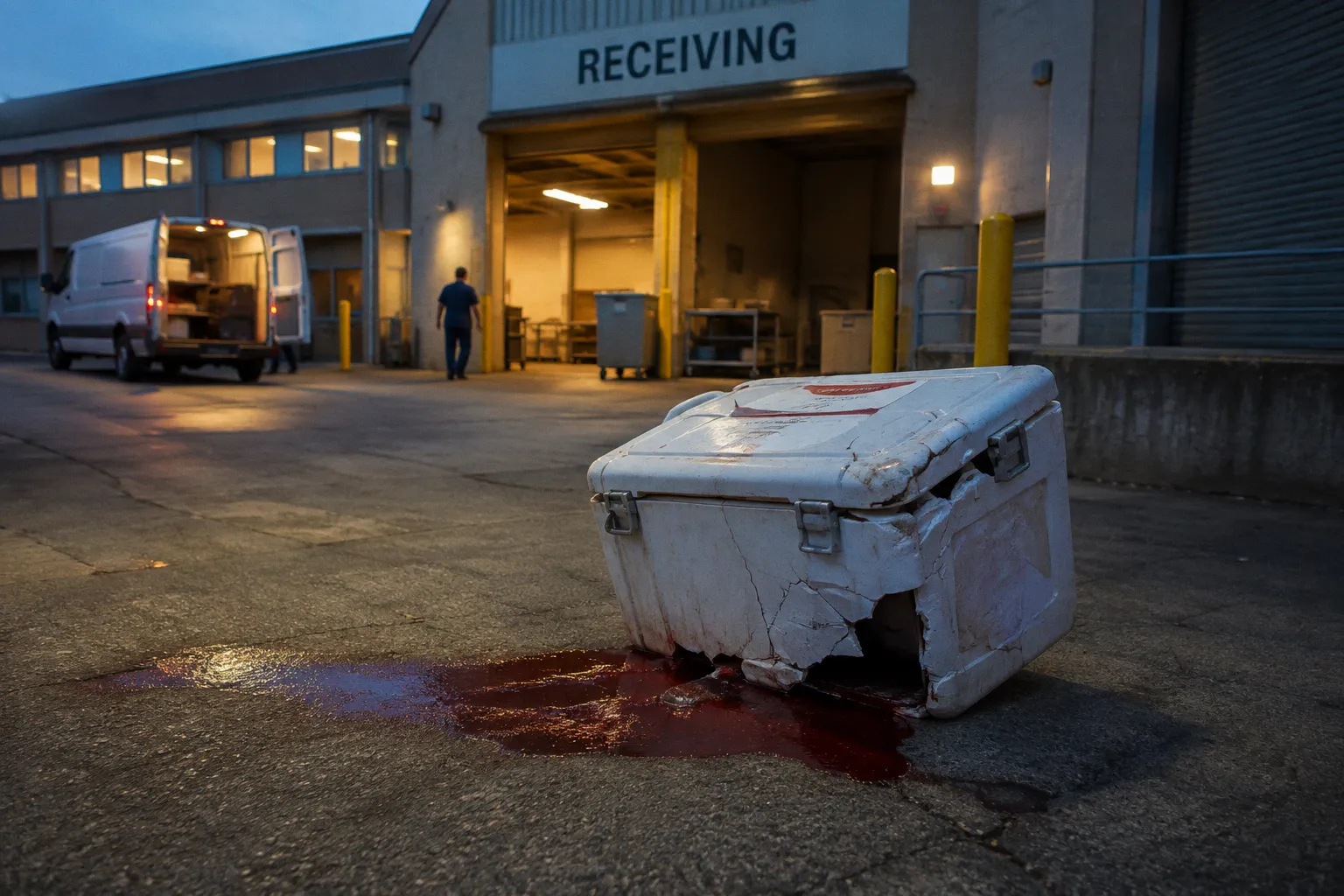
The inventory system may even say it is available. But the clinical product has crossed into regulatory uncertainty, where transfusion is no longer a matter of supply but of liability.
That is the uncomfortable contradiction at the center of blood logistics: a system designed to preserve life can discard usable-looking products because its monitoring and documentation are inadequate. In a representative 40-unit shipment, one failed cooler, one undocumented transfer, or one period of uncontrolled exposure can turn an emergency resource into quarantined stock. The units may be visually normal. Their chain of custody is not.
This is where blood drive cold chain transport errors become more than a technical inconvenience. They expose the gap between clinical urgency and administrative compliance, between the public language of donation and the private mechanics of temperature-controlled distribution.
The anatomy of a cold-chain breach
The cold chain begins before a hospital receives a shipment. It begins with the equipment selected for collection, the packaging configuration, the conditioning of coolant packs, the loading sequence, the route, the handoff procedure, and the quality of the temperature record.
Every transition creates another opportunity for discrepancy.
A mobile blood drive may collect whole blood in a community hall, school, workplace, or temporary medical site. The units then move to a processing facility, a regional blood bank, or a hospital transfusion service. At each stage, staff must know what the product is, which temperature range applies, how long it has been exposed, and whether the equipment has remained within its validated operating conditions.
That is a more demanding process than placing bags in a cooler and driving them across town.
For whole blood and red blood cells, the accepted storage range is 1 °C to 6 °C. Transport is generally controlled within 1 °C to 10 °C. Those numbers are not decorative specifications. They define the boundary between a controlled biological product and an item that may require quarantine, investigation, or disposal.
The problem is that the shipment does not fail in one dramatic instant. It usually degrades through a sequence of ordinary decisions:
1. The cooler is selected for convenience rather than validation. A commercial container may retain cold for food or medication without providing the thermal stability, impact protection, internal configuration, or documentation expected for blood transport.
2. Coolant packs are loaded without a verified conditioning process. Frozen packs placed directly against blood units can create localized freezing risk, while insufficiently conditioned packs may fail to maintain the required range.
3. The shipment leaves without continuous monitoring. A departure temperature recorded on paper says little about the conditions two hours later.
4. A transfer occurs without a formal handoff. The units move from a mobile team to a courier, from a courier to a hospital dock, or from one vehicle to another. Nobody records the exact time or confirms the thermal status.
5. A temperature alarm is treated as an inconvenience. The receiving team faces a familiar pressure: the emergency department needs blood, the inventory is tight, and the shipment looks fine. The temptation is to restore the unit to refrigeration and move on.
That last step is the point at which an equipment problem becomes a governance problem. Re-cooling does not erase the excursion. It only makes the evidence less visible.
A blood unit can remain physically present, visually normal, and clinically unavailable. That is the cold-chain failure in its purest form.
A representative 40-unit loss should therefore not be described simply as a cooler malfunction. The cooler may be the visible failure. The deeper failure is the absence of a system capable of answering basic questions: When did the deviation begin? How long did it last? Which units were affected? Who authorized release? What evidence supports that decision?
Without those answers, quarantine is not excessive caution. It is the only defensible position.
Thermal thresholds are product-specific, not negotiable
Blood components do not share one universal temperature requirement. Treating the cold chain as a single refrigeration problem is an administrative shortcut with clinical consequences.
| Blood component | Typical storage or transport requirement | Primary concern during deviation |
|---|---|---|
| Whole blood and red blood cells | Storage at 1 °C to 6 °C; transport generally at 1 °C to 10 °C | Hemolysis, bacterial proliferation, loss of product integrity |
| Platelet concentrates | 20 °C to 24 °C | Loss of platelet function and increased risk from unsuitable storage conditions |
| Fresh frozen plasma | Below approximately −20 °C to −30 °C, depending on applicable requirements | Thawing, component degradation, and loss of validated storage status |
The distinction matters during mixed shipments. A container designed around red-cell refrigeration is not automatically suitable for platelets. A transport plan that protects plasma may expose red cells to inappropriate conditions. A single “blood cooler” label can conceal three different thermal regimes and several incompatible assumptions.
For red cells, transport between 1 °C and 10 °C is not permission to improvise. The upper limit is not a target, and it is not a buffer that can be spent casually during loading delays, traffic, or an unplanned stop. It is part of a validated process that must account for duration, packaging, ambient conditions, and the history of the product.
NHS Blood and Transplant guidance, for example, places a defined limit on certain red-cell temperature excursions up to 10 °C: the exposure must not exceed five hours. If the permitted duration is exceeded, or if previous excursion flags complicate the history, the units require quarantine and may require disposal. The point is not that every excursion produces immediate biological failure. The point is that the system must establish whether the product remained within an approved risk boundary.
This is why a temperature deviation is not properly managed by asking whether the bags feel cold. Human touch is not a calibrated instrument, and the surface temperature of a bag is not a complete record of its internal thermal history.
A cold-chain investigation needs at least four kinds of information:
- the component type and unit identification;
- the temperature range and duration of the deviation;
- the transport container and its validation status;
- the chain of custody from collection through receipt.
When those records are incomplete, the uncertainty itself becomes a product risk. Blood banks are not permitted to convert uncertainty into reassurance simply because demand is high.
The hemolysis trap
The word “hemolysis” often appears late in discussions of blood transport, as though it were a laboratory detail rather than a logistics consequence. It is neither. Red blood cells are living cellular products with membranes that can be damaged by temperature stress, freezing, mechanical handling, and inappropriate storage.
Out-of-range thermal exposure can cause in-vitro hemolysis. The consequence may not be visible to the person unpacking the shipment. A bag can look intact while its cellular quality has been compromised. The clinical risk is not reliably assessed by appearance alone.
The supplied evidence associates in-vitro hemolysis with 40% to 70% of rejected pre-analytical blood specimens. That figure concerns rejected specimens, not a universal wastage rate for transported red-cell units, and the distinction matters. It should not be inflated into a claim that a particular 40-unit shipment suffered a specific percentage of hemolysis. It does, however, illustrate the scale of the underlying quality problem: thermal and handling conditions can materially affect blood products before they reach the patient.
The most dangerous administrative response is to reduce the investigation to a binary question: Was the shipment warm or cold?
The correct questions are more exact:
- Did the temperature remain inside the validated range for the entire journey?
- Was there evidence of freezing or excessive warming?
- Were the monitoring devices positioned to capture the relevant conditions?
- Did the data logger record continuously, or only at selected points?
- Were the units transferred between containers?
- Was the exposure duration known or merely estimated?
- Had the same container or coolant configuration produced previous alarms?
This is not pedantry. Exposure duration changes the assessment. So does the starting condition. A red-cell unit that leaves a controlled refrigerator at 4 °C is not in the same position as one that has already experienced an earlier excursion. A shipment that reaches 10 °C briefly under a documented protocol is not equivalent to one that sits in an unmonitored vehicle for an unknown period.
The phrase “we put it back in the refrigerator” is therefore operationally weak. Refrigeration can stop further warming. It cannot reconstruct the missing portion of the chain.
Why visual inspection is a poor safeguard
Visual checks have a role, but they cannot replace temperature evidence. Staff may look for leaks, clots, discoloration, damaged bags, or signs of freezing. These checks can identify obvious defects. They cannot reliably establish whether a unit experienced a prolonged excursion within a sealed container.
The risk is especially pronounced when the receiving team is under pressure. A shortage creates a perverse incentive: the more urgently blood is needed, the more likely personnel are to treat ambiguity as an obstacle to overcome. Yet that is precisely when release decisions need stronger controls.
In an effective transfusion service, the receiving team should be able to isolate affected units without paralyzing the rest of the inventory. That requires unit-level identification, segregated quarantine space, clear authority to block release, and a documented escalation path to the transfusion medicine specialist or quality officer.
If the entire 40-unit shipment is discarded because no one can determine which units were exposed, the wastage is not only a transport failure. It is also an inventory-design failure.
The cost of a failed shipment is not limited to the units thrown away. It includes the missing evidence that prevents selective quarantine.
Beyond the ice chest: equipment creates its own risk
The familiar commercial cooler is attractive because it is inexpensive, portable, and available. It is also a frequent source of false confidence.
A container can be insulated and still be unsuitable for blood transport. It may not maintain a stable temperature across the internal load. It may expose units to direct contact with frozen packs. It may have no provision for calibrated data logging. It may be vulnerable to opening, vibration, ambient heat, or repeated transfers. None of those weaknesses is solved by adding more ice.
Validated transport equipment is designed around the product and the route. It should be assessed for thermal performance, loading configuration, duration, handling, cleaning, security, and monitoring. In prehospital or mobile settings, the equipment also has to tolerate the practical disorder of emergency logistics: vehicle vibration, multiple stops, changing ambient temperatures, and staff who may not be specialists in blood-bank procedures.
Common cold-chain failures include:
- using non-validated commercial coolers in place of ruggedized medical transport equipment;
- relying on paper logs that capture only departure and arrival readings;
- placing temperature sensors where they measure the air near the lid rather than the product environment;
- transferring units between containers without preserving continuous temperature history;
- using coolant packs whose conditioning status is unknown;
- opening the container repeatedly during route delays or delivery disputes;
- failing to inspect and calibrate data loggers;
- treating a missing record as evidence that no deviation occurred.
That final assumption deserves particular scrutiny. In regulated supply chains, the absence of a record does not establish compliance. It establishes an evidentiary gap.
The mobile blood drive presents a special challenge because it operates outside the controlled architecture of a fixed blood bank. The collection site may not have a dedicated refrigerator, loading dock, backup power, or trained logistics coordinator. The workflow is often optimized for donor throughput: register, screen, collect, label, pack, leave. But the blood does not become less regulated because it was collected in a temporary venue.
A mobile operation needs the same discipline in a smaller footprint:
1. The collection team confirms the component and transport requirements before packing.
2. The container configuration is predefined and validated rather than improvised on site.
3. A calibrated monitoring device starts recording before departure.
4. Unit movement and custody changes are documented.
5. The receiving blood bank reviews the temperature history before release.
6. Any excursion triggers quarantine and a defined clinical-quality assessment.
The process is not glamorous. It is not supposed to be. Blood logistics succeeds when the boring controls work every time.
The five-hour problem and the limits of “acceptable deviation”
Rules allowing a limited excursion are often misunderstood. A maximum duration is not an invitation to operate near the maximum. It is a boundary for a controlled exception, typically within a defined product and process context.
Under NHSBT guidance, red-cell excursions up to 10 °C must not exceed five hours in the specified circumstances. That does not mean a unit can be warmed repeatedly, cooled again, and treated as compliant because the total estimated time remains under five hours. Nor does it mean the rule applies identically to every blood component, every container, or every institution.
A compliance-minded investigation must determine whether the deviation fits the exact rule being applied. That involves more than reading a number from a logger. It involves product identity, prior history, validated packaging, exposure duration, and the applicable local policy.
This is where institutional narratives often become conveniently vague. A hospital may describe a shipment as having experienced a “minor temperature issue,” language that sounds reassuring while concealing the material facts. Minor according to which threshold? For how long? Measured by what device? With what prior history? Reviewed by whom?
The language of incident reporting matters because it determines whether the organization learns from the failure or merely closes it.
A weak report says:
- cooler malfunction;
- shipment rejected;
- replacement blood requested.
A stronger report identifies:
- the precise deviation window;
- all affected units and components;
- the container and sensor used;
- the points at which custody changed;
- the immediate containment action;
- the release or disposal decision;
- the systemic corrective action.
The distinction is between describing an event and preserving accountability.
Quarantine is not waste
Blood-bank wastage is often discussed as though every discarded unit represents an avoidable moral failure. That framing is incomplete. Discarding a product that cannot be shown to meet safety and quality requirements may be the correct decision. The failure occurred earlier, when the system allowed the product’s status to become unknowable.
Quarantine protects patients and protects the integrity of the inventory. It creates time for a qualified review. It prevents a questionable product from being normalized under emergency pressure.
The ethical problem is not that a blood bank refuses to transfuse a unit with uncertain history. The ethical problem is building a supply chain in which uncertainty is routine and then expecting clinicians to absorb the consequences.
Modernizing the logistics: from paper reassurance to continuous evidence
The most defensible improvement is not simply purchasing more sensors. Technology cannot repair an undefined workflow. An IoT temperature monitor attached to a poor container produces a more detailed record of failure, not a compliant cold chain.
Continuous monitoring becomes useful when it is connected to operational authority. Someone must receive the alert, understand its significance, stop the shipment if necessary, initiate quarantine, and document the decision. Otherwise, the system produces notifications that nobody owns.
A robust monitoring architecture should address several points:
- Calibration: Sensors need a documented calibration status and a known accuracy appropriate to the required temperature range.
- Placement: The device must reflect the product environment, not merely the warmest or coldest corner of the container.
- Continuity: Monitoring should cover loading, transport, handoff, and receipt, including periods when the container is temporarily opened.
- Alert thresholds: Alarms should distinguish between brief fluctuations and sustained deviations while preserving the underlying data.
- Connectivity: If real-time transmission is unavailable, the device must retain a complete record for later review.
- Chain of custody: Temperature data should be linked to unit identifiers, container identifiers, and custody events.
- Exception handling: Staff need a predefined response rather than an improvised debate at the receiving dock.
There is also a procurement issue. Hospitals frequently purchase equipment by unit price while treating validation, maintenance, software, and staff training as secondary costs. That accounting may be convenient, but it ignores the commodity at risk. A low-cost cooler that contributes to the loss of 40 units is not economical. It is merely cheap at the moment of purchase.
The same applies to donor blood registration and collection planning. Voluntary donation campaigns are often judged by attendance or units collected. Those metrics stop at the point of acquisition. They do not show whether the blood was processed, transported, stored, released, and transfused without avoidable loss.
A donation that never survives the cold chain is not a successful supply outcome. It is an acquisition event followed by a logistics failure.
Hospitals should therefore connect donor-drive performance to downstream measures:
- units collected versus units received;
- units received versus units released;
- temperature excursions by route and container type;
- rejected units by documented cause;
- time from collection to controlled storage;
- repeat failures involving the same vendor, vehicle, or workflow;
- percentage of shipments with complete temperature and custody records.
These are not merely management indicators. They reveal where the blood supply is being converted into waste.
What a 40-unit loss should trigger
A shipment failure of this scale should lead to more than a replacement order. Replacement blood addresses the immediate shortage. It does not correct the bottleneck that produced it.
The review should examine the entire chain without allowing the first visible defect to become the final explanation:
1. Collection: Were units packed promptly and according to component-specific requirements?
2. Equipment: Was the container validated for the route, load, and ambient conditions?
3. Monitoring: Was the logger calibrated, correctly placed, and active for the complete journey?
4. Transport: Were there delays, vehicle changes, unauthorized openings, or unrecorded stops?
5. Handoff: Did each custody transfer include time, identity, condition, and responsibility?
6. Receipt: Were units quarantined immediately when the data was incomplete or out of range?
7. Governance: Who had authority to release, discard, or investigate the product?
8. Prevention: What changes will be verified rather than merely promised?
The final question is the one institutions tend to avoid. Can the organization demonstrate that the corrective action worked on the next shipment?
A revised policy is not a control until staff follow it. A new data logger is not a safeguard until alerts produce timely action. A vendor assurance is not evidence of compliance until the container performs under the conditions in which it is actually used.
Blood supply systems are full of official language about resilience, readiness, and community partnership. Those concepts matter, but they are tested in the unremarkable spaces between collection and refrigeration. A donor may provide the commodity voluntarily. The hospital may receive it under a formal program. None of that exempts the supply chain from failure.
The lost 40-unit shipment, treated here as a representative cold-chain breach rather than a documented single incident, exposes a familiar pattern: the clinical product is carefully regulated while the logistics around it remain vulnerable to improvisation. Temperature limits are precise. Responsibility is not. Monitoring technology is available. Ownership of the alarm is often unclear. Disposal decisions are defensible. The preventable uncertainty that precedes them is not.
The remaining question is less comfortable than whether the blood could have been saved. It is whether the system knew enough, early enough, to save it—and whether anyone was required to know.