residents living in rural areas, this gap contributes to a heavier burden of premature death, driven by conditions like heart disease, cancer, and chronic lower respiratory disease. The core challenge is not a lack of knowledge about these diseases but a critical deficit in the timing of their discovery. In communities without a specialist down the road, the opportunity for early intervention shrinks with every season that symptoms go unmeasured. Closing this gap hinges on a fundamental shift: bringing the diagnostic step directly to the neighborhood.
The Rural Health Gap: Addressing the Specialist Shortage
The disparity in healthcare access between rural and urban areas is stark and systemic. The provider-to-population ratio in rural communities is less than half of that in urban centers, and access to specialists is even more limited, often around 11% of metropolitan capacity. This means a single family physician in a rural county may serve as the primary provider for hundreds of square miles, managing everything from routine checkups to acute trauma. When a patient presents with elevated blood pressure, the referral pathway to a cardiologist may involve prohibitive travel and lengthy wait times, effectively making the initial primary care visit the most crucial point of intervention.
This reality reshapes the very meaning of preventive care. Screening is no longer a scheduled line item on a health calendar; it becomes the decisive first encounter. When a clinician can measure a key biomarker and deliver the result during the same visit, the clinical conversation changes from hypothetical to actionable. The patient leaves not with a lab slip and vague instructions, but with a preliminary understanding and, potentially, a management plan initiated on the spot.
The most valuable minute in rural medicine is the one where a result is delivered in the same room it was measured.
Point-of-Care Testing as a Diagnostic Bridge
Point-of-care testing (POCT) operationalizes this "same-room result" model. It bypasses the logistical chain of sample transport and central laboratory processing, placing compact analyzers directly on the clinic countertop. A finger-prick sample can yield a clinically actionable reading for conditions like diabetes and kidney disease in minutes. In Australia, networks of POCT devices support over a hundred rural and remote health services, enabling immediate pathology during routine consultations. Two readings have proven particularly transformative: HbA1c, which reflects average blood sugar control over months, and the urine albumin-to-creatinine ratio, a sensitive marker for early kidney stress.
The operational model demonstrated during health crises provides a blueprint for chronic disease management. Mobile testing units deployed for rapid response can be integrated into ongoing community health surveillance. The infrastructure, personnel, and logistical relationships built for one urgent purpose often possess the capability to address broader, persistent health needs. This adaptability means the same benchtop analyzers and trained local teams used in acute scenarios can be deployed for routine chronic disease monitoring, creating continuity where it is most needed.
| Parameter | Standard Lab Referral | Point-of-Care Testing (POCT) |
|---|---|---|
| Time to Result | 3–14 days, plus sample transport logistics | Minutes, during the same clinical consultation |
| Patient Follow-through | High drop-off between sample draw and result return | Enables same-visit counseling and initial management |
| Operational Footprint | Centralized laboratory, requires courier network | Benchtop device, compatible with mobile clinic trays |
| Primary Clinical Role | Gold-standard reference and complex assays | Frontline screening, triage, and chronic disease monitoring |
| Key Consideration | Definitive diagnostic tool | Highly effective screening tool; borderline results may still require confirmatory lab testing |
It is essential to recognize the role POCT plays. It is a diagnostic bridge, not a wholesale replacement for laboratory medicine. A borderline or concerning POCT result often necessitates confirmatory testing at a central facility. A positive screen for a serious condition like a heart attack still mandates evacuation to a hospital. However, the bridge's value is in its function: it carries patients from suspicion to action within a single encounter. Cases that might have been lost to follow-up between a lab draw and a result now receive a conversation, an initial prescription, or a direct referral before they even leave the clinic.
Cellular-Enabled Monitoring: Bypassing the Broadband Barrier
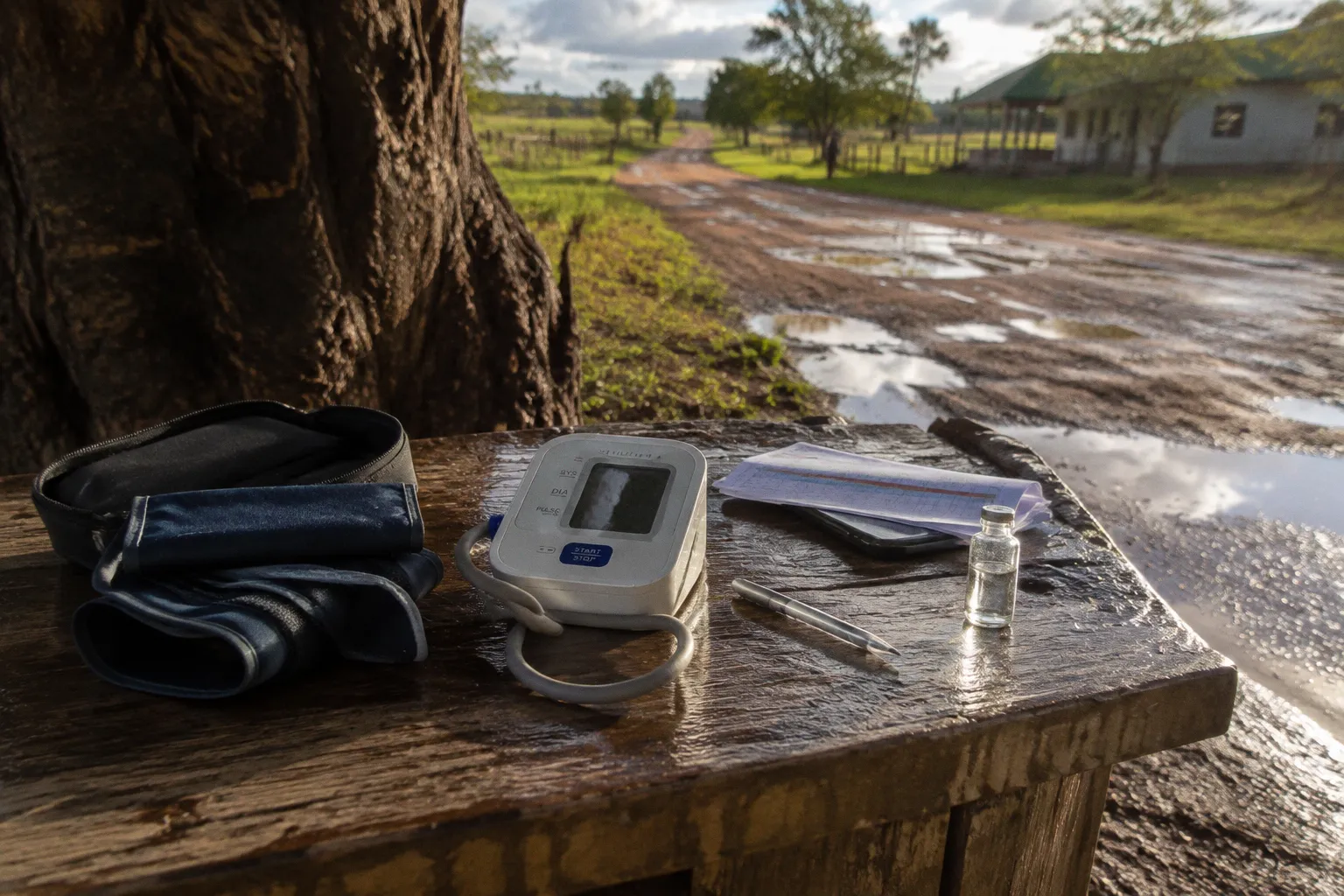
If POCT extends the clinic's diagnostic reach, remote patient monitoring (RPM) extends its surveillance into the patient's home. The concept is straightforward: a cellular-enabled blood pressure cuff on a kitchen table takes a reading and transmits it over a mobile network to a clinician's dashboard. There is no need for home Wi-Fi, no complex app to manage, and no reliance on fixed broadband—a critical advantage in areas where such infrastructure remains sparse. The vitals monitored are those directly tied to preventable rural mortality: blood pressure for hypertension and stroke, blood glucose for diabetes, weight for heart failure, and oxygen saturation for chronic respiratory conditions.
Each automated reading, taken consistently at home, contributes to a longitudinal dataset. A few months of daily blood pressure logs provide a trendline far more informative than a single office reading. This allows a primary care physician to make medication adjustments or flag concerning patterns based on real-world data, reducing the need for frequent, burdensome clinic visits while maintaining clinical oversight.
The technology's efficacy hinges on connectivity that already exists. Cellular networks cover the vast majority of inhabited areas, including most rural regions. Devices that leverage these networks can reliably transmit data from locations where installing fiber-optic broadband is economically or logistically infeasible for years to come. This allows clinical teams to receive a continuous stream of patient data, ensuring that the next in-person visit is informed by a history of home measurements, not just a snapshot from the day of travel.
Monitoring does not replace the clinic visit. It just makes sure the next visit happens with information, not guesswork.
Empowering Community Health Workers with Mobile Tools
The technology alone is inert. The essential human component is the community health worker—often a trusted member of the neighborhood—who operates the devices, explains their use to patients, and interprets the initial results within the context of the patient's life. They notice the non-biometric signs that a sensor cannot: a pantry that suggests poor nutrition, a decline in mobility, or a family's difficulty affording medications. Their role transforms screening from an episodic event into a continuous process of support and engagement.
Equipping these workers creates a sustainable model for health surveillance. A mobile clinic's periodic visit provides a screening snapshot, but a trained local presence ensures follow-up and data continuity. The practical toolkit carried by a community health worker is chosen for ruggedness, simplicity, and direct clinical utility:
- A handheld HbA1c analyzer providing results in minutes from a small blood sample.
- A cellular-enabled blood pressure cuff that automatically logs and transmits readings.
- A pulse oximeter for assessing respiratory health, especially important in high-altitude or environmentally affected areas.
- Urine dipstick tests for markers like albumin, which can indicate early kidney dysfunction.
- A rugged tablet or smartphone with offline-capable software for recording data and following screening protocols.
This worker is not merely a courier for samples. They are a frontline clinician, capable of performing a screening, discussing the preliminary result with the patient, and initiating the next step in care, whether that involves lifestyle counseling, ensuring medication adherence, or arranging a higher level of care.
Scaling Preventive Care Beyond Urban Centers
The evidence supporting community-based chronic disease screening is robust. It consistently shows that early detection in underserved areas reduces rates of late-stage diagnosis, lowers hospitalization costs, and, most importantly, improves quality of life. The challenge is no longer proving the concept but replicating its success factors at scale.
Three elements appear non-negotiable. First, the technology must be independent of the infrastructure rural areas have historically lacked. Cellular-enabled POCT and RPM devices meet this criterion, whereas platforms dependent on high-speed broadband do not. Second, the workforce must be locally rooted. External screening teams that visit and depart leave behind data points, not capacity. Sustainable impact requires training and retaining community health workers who become permanent points of contact. Third, the screening protocol must lead to immediate, actionable outcomes. A test whose result sits in a file without triggering a clinical decision is a missed opportunity.
When these conditions are met, the paradigm shifts. Preventive care evolves from a centralized, urban-centric model to a distributed network operating at the neighborhood level. It leverages the clinics that already exist and the people already trusted in their communities, equipping them with tools to intervene before a crisis develops. The path forward is practical and specific: expanding the deployment of POCT devices in rural clinics, placing more cellular-enabled monitors in homes, and investing in the training and support of community health workers. This sustained effort builds a system where early detection becomes the norm, not the exception, closing the health gap one informed intervention at a time.