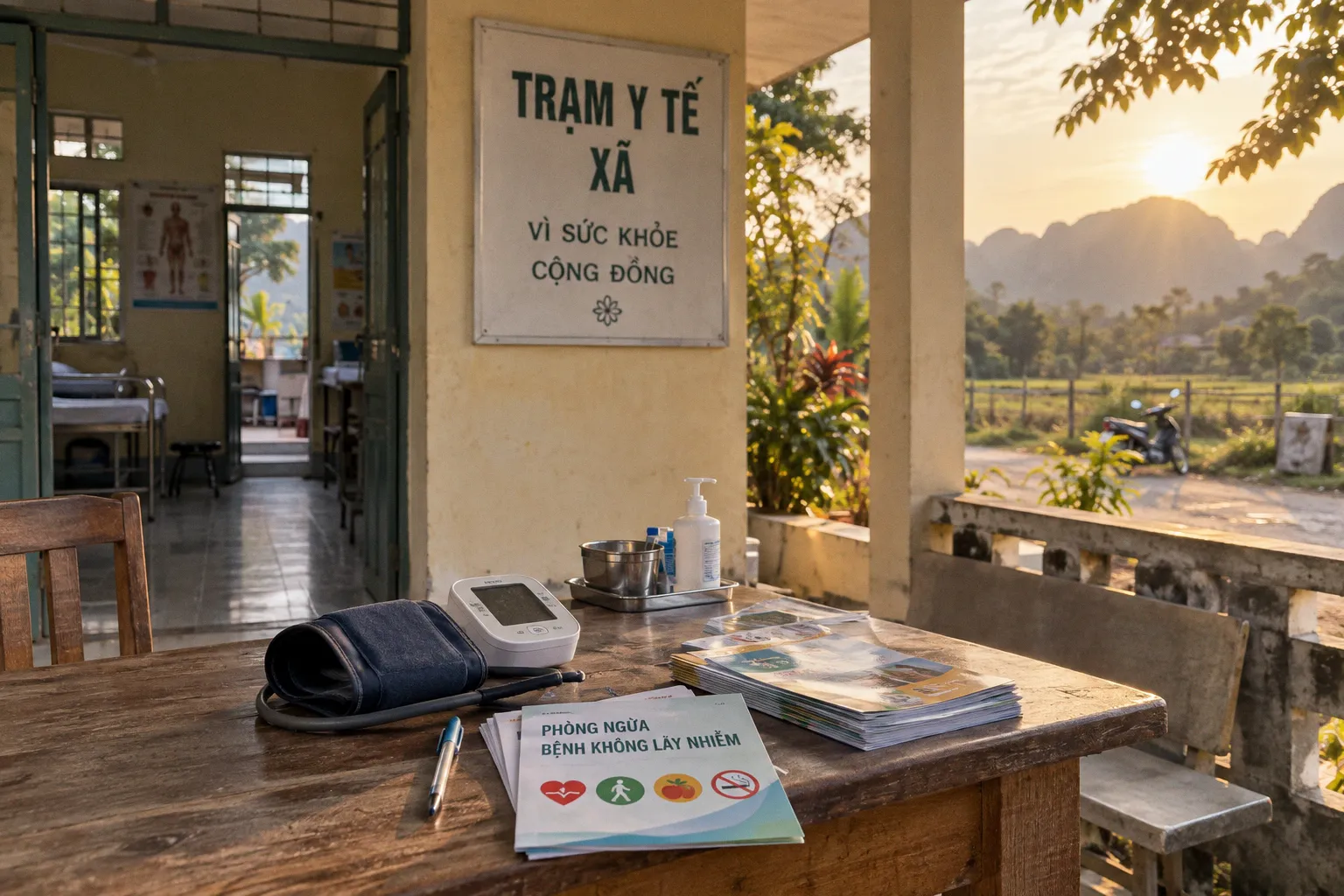
Every morning, the courtyard at Binh Quoi Commune Health Station in Ho Chi Minh City fills with quiet conversation — mothers soothing children, neighbors comparing notes on their blood pressure readings. It's a gentle scene, the kind you could overlook. But according to the World Health Organization, this unremarkable daily rhythm now reaches roughly 10 million people each year, and it is quietly reshaping how a country of nearly 100 million confronts its leading killers: hypertension and diabetes.
When the nearest hospital is no longer the only option
Ms Hua Thi Thien lives with both conditions. For years, managing them meant long trips to distant hospitals, relying on family members for transport, navigating crowded outpatient departments. Now she cycles to her commune health station. Her medication has been better adjusted, side effects have eased, her weight has dropped and everyday tasks feel easier. In her words, the staff are thorough and reassuring — a trust she didn't feel when care was scattered and far from home.
Her experience mirrors a national shift. Under a Ministry of Health initiative backed by WHO and Resolve to Save Lives, Vietnam has built a hypertension control model that screens approximately 10 million people annually. More than 2 million have entered treatment. Among enrolled patients, blood pressure control has climbed from 53 percent in 2022 to 72 percent in 2025 — a meaningful jump for a country where an estimated 18 million people live with high blood pressure, many without knowing it.
The stakes are stark. Noncommunicable diseases account for 80 percent of all deaths in Vietnam — close to half a million lives each year. Unmanaged hypertension quietly drives heart attacks, strokes and kidney failure, burdening families and health systems alike.
Shifting the workload to where people already live
The backbone of this model is deceptively simple: move routine screening and stable-case management out of hospitals and into commune health stations — the tier of care closest to neighborhoods and villages. Up to 80 percent of diagnosed hypertension and diabetes cases in Vietnam are classified as mild or moderate, meaning they can be effectively managed without a hospital visit. Since 2016, the Ministry of Health and WHO have worked alongside provincial health departments, public health institutes and local health stations to make that shift real.
Commune stations now use an online noncommunicable disease reporting system that keeps patient records current, helping staff track who needs a follow-up and who might be falling through the cracks. For patients like Ngo Xuan Thien, who spoke to WHO representatives during a 2026 visit, the result is straightforward: shorter waits, quicker care. The groundwork — training, digital tools, medication supply chains — has been laid station by station, province by province.
Why this matters beyond Vietnam's borders
Vietnam's approach aligns with Politburo Resolution 72, which envisions a people-centered health system anchored in universal health coverage. But the implications stretch further. Hypertension is a regional priority for WHO's Western Pacific and will feature at the seventy-seventh session of the Regional Committee in October 2026. What's unfolding in commune courtyards across Vietnam offers a practical case study: how sustained partnership, digital record-keeping and task-shifting can bend a national epidemic curve without waiting for hospital infrastructure to catch up.
For frontline health workers elsewhere — in charitable hospitals, community clinics, mobile outreach teams — the Vietnamese model underscores something deeply familiar: resilience belongs to the neighborhood. When care meets people where they already gather, trust follows. And with trust comes the kind of sustained, everyday management that keeps a blood pressure reading from becoming an emergency.