As global development assistance for health contracts, PMNCH reports that the World Health Organization and Thailand's National Health Commission Office are convening the fourth installment of a social participation webinar series, with UHC2030 support, positioning community input as a determinant of which populations gain coverage under universal health coverage frameworks.
According to the PMNCH announcement, the series addresses how countries can institutionalize social participation in health financing policy processes. With external aid budgets tightening, governments are revisiting revenue mobilization, risk pooling, and service purchasing — decisions that determine who is included and who is excluded on the path to UHC. The systematic participation of communities and civil society is framed as a structural variable, not a procedural formality.
The financing variable charitable providers should track
Recent reports from WHO, the World Bank, and the Norwegian Institute of Public Health, cited in the webinar materials, argue that participatory processes produce more efficient resource allocation, higher utilization rates, and stronger accountability mechanisms. For charitable hospitals, mobile outreach programs, and community blood donation drives operating in underfunded or rural districts, the implication is operational: donor and public financing formulas tied to participation criteria may increasingly determine whether funds reach their catchment areas. Community engagement becomes a documented input to budget justification.
The panel composition for the session — government representatives, civil society, and international partners — signals a shift from consultation as a downstream checkbox to engagement during policy design itself.
Parallel signals in disability infrastructure and rural outreach
A separate WHO-hosted side event on disability-inclusive health highlighted Montenegro as the first country in the European Region to implement the WHO health equity guide for persons with disabilities, with a national action plan co-produced with disability organizations. The case is notable as a documented instance of participation translated into national infrastructure, including adapted preventive screenings and real-time sign language interpretation to reduce persistent service gaps.
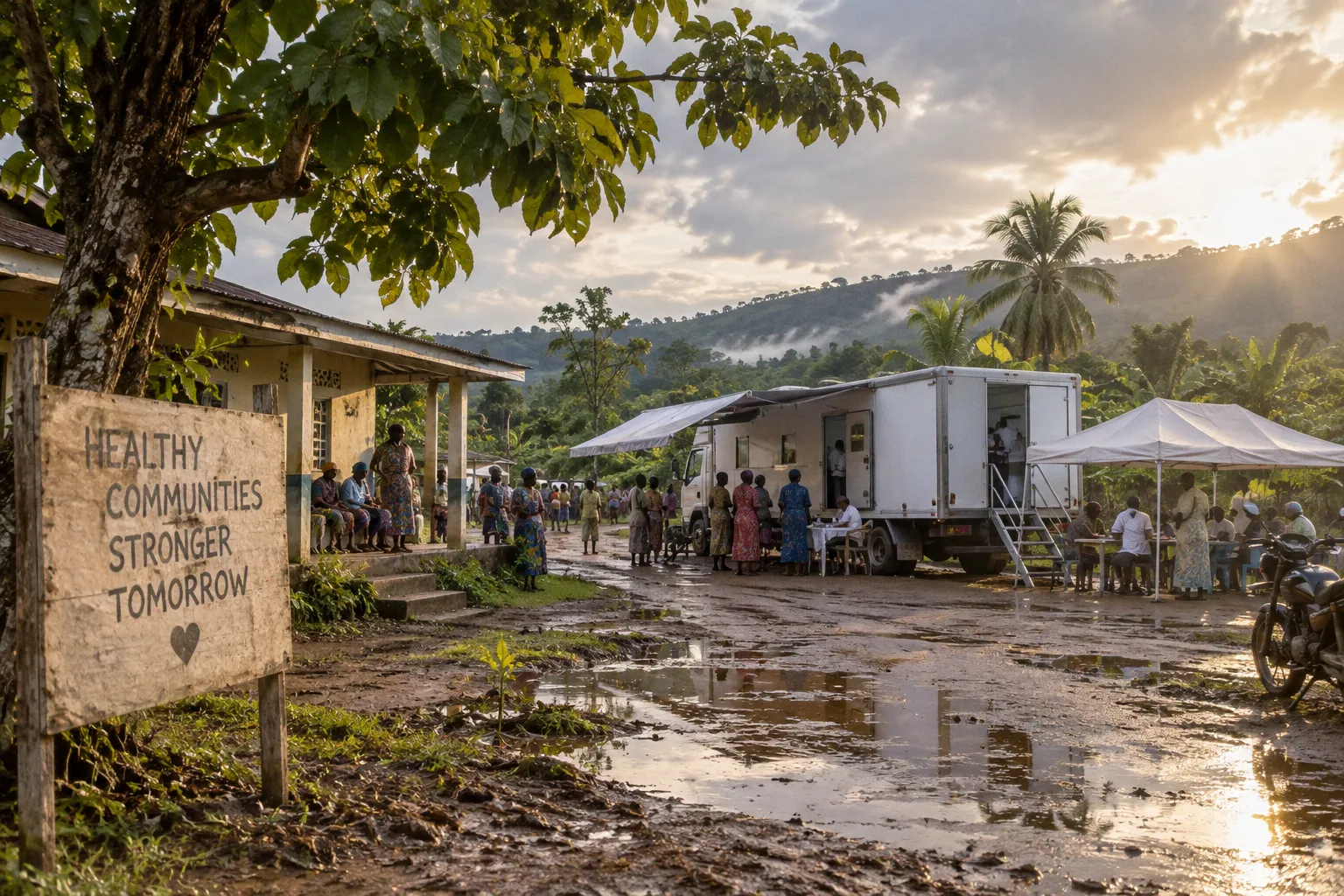
In a different operational setting, Gavi, the Vaccine Alliance reports a health outreach partnership deploying monthly mobile clinics to remote cocoa-farming communities in Côte d'Ivoire, delivering free doctor consultations, eye examinations, and routine childhood immunizations. The model — scheduled, free, community-embedded — aligns with the participation framework's emphasis on predictable access for intended beneficiaries, rather than facility-anchored delivery that assumes the patient can reach the provider.
What to monitor for patients and clinic operators
For charitable providers and the communities they serve, the near-term indicators are concrete: whether donor reporting requirements begin referencing participation criteria, whether national financing revisions cite community input as a prerequisite for allocation, and whether outreach grants shift toward the mobile-clinic model outlined above or remain facility-anchored. Under that emerging structure, community participation stops being rhetorical and becomes a measurable line item — with direct consequences for service availability in the districts that depend on charitable and outreach infrastructure most.