Inside that primary bag sits roughly 450 to 500 milliliters of whole blood, mixed with about 63 millilitres of anticoagulant-preservative such as Citrate Phosphate Dextrose or its adenine-fortified cousin, CPD-A. From this moment a clock starts ticking that no technician can reset. Five to eight hours is what the lab gets before component preparation has to begin, and every additional hour quietly erodes the donation's therapeutic value. This is the unseen choreography of every functional blood system: the work that turns one act of generosity into three distinct medical products, performed in rooms that donors almost never see.
The Physics of Fractionation: Differential Centrifugation Explained
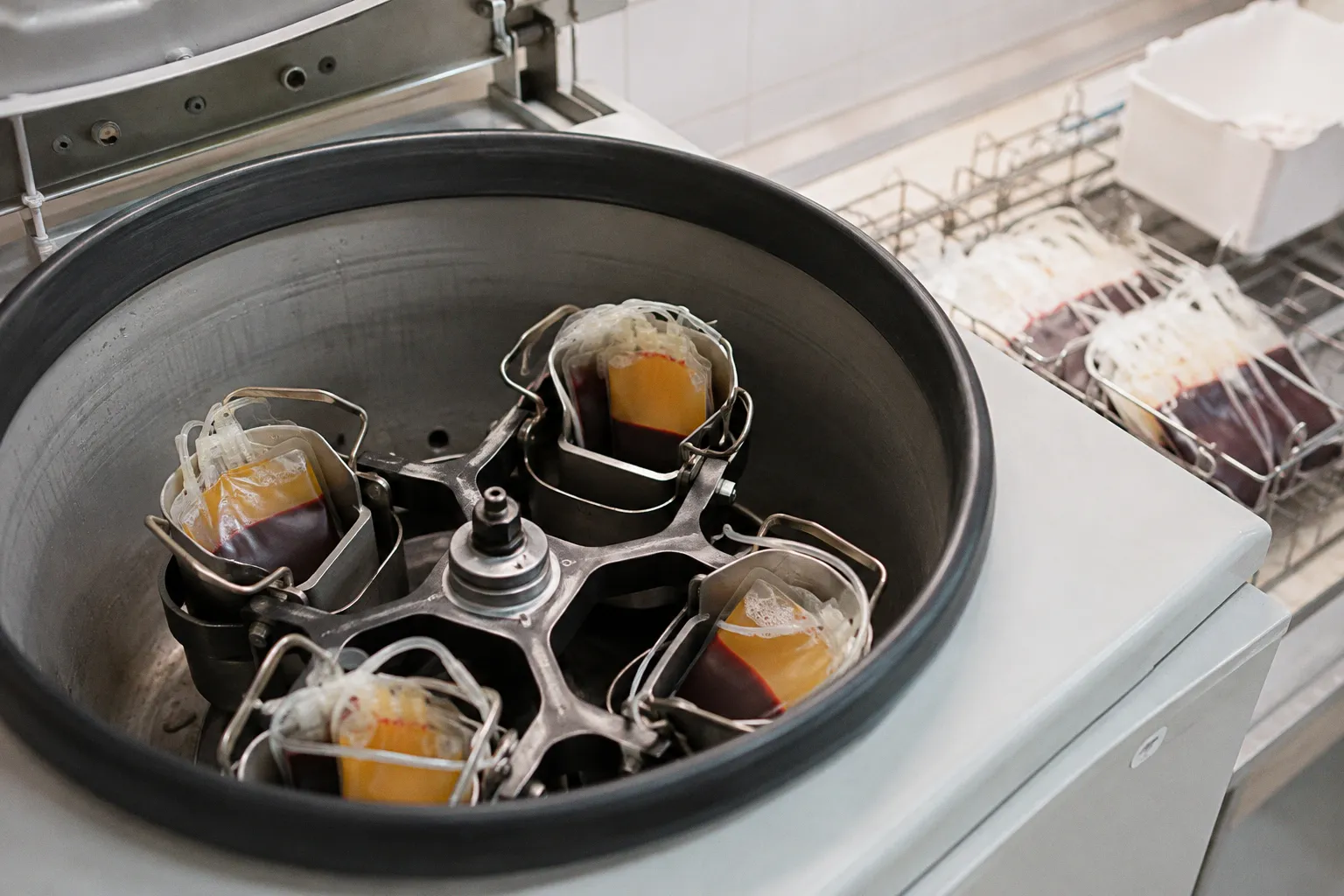
To stand beside a refrigerated centrifuge in a working blood bank is to watch a piece of physics being used as a precision instrument. Differential centrifugation exploits the simple fact that blood is not a uniform liquid but a layered community of cells and plasma, each with its own weight. By volume, plasma makes up roughly 55 percent of the donation and the formed cellular elements (red cells, white cells, platelets) the remaining 45 percent. Once a sealed bag of anticoagulated whole blood is spun inside a refrigerated rotor at high gravitational force, that density stratification becomes visible in seconds.
The heavier red cells migrate outward and downward, packing against the bottom of the bag. The platelets and most white cells, sitting at intermediate density, gather as a thin whitish band in the middle — the so-called buffy coat. The plasma, lightest of all, rises to the top as a clear, straw-coloured liquid. The lab technician's job, once the rotor finally winds down, is to read those layers with the kind of attention most people reserve for weather. A heavy spin followed by careful expression of the supernatant liquid through sterile-connect tubing yields the three core components: packed red blood cells, fresh frozen plasma, and — depending on workflow — platelet concentrate.
The exact rotational speed and g-force applied differ from one rotor radius to another, which is why no single RPM number travels cleanly between blood banks. What stays constant is the underlying principle: dense fractions drift outward and downward, lighter ones collect above them, and each can be siphoned off in turn without ever breaking the closed system.
Inside that primary bag sits roughly 450 to 500 millilitres of whole blood, mixed with about 63 millilitres of anticoagulant-preservative — one donation, three therapeutic products waiting to be drawn out.
From Whole Blood to Therapeutic Components: The Processing Workflow
The path from donor to patient is rarely a single separation. In most processing labs the workflow splits into two distinct streams depending on which components the regional supply needs that week. Preparing packed red cells and fresh frozen plasma together requires only a single-step heavy spin: one rotor run, one careful brake, and the plasma can be expressed off the top into a satellite bag while the red cells settle into their own.
The work becomes more intricate when platelet concentrate is on the menu. Platelets are the smallest and most fragile of the formed elements, and they do not surrender themselves easily. The lab runs a two-step centrifugation: a low-speed soft spin first to separate platelet-rich plasma from the heavier red cells, and then a heavier second spin on that intermediate plasma to pellet the platelets at the bottom of a transfer bag. A short resting period follows during which the platelets dislodge from the bag wall and resuspend themselves in a small volume of plasma. Only then is the final product weighed against a target volume, leukocyte-reduced where the local protocol calls for it, and placed on an agitator.
| Component | Common preparation route | Approximate volume from one whole-blood donation |
|---|---|---|
| Packed Red Blood Cells (PRBC) | Single heavy-spin separation from whole blood | ~150–200 mL red cell concentrate |
| Fresh Frozen Plasma (FFP) | Single heavy-spin separation, frozen within hours | ~200–250 mL, frozen to –30 °C or colder |
| Platelet Concentrate (Random Donor) | Two-step soft-then-heavy centrifugation | ~50–70 mL per unit |
This branching is the practical heart of the modern blood bank. A single donation does not have to choose between helping a trauma patient, a burn unit, or a leukemia ward — it can quietly service all of them at once, provided the lab does its work on time and on temperature.
The Critical 8-Hour Window: Why Timing Defines Component Viability
Few numbers in this workflow weigh as heavily as the five-to-eight-hour rule, and the rule is not bureaucratic. It is biochemical. Whole blood that sits too long before processing begins to lose labile clotting factors — particularly Factor V and Factor VIII — that fresh frozen plasma is meant to deliver to patients who are bleeding, clotting poorly, or taking anticoagulants that need reversal. Platelets, already fragile, begin to suffer the same fate; their function deteriorates the longer the bag sits at room temperature, and a sluggish platelet concentrate at the bedside is a clinical liability, not an asset.
This is why processing centres run shifts that look almost obsessive to anyone walking through for the first time. Couriers collect donor blood on tight schedules; technologists check the timestamp on every incoming bag before it goes anywhere near a centrifuge; the centrifuges themselves are pre-cooled hours before the first sample arrives. The intervention begins, in a real sense, the moment the donor's needle comes out — even a donation that took fifteen minutes and felt ordinary becomes, behind the lab doors, a time-bound medical product.
A donation can wait a heartbeat, a brief counselling chat, or a long morning on a donor couch — but at the receiving end of the chain, every hour counts. The lab has roughly eight of them.
Storage Standards and Shelf-Life Dynamics for PRBCs, FFP, and Platelets
Component separation is only one half of the story. What happens next — how each product is stored and for how long — is what determines whether the donation will actually reach a patient in the form a clinician wants. Three products, three very different relationships with temperature and time, three distinct disciplines living inside the same blood bank.
Packed red blood cells, once expressed off the plasma, are typically held in a dedicated refrigerator between 2 °C and 6 °C. Without an additive nutrient solution, the standard shelf life runs 35 days; with the additive solution included in the satellite bag, that window extends to 42 days. This longer tail is what allows regional blood centres to buffer their supply against elective-surgery surges and weekend trauma spikes without constantly over-collecting.
Fresh frozen plasma asks for the opposite environment. It is rushed into a blast freezer the moment it leaves the centrifuge, brought to –30 °C or colder, and held there for up to twelve months. Freezing is what protects the labile clotting factors that whole blood begins losing the moment it leaves the donor's arm.
Platelet concentrates occupy a third, almost intermediate world. They cannot be frozen like plasma — their membranes would not survive it — and they cannot be refrigerated like red cells, because cold storage activates them in ways that shorten their clinical usefulness. Instead, platelet concentrates sit on agitators at controlled room temperature, gently rocking around the clock, for a maximum of five days before they expire.
| Component | Storage temperature | Maximum shelf life |
|---|---|---|
| Packed Red Blood Cells (no additive) | 2–6 °C | 35 days |
| Packed Red Blood Cells (with additive solution) | 2–6 °C | 42 days |
| Fresh Frozen Plasma | –30 °C or colder | Up to 12 months |
| Random Donor Platelet Concentrate | Room temperature, continuous agitation | 5 days |
Five days is, in blood-banking terms, not much margin. A weekend collection event held on a Saturday can easily see its platelet units tip past their expiry by the following Thursday, even when no emergencies arise. The resilience of supply chains here depends less on stockpiling and more on the daily rhythm of donor recruitment in the surrounding neighbourhood.
Modern Component Therapy: Moving Beyond Whole Blood Transfusions
There is a final, often unspoken reason for doing all of this work so carefully. Most modern transfusion practice no longer reaches for whole blood as a first-line therapy, and that single shift has quietly reshaped the standard of care in trauma, surgical, and haematology units worldwide. When a clinician needs oxygen-carrying capacity, they request packed red cells. When they need volume and clotting factors, they request plasma. When they need bleeding control in a patient whose platelets have been consumed by chemotherapy or a massive transfusion, they request platelets.
This targeted use of components — sometimes called blood component therapy in clinical shorthand — is what lets one donation be matched to three different patients with three different needs. It also shortens each patient's exposure to donor antigens, reduces the risk of circulatory overload, and improves outcomes for everyone from a newborn in a NICU to an elderly patient brought in after a fall. The move away from whole-blood transfusion is, in many ways, the philosophical centre of the modern blood bank: each fraction exists because a specific patient, somewhere downstream, needed something smaller, cleaner, and more precisely dosed than the original bag.
The Work Behind the Work
What stays with me, after hours spent shadowing the technologists on a weekday shift, is how rarely any of this is visible to the public. The donor experiences a needle and a juice box. The patient receives a unit marked only with a barcode and a blood group. In between sits a long chain of small, unglamorous interventions — cooling, spinning, splitting, weighing, freezing, agitating — carried out by people who measure success in expired units discarded rather than heroic rescues broadcast on the evening news.
And yet nothing in modern emergency care works without the groundwork those shifts perform. Every platelet concentrate placed on an agitator in this hour is a downstream decision someone, somewhere, will be grateful for next week. The rigour of component preparation is what holds the entire voluntary blood system together — quietly, locally, three products at a time.