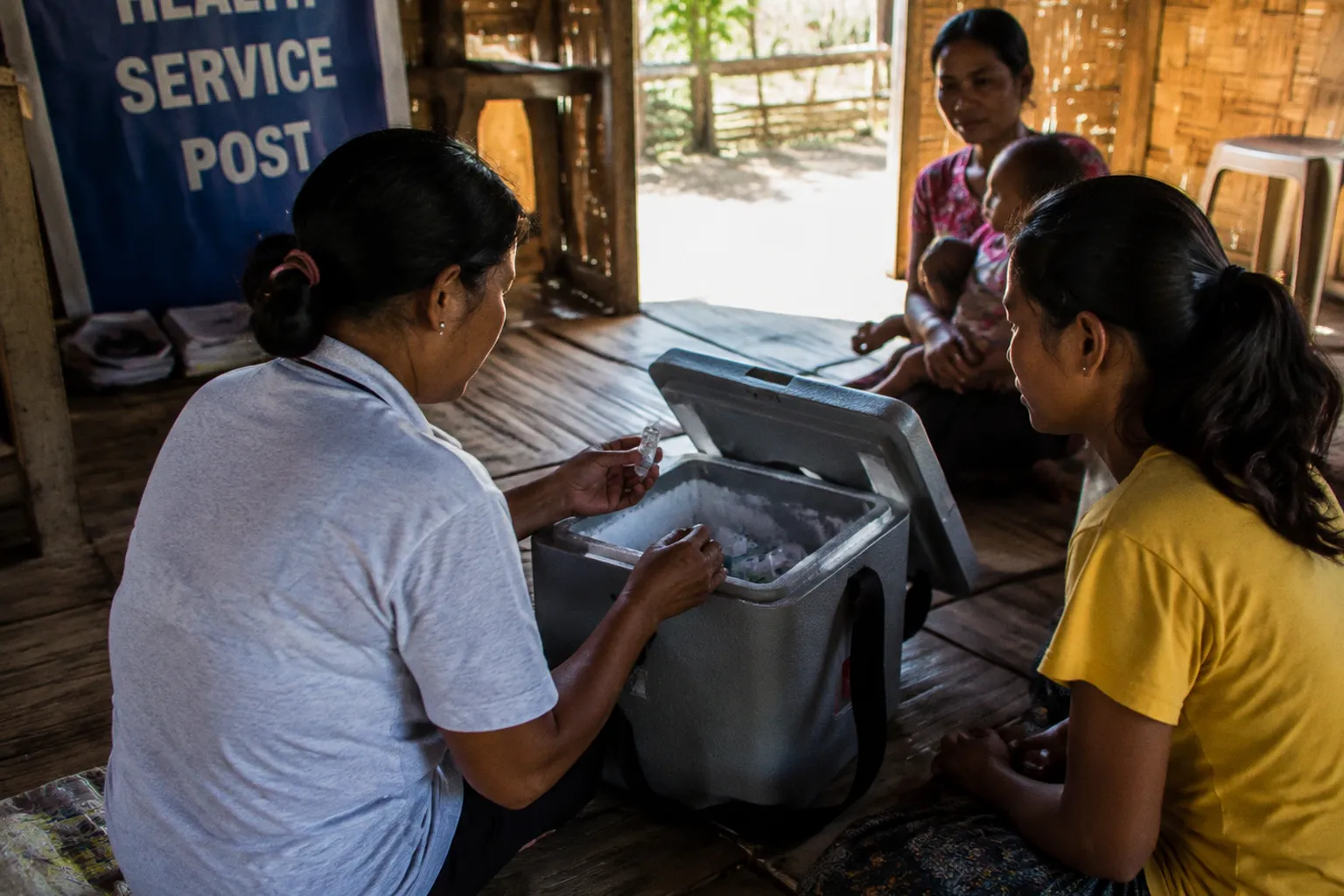
For most routine vaccines, the working window is narrow: between +2°C and +8°C from storage through transport and until administration.
That requirement turns a mobile immunization drive into a logistics operation as much as a clinical one. Before the first child is screened or the first vial is opened, health workers must prepare coolant packs, load carriers, read temperature indicators, estimate travel time, and decide how many doses can safely leave the refrigerator. In remote settings, where there may be no reliable electricity and no replacement supplies nearby, a small mistake in packing can undo an entire day’s groundwork.
The vaccine cold chain in rural outreach drives is therefore not one machine or one insulated box. It is a sequence of protections—central storage, portable cooling, temperature monitoring, trained handling, and carefully defined exceptions for specific vaccines. Each link has to hold while the team moves through heat, distance, delays, and the ordinary unpredictability of community healthcare.
The critical +2°C to +8°C window
Vaccines are biological products. Their potency can deteriorate when they are exposed to temperatures outside the range specified for them, even if the vial still looks normal. A clear liquid does not necessarily signal a safe product, and a label that appears undamaged cannot reveal every temperature excursion.
For most routine immunization programs, the standard storage and transport range is +2°C to +8°C. The aim is not merely to keep vaccines cool. It is to keep them within a controlled range for the full journey, avoiding both excessive heat and accidental freezing.
The second risk is often less visible than heat damage. Some vaccines contain aluminum adjuvants, substances used to help the immune system respond. These freeze-sensitive vaccines can suffer irreversible molecular damage when exposed to temperatures below 0°C. Once that damage occurs, returning the vial to the correct temperature does not restore its original potency.
This is why an outreach team cannot simply take ice packs directly from a freezer and press vaccine vials against them. Frozen packs may create pockets of sub-zero temperature inside a carrier, particularly when the box is opened repeatedly or when vials are placed tightly against the pack surface. A carrier can feel reassuringly cold and still be protecting the vaccines badly.
Temperature management has to account for the entire environment inside the container:
- the temperature of the coolant packs;
- the arrangement of vials and diluents;
- the insulation and capacity of the carrier;
- the duration of the trip;
- the frequency with which the lid will be opened;
- the outside temperature and exposure to direct sunlight;
- the point at which unused doses will be returned or discarded.
A remote immunization logistics plan begins with these physical details. It cannot be built only around the number of patients expected at the site.
Why the journey changes the calculation
A health post may be only a few hours from a district store on a map, but the route can include a long walk from the road, a broken bridge, a ferry crossing, or a village where the team must wait for people to arrive. A carrier that performs well during a direct transfer may behave differently during a day of repeated opening and closing.
The team must also carry more than vaccines. Syringes, safety boxes, cotton, records, hand hygiene supplies, and emergency equipment compete for transport space. The more carefully the team plans its load, the less likely it is that a vaccine carrier will be opened to retrieve unrelated materials.
The cold chain is often described as a technical system, but in practice it is shaped by human movement. A cold box placed in the sun, a lid left open while forms are completed, or a coolant pack positioned against the wrong side of the vial compartment can alter the conditions inside. Good systems reduce the number of decisions workers have to make under pressure.
The cold chain succeeds when temperature protection is designed into the work, rather than left to memory during a long and difficult shift.
Passive cooling and the last mile
Most last-mile vaccine transport does not depend on a refrigerator running beside the vaccination table. Instead, mobile teams use passive cooling equipment: insulated vaccine carriers and cold boxes that hold preconditioned ice packs or other cooling materials.
A passive carrier contains no motor and does not generate cold. It slows the movement of heat from the outside environment into the vaccine compartment. That distinction matters. Its performance depends on preparation, packing, insulation, the condition of the cooling materials, and how often the carrier is opened.
Standard WHO-prequalified vaccine carriers have storage volumes of approximately 0.8 to 3.4 liters. A one-liter carrier can hold up to 700 doses of oral polio vaccine, and some carriers can maintain their cool life for as long as two days under specified conditions. Capacity, however, is not the same as useful field capacity. A team may need to leave room for correct separation, protective packaging, and the practical handling of vials during a busy clinic.
A small carrier may be ideal for a short walking route with a limited number of doses. A larger cold box may suit a multi-day campaign, but it will be heavier and more cumbersome to move. The equipment must match the intervention, not simply the maximum number of vials that can be placed inside.
Preparing the coolant
Ice packs are not interchangeable with vaccine protection. When packs are frozen solid, they may be colder than the vaccine can safely tolerate. For freeze-sensitive products, health workers may need to condition the packs before loading them: allowing some ice to melt and checking that the pack has reached the required state before it is placed beside the vials.
The exact handling procedure depends on the carrier design, the coolant pack, and the vaccine program. A trained worker follows the equipment instructions and the applicable immunization guidance rather than relying on touch alone. In a hot environment, the preparation area itself becomes part of the operation: packs may be moved from a freezer, inspected, conditioned, and loaded while the team is also trying to organize departure.
Newer freeze-preventive carriers reduce this burden. They use engineered Phase Change Material, or PCM, liners, or physical thermal buffers that create a protective layer between the cold source and the vaccine vials. Their purpose is to prevent accidental freezing without requiring workers to condition ice packs manually.
PCM systems are useful because they can absorb or release heat at a defined transition point. Rather than creating an uncontrolled cold surface, the material helps stabilize the compartment around the target range. This does not eliminate the need for training or monitoring, but it can make the packing process more forgiving in places where staff are working quickly and supplies are limited.
Portable carrier temperature management
A carrier needs to be treated as a working piece of clinical equipment, not as a passive parcel. The team should know:
1. How long the carrier can maintain the required range. The stated cool life is tied to test conditions, pack configuration, ambient temperature, and handling.
2. Which vaccines are freeze-sensitive. Different products have different stability profiles, and a general assumption can be unsafe.
3. Where the vials belong inside the carrier. The coldest surfaces are not necessarily appropriate for every product.
4. How often the lid can be opened. Repeated access allows warm air into the compartment and shortens the protective period.
5. How temperature is monitored. A carrier without a usable monitoring method leaves the team guessing after a delay.
6. What happens at the end of the session. Unused vials may need to be returned to controlled storage or handled according to program rules.
The practical goal is simple: keep the vaccine in a known condition from the moment it leaves fixed storage until the moment it is administered. That requires a chain of small, repeatable actions.
| Cold-chain element | What it contributes in a rural drive | Main operational pressure |
|---|---|---|
| Passive vaccine carrier | Protects doses during walking, motorcycle transport, and short outreach sessions | Limited capacity and reduced performance with frequent opening |
| Cold box | Holds a larger stock for longer transfers or campaign staging | Heavier to transport and often less convenient at the vaccination table |
| Conditioned ice packs | Provide cooling without direct freezing contact | Require correct preparation before loading |
| PCM or freeze-preventive liner | Buffers the vaccine from sub-zero coolant and stabilizes temperature | Depends on correct configuration and product-specific guidance |
| Temperature monitoring tool | Shows whether the required range has been maintained or breached | Readings are useful only when workers know how to interpret and act on them |
| Solar Direct Drive refrigerator | Maintains fixed cold storage in an off-grid health post | Requires suitable installation, maintenance, and reliable daily use |
Preventing freeze damage in the field
Heat is easy to imagine in rural outreach work: a carrier left in a vehicle, a long wait under a metal roof, or a road exposed to afternoon sun. Freezing damage is quieter. It can occur inside a well-insulated container that appears to be doing its job.
The danger usually begins at the interface between the coolant and the vial. A frozen ice pack can be far below the safe temperature for a freeze-sensitive vaccine. If the vial touches that pack, or if cold air is concentrated around it, the product may cross the sub-zero threshold even while the rest of the carrier remains within an apparently acceptable range.
A properly engineered thermal buffer changes the geometry of that risk. Instead of asking a frontline worker to judge whether a pack is safe by appearance or touch, the carrier creates separation and moderates the transfer of cold. PCM liners are designed for this purpose. They help prevent the sharp temperature drop that can occur when vaccine vials sit directly beside frozen coolant.
This is not an argument for treating equipment as foolproof. A carrier still has to be packed according to its instructions. Vials should not be forced into spaces that compromise the liner or separator. The lid needs to close fully, and the carrier must not be used as a general storage box for items that interfere with airflow or insulation.
Temperature monitoring provides another layer of protection. Depending on the program and equipment, workers may use indicators or digital tools to identify excursions. The reading is not a formality to complete after the drive. It helps answer an immediate clinical question: can these doses still be used, or has the cold chain been compromised?
That decision may have consequences for the entire session. If there is no replacement supply at the outreach site, staff may have to pause immunization, contact the supervising health post, or isolate affected vials until the responsible program authority gives direction. The correct response is not to conceal uncertainty by placing the vials back in the carrier and continuing as though nothing happened.
The discipline of packing
Packing is one of the least visible parts of a vaccination drive and one of the most consequential. Before departure, the worker has to translate a schedule into a physical arrangement: which products are needed, how many doses are reasonable for the expected attendance, which materials must remain dry, and how the carrier will be opened throughout the day.
A disciplined packing sequence reduces hurried improvisation:
- confirm the destination, route, and expected duration;
- check the condition and preparation status of cooling materials;
- identify vaccines that must not freeze;
- place vials in the carrier according to the equipment guidance;
- position the temperature monitor where it can provide a meaningful reading;
- secure the lid and protect the carrier from direct sunlight;
- carry only what the session can safely manage;
- record departure and return information where required.
These steps sound modest because they are. Community medicine is often built from modest steps repeated reliably by people whose shifts are already full. The resilience of the system lies less in dramatic technology than in whether the same safe process survives a late vehicle, a crowded clinic, or a sudden change in weather.
Controlled Temperature Chain: a carefully defined exception
The standard +2°C to +8°C range is not the only possible pathway, but alternatives are tightly limited. The World Health Organization’s Controlled Temperature Chain, or CTC, allows certain licensed vaccines to be held at ambient temperatures for a defined period immediately before administration.
Under the stated CTC conditions, specific vaccines such as Euvichol-Plus oral cholera vaccine may be kept at temperatures up to +40°C for at least three days before administration. This can make a major difference in an isolated community where carrying a cold box through every stage of a campaign would be difficult or where the final distribution route is too long for conventional passive cooling alone.
CTC does not mean that vaccines can generally be stored warm. It is not a blanket waiver from the cold chain. The protocol applies only to vaccines that have been licensed and approved for that use, and only when the packaging, labeling, temperature limit, time window, and monitoring requirements are followed.
The distinction is critical:
- a vaccine must be specifically eligible for CTC;
- the ambient temperature must remain within the authorized limit;
- the vaccine can remain outside the standard range only for the approved duration;
- the CTC period is tied to administration, not indefinite storage;
- vaccines without explicit CTC authorization remain subject to their normal storage requirements.
For a mobile medical camp, this can simplify the final leg of delivery, but it does not remove the need for planning. Staff still need to know when the CTC clock begins, which vials are in the CTC pathway, and how to prevent them from being mixed with products that require continuous +2°C to +8°C protection.
In practice, CTC is best understood as a targeted intervention in the supply chain. It gives a program more room to reach a neighborhood or isolated settlement, but only because the boundaries are clear.
Controlled Temperature Chain protocols widen the route to a community; they do not loosen the rules around vaccine safety.
Solar refrigerators at the health-post level
Passive carriers solve the last-mile problem, but they need a reliable place to begin. In off-grid rural areas, that fixed point may be a primary health post equipped with a Solar Direct Drive refrigerator.
An SDD refrigerator uses solar energy to maintain cold storage and freeze coolant packs without relying on grid electricity or batteries. In a region where power cuts are routine or where no electrical network reaches the facility, that capability provides the groundwork for outreach. It allows a health post to hold vaccines safely, prepare carriers, and support repeated community sessions rather than waiting for every dose to arrive from a distant district store.
The value of solar refrigeration is not only technical. It changes the rhythm of care. A health worker can plan a screening or immunization day around the needs of the neighborhood instead of around the arrival of a generator’s fuel or a short period of electricity. A clinic can freeze coolant packs locally, reducing the distance those materials must travel before the final transfer.
But the refrigerator still sits inside a larger system. Solar panels need a suitable installation and protection from damage. The unit needs maintenance, cleaning, temperature checks, and staff who understand what to do when the reading moves outside the expected range. The health post needs a process for stock rotation, resupply, and escalation when equipment fails.
A solar refrigerator cannot compensate for poor inventory planning. If a team takes too many doses to a remote camp, the unused stock may be exposed to unnecessary handling on the return journey. If it takes too few, families may make a difficult trip only to find that the session cannot serve them. Cold-chain capacity and community trust are connected: every canceled clinic carries a human cost.
Connecting fixed storage to mobile care
The strongest rural immunization systems treat the health post, carrier, transport route, outreach site, and return process as one continuous operation. The equipment may change along the way, but the responsibility does not.
A practical workflow looks like this:
1. At the fixed health post, staff confirm stock, expiry information, temperature records, and the day’s estimated demand.
2. Before departure, they prepare or select the appropriate coolant materials and pack vaccines to avoid direct contact with unsafe cold surfaces.
3. During transport, the carrier stays closed as much as possible and is shielded from direct heat.
4. At the outreach site, the team opens the carrier only when necessary, keeps the vaccination workspace organized, and monitors the condition of the contents.
5. During the session, workers separate active-use materials from the remaining stock so the carrier does not become a constantly searched container.
6. After the final patient, they account for remaining vials and follow the applicable rules for return, reuse, or disposal.
7. Back at the health post, staff review temperature information and document any excursion or equipment problem before the next shift begins.
The workflow is straightforward on paper. Its difficulty comes from the environment in which it has to hold: heat that arrives early, roads that slow the team, children waiting in crowded rooms, and staff who may be carrying several public health responsibilities at once.
That is why training must include the physical behavior of the equipment, not only a statement of the correct temperature range. Workers need to understand why ice packs are conditioned, why a vial must not touch a frozen surface, how PCM protection works, and what a temperature reading means for the doses in front of them.
Designing outreach around the cold chain
A vaccination drive is often planned around population numbers: how many people live in the target area, how many children are expected, or how many doses are available. Those figures matter, but they do not describe the whole intervention. The route, carrier, storage point, weather, and timing determine whether the doses can reach people safely.
Planning for a remote drive should bring together several practical questions:
- Is the outreach site close enough for a passive carrier to maintain its temperature for the full transfer and clinic session?
- Will the team need to carry vaccines on foot, by motorcycle, boat, or more than one mode of transport?
- Is the carrier sized for the expected stock without forcing workers to overpack it?
- Are the vaccines freeze-sensitive, and are the cooling materials compatible with them?
- Is a PCM or freeze-preventive carrier available?
- Can the team monitor temperature during transport and at the site?
- Does the route include delays that could extend beyond the planned cool life?
- Is there a solar-powered health post or other fixed storage facility nearby?
- Are any vaccines eligible for a formal CTC pathway, and has the team been trained to use it correctly?
- What is the contingency plan if the carrier is damaged, delayed, or found outside the accepted temperature range?
The answers are not administrative decoration. They shape whether the intervention can proceed. A rural screening camp, a public immunization drive, and a tribal healthcare outreach session may all use portable equipment, but their cold-chain requirements can differ sharply because of travel time, vaccine type, attendance, and resupply options.
The most effective teams build flexibility into the schedule without treating safety limits as flexible. They may choose a nearer site, split a large campaign into smaller sessions, use a larger cold box for the first transfer and smaller carriers for distribution, or coordinate with a solar-equipped health post. These are logistical decisions, but they determine clinical reach.
The human infrastructure behind the equipment
Technology gets attention because it is visible: the insulated carrier, the PCM liner, the temperature monitor, the solar panel above a health post. Yet the cold chain is maintained by people who prepare, carry, read, record, and respond.
A community health worker may be the person who knows which families live beyond the usual road, which footpath becomes impassable after rain, and when the village market brings people together. A nurse may be responsible for both vaccination and the temperature record. A driver or local guide may determine whether the team reaches the site before the session’s usable window narrows.
Their decisions are shaped by workload and conditions. If the carrier is difficult to open, the team may leave it open longer. If the temperature indicator is confusing, a reading may go unrecognized. If replacement packs are stored far away, workers may be tempted to continue after a delay that should have triggered a review.
Good cold-chain design respects this reality. It makes the safe action the practical action. Freeze-preventive carriers reduce dependence on perfect ice-pack conditioning. Solar Direct Drive systems reduce dependence on unreliable grid power. Clear CTC labeling reduces the chance that a permitted exception will be applied to the wrong vaccine. A well-planned route reduces the number of hours that staff have to protect supplies under difficult conditions.
The aim is not to turn frontline workers into equipment technicians. It is to give them dependable tools and a clear response when conditions change.
A chain measured in trust
The final measure of a rural immunization system is not only whether a carrier stayed cold. It is whether people can rely on the service: whether the team arrives with usable vaccines, whether a delayed session is handled honestly, and whether the health post can support the next outreach day.
The technical rules are exact. Most routine vaccines require +2°C to +8°C. Freeze-sensitive products can be permanently damaged below 0°C. Passive carriers, conditioned packs, PCM buffers, temperature monitors, CTC protocols, and solar refrigerators each solve a different part of the route. None is a substitute for the others in every setting.
Together, they create a bridge between fixed medical storage and the neighborhoods that fixed facilities do not easily reach. That bridge is built during every early departure, every careful packing sequence, every temperature check in a hot village clinic, and every decision to hold a questionable vial aside rather than take a chance.
In remote healthcare, access begins before the patient reaches the vaccination table. It begins with the groundwork that keeps the intervention safe all the way there.