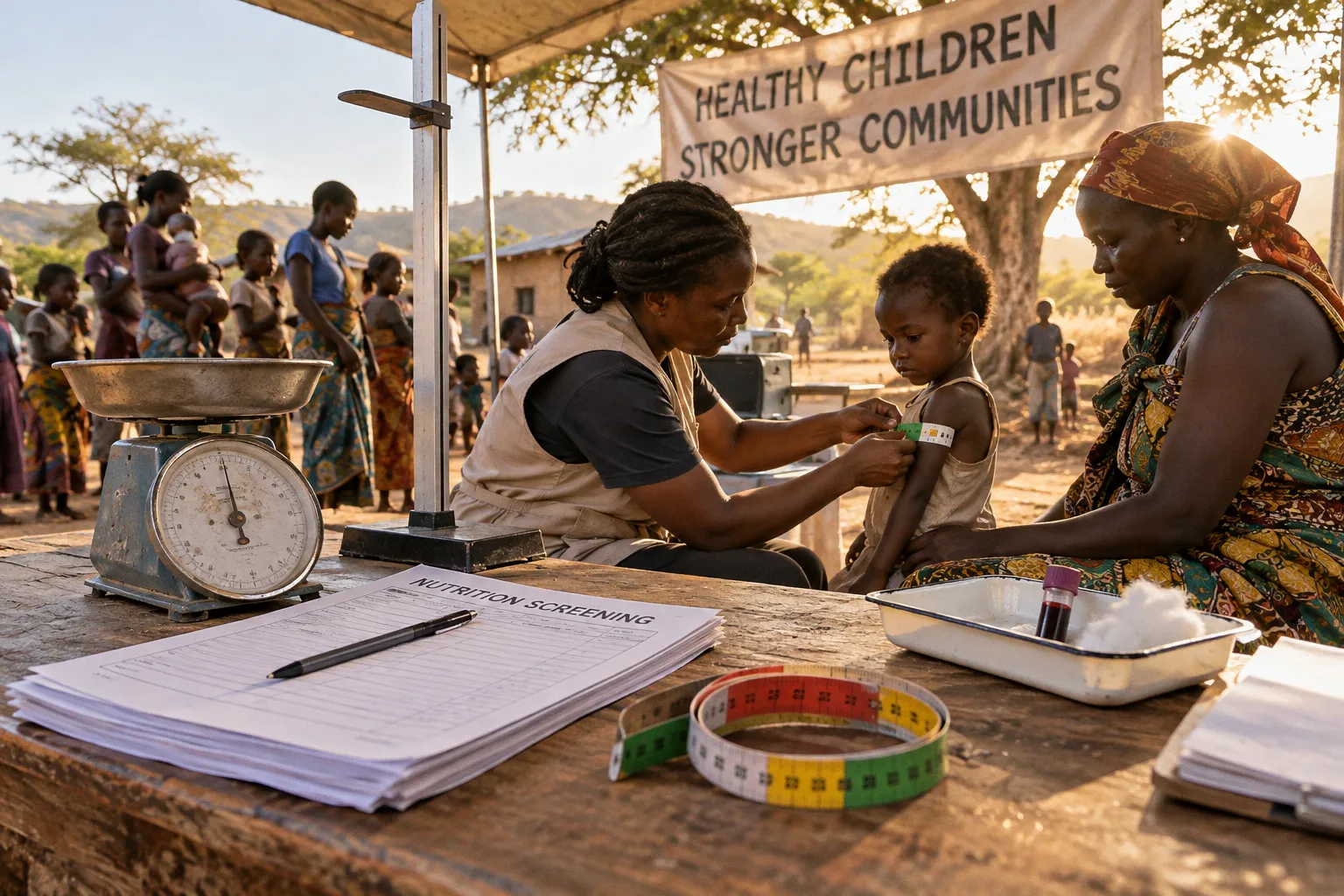
A weighing scale may be difficult to transport, a height board may be unavailable, and reliable electricity may not exist for digital devices. A portable Mid-Upper Arm Circumference tape, by contrast, can be carried by a community health worker and used with limited infrastructure.
That difference affects coverage. When screening depends on heavy equipment, assessment is concentrated at fixed facilities. When it uses a simple, color-coded MUAC tape, screening can move into households, outreach posts, schools, and emergency settlements. This does not make MUAC a complete clinical assessment. It makes it a practical first detection layer for identifying children who require further evaluation.
The role of MUAC in resource-limited settings
Mid-Upper Arm Circumference measures the circumference of the upper arm, usually at a standardized midpoint. The measurement provides an indirect view of muscle mass loss. In acute malnutrition screening, this has operational value because the tool does not require a balance scale, height board, battery, or stable floor surface.
The tape uses color zones:
- Red indicates severe concern and requires urgent referral under the applicable clinical protocol.
- Yellow indicates moderate concern and requires follow-up, assessment, or referral according to local program rules.
- Green indicates that the child is not classified in the same risk band by MUAC at that screening point, although it does not exclude all forms of malnutrition or illness.
The color system is designed for rapid decisions in settings where clinical personnel and equipment are limited. The tape is inexpensive, portable, and simple enough for community-level use after training. Its operational strength is not diagnostic complexity. It is the ability to identify risk consistently across dispersed locations.
MUAC also has direct prognostic value for child mortality because it reflects loss of muscle tissue. That makes it particularly relevant during food insecurity, displacement, outbreaks, and other emergencies in which a program must determine whether children require immediate assessment.
However, the measurement should not be treated as a substitute for comprehensive evaluation. A child may have illness, edema, dehydration, developmental problems, or an underlying metabolic condition that MUAC alone cannot characterize. The tape identifies a screening signal. It does not determine the full clinical cause.
Why conventional anthropometry becomes difficult in the field
Weight-for-height assessment remains relevant in nutrition programs. A weight-for-height value below –2 Z-scores is used in emergency assessments to define wasting. In practice, however, the measurement requires two separate data points and equipment that must be transported, calibrated, positioned, and maintained.
Field teams face predictable constraints:
1. Transport burden. Scales and height boards add weight and volume to outreach kits.
2. Surface requirements. A scale requires a stable, level surface. A height board requires adequate space and correct positioning.
3. Child cooperation. Movement can distort both weight and height measurements.
4. Training requirements. Errors in posture, reading, or recording can reduce data quality.
5. Maintenance. Equipment can be damaged by dust, humidity, repeated transport, or poor storage.
6. Low outreach frequency. If equipment is available only at a facility, households far from that facility may be screened less often.
MUAC removes several of these constraints. It does not remove the need for trained staff, standardized technique, or clinical referral. It changes the minimum infrastructure required to begin screening.
A portable tool does not solve malnutrition. It reduces the distance between deterioration and detection.
Building a reliable MUAC screening workflow
A field team should treat MUAC screening as a workflow rather than as a single measurement. The quality of the program depends on what happens before, during, and after the tape is applied.
1. Define the screening population
The team must establish which children are eligible under the program protocol. Age range, referral criteria, repeat-screening intervals, and exclusion rules should be set before outreach begins. These parameters cannot be improvised at household level because inconsistent eligibility produces inconsistent coverage data.
The protocol should answer four operational questions:
- Which children are screened?
- Which color zones trigger referral or follow-up?
- Who confirms the result?
- How quickly must the child reach a clinical service?
The exact thresholds and actions should follow the applicable national or program guideline. A color band is not a universal treatment order. It is a standardized signal within a broader care pathway.
2. Prepare the equipment
A basic screening kit usually requires:
- MUAC tapes suitable for the target population;
- recording forms or a mobile data collection application;
- pens, identification materials, and referral documentation;
- hand hygiene supplies;
- a protected container for the tapes and paper records;
- communication access for urgent referrals where available.
The tape should be clean, legible, and free from stretching or damage. If a tape has become distorted, faded, or difficult to read, it should be removed from service. A low-cost instrument can still create high-cost errors if the measurement zones are unclear.
Mobile and smartphone applications can support rapid synchronization of field data. Their value is greatest when they reduce delays between household screening and program review. Digital collection does not automatically improve accuracy. It improves the speed and visibility of information when the form design, user training, and network procedures are adequate.
3. Standardize the measurement technique
Training should demonstrate the same sequence every time. The child’s arm must be positioned consistently, the midpoint identified according to the protocol, and the tape placed without compressing the soft tissue. The worker should read the relevant zone only after the tape is correctly positioned.
A practical training session should include:
1. Demonstration by an experienced trainer.
2. Supervised practice on multiple children.
3. Comparison of readings between trainees.
4. Correction of positioning and recording errors.
5. Repeat assessment after a defined interval.
6. Documentation of who is authorized to conduct independent screening.
The purpose is not to turn community workers into clinical diagnosticians. The purpose is to reduce avoidable variation. If two workers classify the same child differently because they use different arm positions or tape tension, the program cannot reliably monitor changes over time.
4. Record the result at the point of contact
The record should link the measurement to the child, household, location, date, and responsible worker. A number without context has limited operational value. It cannot show whether a child was referred, whether the referral was completed, or whether the child was screened twice by different teams.
At minimum, the program should capture:
- Child identifier or household identifier;
- Age or age category, where required by the protocol;
- Sex, if included in the reporting standard;
- MUAC color classification;
- Presence of visible edema or other danger signs, if the worker is trained to assess them;
- Referral status;
- Follow-up date;
- Final facility disposition when available.
A paper form may be more reliable than an application in areas with weak connectivity. A digital system may be preferable where synchronization and supervision are already established. Resource allocation should follow field conditions, not technology preferences.
Implementing the Family-MUAC model
The Family-MUAC approach, also called Mother-MUAC, moves part of the screening responsibility from the health facility to caregivers. Mothers or other household members are trained to measure their own children with a MUAC tape and identify the color zone that requires action.
This model addresses a structural problem. Community health workers cannot visit every household frequently enough to detect every episode of deterioration. Caregivers are already present in the household. Training them creates a larger observation network without requiring a proportional increase in paid outreach staff.
The model works only when the instructions are simple and the referral pathway is credible. A caregiver who identifies a red-zone result needs to know where to go, when to go, and whether the receiving service will accept the referral. If the health facility is distant, closed, under-resourced, or unable to provide follow-up, the screening program will generate information without sufficient response capacity.
A practical household training sequence
Family-MUAC training should be short, demonstrative, and repeated. A suitable sequence includes:
1. Explain the purpose. The caregiver learns that the tape detects a possible nutrition problem early. It is not a complete diagnosis.
2. Show the correct position. The trainer demonstrates the arm position and measurement point.
3. Demonstrate tape placement. The tape should be placed according to the program protocol, with appropriate tension and no twisting.
4. Interpret the color zone. The caregiver learns what red, yellow, and green mean within the local referral system.
5. Practice on the child. The caregiver performs the measurement under supervision.
6. Repeat the demonstration. The caregiver shows the method again without prompting.
7. Provide the referral instruction. The household receives a clear action for each relevant result.
8. Schedule reinforcement. Community workers revisit the technique during routine outreach.
The final step is often underestimated. Skill retention declines when households do not use the tape regularly or when local messages change. Refresher instruction is part of the intervention, not an optional communication activity.
The referral pathway determines the value of screening
A screening result has three possible operational states:
| Screening result | Immediate program meaning | Required system response |
|---|---|---|
| Red zone | High-risk signal requiring urgent evaluation | Rapid referral to an appropriate health service and confirmation of arrival |
| Yellow zone | Moderate-risk signal requiring assessment or follow-up | Scheduled evaluation, monitoring, and escalation if the condition worsens |
| Green zone | No elevated MUAC risk identified at that visit | Continue routine preventive contact and repeat screening according to protocol |
The table describes program logic, not independent clinical management. Danger signs or other symptoms can require referral regardless of MUAC color. Similarly, a green result does not prove that the child is healthy.
A referral system should define transport options, facility hours, responsible staff, and escalation contacts. Without these elements, the program may report high screening numbers while producing low treatment access. That is a utilization failure, not merely a data problem.
Standardizing field data collection
Community nutrition programs require data that can support decisions at several levels. The individual child requires follow-up. The outreach supervisor requires a picture of workload and referral completion. The district or hospital network requires information about geographic coverage and changing malnutrition burden.
Data collection should therefore distinguish between three measures:
- Screening volume: how many children were assessed.
- Screening coverage: how many eligible children were reached within the target area.
- Referral completion: how many children with concerning results reached an appropriate service.
High volume does not guarantee high coverage. A team may screen many children in an accessible village while missing remote households. High referral issuance does not guarantee treatment access. A child may receive a referral slip and never reach the facility because transport costs or distance remain unresolved.
Emergency programs sometimes use community mass MUAC screening to assess acute malnutrition across extensive regions, particularly where sentinel surveillance is absent. These exercises can generate rapid geographic information. For rapid screening data to be valid, field teams need a defined sampling and reporting approach. A minimum sample of at least 200 children per site is identified in the available guidance for rapid MUAC screening data validity. That figure is a methodological condition for particular rapid assessments, not a universal requirement for every household screening visit.
Paper, mobile, or hybrid collection
The selection of a data system should be based on infrastructure and error risk.
Paper collection is appropriate when:
- Mobile devices are scarce;
- Network coverage is unstable;
- Battery charging is difficult;
- The program has strong supervisory review and secure storage.
Mobile collection is useful when:
- Devices are available to workers;
- Forms can function offline;
- Synchronization is reliable;
- Supervisors need near real-time visibility;
- The program can protect personal health information.
Hybrid collection may be the most resilient option. Workers can record measurements offline and synchronize later, while maintaining a paper backup for outages or urgent referrals.
The central objective is not digitization. It is continuity between measurement, referral, follow-up, and program analysis. A sophisticated application with incomplete records is less useful than a basic system that captures the full pathway.
The relevant performance metric is not the number of tapes distributed. It is the number of children identified, reached, assessed, and followed through the appropriate care pathway.
Scaling community-led nutrition surveillance
Scaling requires more than purchasing additional tapes. It requires a defined operating model.
A rural hospital, charitable health service, or district nutrition program should map the following components before expansion:
- Target communities and estimated eligible population;
- Number and location of trained community workers;
- Household distribution strategy for Family-MUAC;
- Facility capacity for assessment and treatment;
- Transport and communication constraints;
- Data submission frequency;
- Supervisor-to-worker ratio;
- Stock requirements for tapes, forms, and referral materials;
- Mechanism for identifying missed settlements.
Coverage should be reviewed geographically. A program that serves communities near a hospital may appear successful while leaving distant settlements outside the system. Resource allocation should account for travel time, terrain, seasonal access, and population dispersion.
Supervision is another limiting factor. Community workers need periodic observation, not only initial training. Supervisors can compare measurements, review referral records, identify repeated documentation errors, and determine whether caregivers understand the color zones. In a large program, quality assurance should use a sample of repeat measurements rather than relying exclusively on self-reported performance.
Mobile applications can support this process by transferring field data rapidly from rural areas. When information is synchronized near real time, supervisors may identify clusters of red-zone results or locations with unusually low screening activity. These signals can inform outreach scheduling and supply distribution. They do not replace clinical interpretation.
Linking screening to preventive care
Malnutrition screening should not operate as a separate event disconnected from broader rural health services. The same outreach contact may support:
- Immunization review;
- Maternal and child health checks;
- Hygiene and sanitation education;
- Chronic disease risk identification among adults;
- Referral for infectious disease evaluation;
- Monitoring of household food insecurity;
- Follow-up after hospital discharge.
The integration must remain operationally realistic. Adding services to every visit can increase worker burden and reduce the quality of each task. Programs should define which activities are compatible with the available time, training, and referral capacity.
For vulnerable populations, prevention is partly a question of timing. Early identification allows a health system to intervene before deterioration requires more intensive treatment. But early identification creates value only when the system has enough infrastructure to respond.
Limitations and clinical integration of portable tools
MUAC has clear advantages in rural screening, but it also has boundaries.
First, MUAC is not a complete nutritional profile. It does not describe all forms of malnutrition, dietary deficiency, chronic growth impairment, or underlying disease. A child can have a clinically significant problem that is not captured by a single arm measurement.
Second, the measurement is sensitive to technique. Incorrect positioning, excessive tape tension, poor lighting, or inaccurate recording can change classification. Training and supervision are therefore part of the measurement system.
Third, a single color band cannot determine inpatient management. Children with severe readings or danger signs require secondary evaluation by qualified clinical staff. The facility must assess the child in context and determine the appropriate treatment pathway.
Fourth, the tool is primarily used for identifying wasting and acute malnutrition risk in children. It should not be generalized automatically to adult populations or to all clinical settings. Detailed universal diagnostic concordance between MUAC-based approaches and standard weight-for-height assessment is not established across every remote population and program design.
Finally, screening can expose a deficit in health-system capacity. If outreach teams identify more children than clinics can assess, the apparent success of detection may be followed by referral congestion. Programs should monitor service utilization rates alongside screening totals. Otherwise, the reporting system will reward detection without measuring whether care was delivered.
A practical operating standard
A credible rural malnutrition screening program has five linked properties:
1. Accessible measurement. The tool can be used where the child lives, not only where the hospital is located.
2. Consistent technique. Workers and caregivers follow the same measurement procedure.
3. Clear classification. Color zones lead to predefined actions.
4. Functional referral. Children with concerning results can reach an appropriate clinical service.
5. Closed-loop data. The program records screening, referral, attendance, and follow-up.
Portable anthropometric tools reduce the infrastructure deficit at the first stage of care. Family-MUAC extends observation into households. Mobile data systems can shorten reporting delays. None of these components is sufficient alone.
The projected outcome depends on system integration. Where screening is linked to trained workers, reliable referral pathways, and adequate facility capacity, MUAC can expand the reach of early detection at relatively low logistical cost. Where those links are absent, the program may produce accurate measurements without changing clinical outcomes.
For rural health services, the policy implication is direct: resource allocation should prioritize the complete detection-to-treatment pathway rather than the distribution of screening devices alone. The tape is the entry point. The health system determines what happens next.