It also does not include the full range of capital requirements associated with vehicle acquisition, clinical buildout, specialty equipment, and launch preparation.
The financial structure is clear: mobile health clinic operating costs are driven primarily by labor and recurring operations, not by the vehicle alone. Initial platform and buildout expenses can range from $150,000 to more than $600,000, but personnel may consume up to 90% of the direct operating budget once the unit is active. In rural settings, maintenance and vehicle operations can account for approximately 23% of annual costs.
This changes the way mobile outreach should be evaluated. The relevant question is not whether a vehicle can be purchased. It is whether the surrounding workforce, route infrastructure, clinical model, and referral capacity can be sustained over several budget cycles.
The financial anatomy of mobile outreach: beyond the initial buildout
A mobile clinic has two distinct financial profiles.
The first is the capital profile. It covers the platform required to deliver care:
- Vehicle acquisition.
- Interior construction and clinical fittings.
- Diagnostic and treatment equipment.
- Power, water, refrigeration, and communications systems.
- Accessibility modifications.
- Information technology and telemedicine infrastructure.
The second is the recurring operating profile. It covers the activities required to keep the service functional:
- Clinical and nonclinical personnel.
- Fuel and transportation.
- Vehicle maintenance.
- Medical supplies.
- Insurance and licensing.
- Scheduling and community coordination.
- Data systems and patient follow-up.
- Waste management and infection-control materials.
These profiles are frequently combined in public descriptions of program cost. That produces distorted comparisons. A $400,000 vehicle investment is visible and easy to approve as a one-time allocation. A staffing deficit that emerges in the second year is less visible, but it is more consequential for service continuity.
Available cost data places initial vehicle acquisition and buildout between $150,000 and more than $600,000, depending on the size of the vehicle and the level of specialty equipment. A basic screening unit and a dental or diagnostic vehicle do not have the same infrastructure requirements. Nor do they generate the same utilization rates or require the same clinical workforce.
The annual cost range is wider still. General estimates place recurring expenses at approximately $300,000 to $800,000 or more, while a cost analysis of mobile clinics in the Southern United States found mean annual operating costs ranging from $300,000 to $2.5 million across different service models. Dental and preventive care programs were among the more expensive models in that analysis.
The difference is not an inconsistency in the data. It reflects the fact that “mobile clinic” is an operating category rather than a single service design. A screening van, a primary care unit, a dental clinic, and a specialty diagnostic vehicle have different cost centers, staffing requirements, and throughput constraints.
| Cost dimension | Lower-complexity outreach model | Higher-complexity mobile clinic |
|---|---|---|
| Vehicle platform | Smaller vehicle with limited clinical interior | Larger platform with multiple treatment areas and specialized equipment |
| Clinical staffing | Small team focused on screening, education, or basic services | Multidisciplinary team with licensed clinicians and support personnel |
| Equipment profile | Basic examination and screening tools | Dental, diagnostic, laboratory, imaging, or treatment equipment |
| Primary utilization constraint | Route density and community attendance | Appointment capacity, equipment availability, and specialist staffing |
| Recurring cost exposure | Personnel, fuel, supplies, scheduling | Personnel, maintenance, supplies, compliance, equipment service, and coordination |
| Financial risk | Low volume at scheduled sites | High fixed cost with underused specialty capacity |
The central planning error is to treat the vehicle as the program. The vehicle is only the delivery platform. The service is the combination of staff, routes, clinical protocols, supply chains, referral agreements, and patient follow-up systems operating around it.
A mobile clinic is not a cheaper hospital on wheels. It is a distributed access system with its own fixed costs and utilization limits.
Personnel-heavy models: why staffing dominates the annual budget
Personnel is the largest recurring expense in most mobile outreach programs. In one documented example, The Family Van mobile clinic in Boston allocated 90% of its operating budget to personnel. That proportion is not an outlier to be dismissed as an accounting anomaly. It reflects the labor intensity of delivering clinical services in dispersed locations.
A mobile unit typically requires more than the clinician visible during a patient encounter. The operating workforce may include:
- Physicians, nurse practitioners, physician assistants, nurses, or other licensed providers.
- Medical assistants and screening personnel.
- Drivers and vehicle operators.
- Outreach coordinators who organize sites and attendance.
- Schedulers and data-entry staff.
- Interpreters or culturally specific community health workers.
- Supervisors responsible for clinical quality and compliance.
- Staff responsible for referral management and patient follow-up.
The staffing model depends on the service definition. A free health checkup camp may require a different team from a rural telemedicine program. The latter still requires personnel to collect measurements, prepare patients, manage connectivity, document encounters, and coordinate referrals. Telemedicine can reduce some travel requirements for specialists, but it does not eliminate the local labor needed to make remote care usable.
Personnel costs also have a direct relationship with geographic coverage. A fixed clinic can serve a defined area from one location. A mobile unit must transport staff, equipment, and supplies across a route. As the service area expands, travel time increases and the number of clinical encounters per staff hour can decline. That creates a utilization problem: the program may reach more communities while producing fewer billable or completed encounters per operating day.
The consequence is a tradeoff between coverage and productivity. A route that visits one high-volume site repeatedly may produce a stronger cost-per-patient result. A route that reaches several isolated communities may deliver greater geographic equity but operate at a higher cost per encounter. Neither result is automatically inefficient. They represent different allocation objectives.
A rural medical screening program may be designed to maximize early detection in populations that otherwise have limited access to primary care. Its performance should not be judged solely by the number of encounters per day. At the same time, the program cannot ignore throughput. A model that consistently reaches too few patients may indicate weak site coordination, inadequate community outreach, excessive travel time, or a mismatch between available services and local demand.
The most useful financial model therefore separates staffing into three categories:
1. Direct clinical labor. Time spent examining, treating, screening, educating, or counseling patients.
2. Operational labor. Driving, setup, sterilization, inventory control, scheduling, and documentation.
3. Coordination labor. Site development, community health worker activity, referral management, and program administration.
Combining these categories into a single labor line hides the operational mechanism. A unit may have a reasonable number of clinical encounters but still require excessive coordination time because referral networks are incomplete or patient records do not move reliably between the mobile service and fixed facilities.
This is particularly relevant to tribal healthcare outreach and isolated rural programs. The cost of access is not limited to transportation. Language services, local trust-building, seasonal travel conditions, and coordination with existing primary healthcare workers can determine whether a scheduled site generates meaningful utilization.
Operational efficiency and the cost-per-patient metric
Cost per patient visit is one of the most useful measures for comparing mobile service models, but it is also one of the easiest to misuse.
Across mobile clinic service types in the Southern United States, reported cost per patient visit ranged from $65 to $529. The spread is substantial. It shows that a single average cannot describe the financial performance of mobile outreach.
A low cost per visit may result from high patient volume, a limited service package, low travel distance, or strong integration with an existing health center. A high cost per visit may reflect specialty services, low-density routes, complex equipment, or the clinical requirements of populations with limited access. The number alone does not establish whether the model is effective.
A useful operational calculation begins with the full recurring expense:
Annual operating cost ÷ completed patient visits = cost per patient visit
But the denominator must be defined carefully. Scheduled appointments, patient registrations, screenings, consultations, and completed treatment encounters are not interchangeable. A program that reports all scheduled appointments as visits may overstate utilization. A program that counts only completed treatment episodes may understate the reach of preventive services.
The calculation should also distinguish between:
- First-time visits and follow-up visits.
- Screening encounters and treatment encounters.
- Clinical visits and health education contacts.
- Referred patients and patients receiving care on the unit.
- Unique patients and total encounters.
This matters because mobile outreach often performs functions that fixed facilities do not perform in the same way. A public immunization drive may generate high throughput but limited revenue. A chronic disease screening event may identify patients who require extensive follow-up elsewhere. A community health worker may spend significant time preparing a patient for referral without producing a conventional clinical encounter.
The economic value of that activity can be real, but it requires a broader measurement framework.
Utilization is a route-design problem
The operating schedule is a primary determinant of unit economics. A vehicle that spends a large portion of the day traveling has a different cost structure from one stationed at a central community location with sustained demand. The same staffing team can produce very different cost-per-patient outcomes depending on route density and appointment reliability.
Common sources of low utilization include:
- Sites selected without reliable population or demand data.
- Visit schedules that do not match local work patterns.
- Poor coordination with schools, employers, shelters, or community organizations.
- Insufficient notice before a mobile clinic arrives.
- Services that do not correspond to the most common local access barriers.
- Referral pathways that discourage repeat attendance.
- Equipment downtime or staffing gaps.
This is where community outreach infrastructure becomes a financial variable. Outreach is not an accessory to clinical operations. It determines whether the unit arrives to a prepared patient population or operates below capacity.
A mobile medical unit serving remote communities may also face a more basic constraint: the number of available operating days. Weather, road conditions, vehicle repairs, staff leave, and supply shortages can all reduce annual service capacity. When fixed costs remain stable while completed visits fall, the cost per visit rises rapidly.
The cost of underutilized capacity
Specialized mobile units carry a higher risk of underutilization because their equipment and staffing are more expensive. A dental clinic, for example, cannot be evaluated using the same throughput assumptions as a preventive screening van. Its clinical service may require longer appointment times, sterilization procedures, specialized supplies, and more complex maintenance.
That does not make specialty outreach financially unsound. It means the program must be designed around an adequate referral and scheduling base. A vehicle with advanced equipment but insufficient appointments represents an allocation problem. Capital has been committed, but the infrastructure needed to convert that capital into service volume is incomplete.
The same principle applies to rural telemedicine. Remote specialist access can reduce the need for patients to travel long distances, but the system still depends on stable connectivity, functioning devices, trained local staff, and a receiving provider with available appointment capacity. A technology purchase without workflow integration creates a new underutilized asset rather than resolving the access deficit.
The economic impact of mobile units on emergency department spending
The strongest economic argument for mobile clinics is not always the direct cost of a mobile visit. It is the potential reduction in higher-cost emergency department use.
A Southern California mobile clinic program was reported to generate approximately $2.5 million in avoided emergency department costs annually, with an estimated return on investment of 23:1. This result is significant, but it should not be treated as a universal benchmark. Avoided-cost estimates depend on the population served, the services provided, the baseline rate of emergency department use, and the method used to attribute avoided spending to the mobile program.
The causal pathway is straightforward:
1. A patient faces a barrier to fixed-site care.
2. The mobile unit provides screening, primary care, preventive services, or early intervention closer to the patient.
3. A condition is addressed before it requires emergency treatment, or the patient is directed to an appropriate lower-cost service.
4. Emergency department utilization and associated costs may decline.
The strength of that pathway depends on clinical scope. A mobile unit that only distributes information has a different effect from one that can diagnose, initiate treatment, manage chronic disease, and complete referrals. The program’s role in the local care network determines whether it changes utilization or simply adds another point of contact.
Referral capacity is therefore central. If the mobile team identifies hypertension, diabetes, infection, or another condition but cannot secure follow-up care, the intervention may not produce durable cost avoidance. The patient has been screened, but the underlying access deficit remains.
This is why mobile outreach should be assessed as part of a wider healthcare system rather than as an isolated vehicle project. The unit may operate in the field, but its results depend on fixed hospitals, primary care practices, laboratories, pharmacies, specialists, public health agencies, and transportation services.
The emergency department savings model also raises a measurement issue. Avoided utilization is not directly observed in the same way as a completed visit. It is estimated by comparing observed patterns with an expected baseline. That requires a defensible method and a defined comparison population. Without those controls, a reported return on investment can combine genuine savings with assumptions that are difficult to verify.
The 23:1 result is therefore best understood as evidence of potential economic leverage, not as a guaranteed program return. Some mobile units will serve populations with high preventable emergency use and strong referral access. Others will operate in areas where the main deficit is not primary care but transportation, specialist capacity, medication affordability, or hospital discharge coordination.
The financial return of mobile care is determined downstream. A screening encounter has limited system value if the patient has nowhere to go next.
Rural mobile clinic expense breakdown: maintenance, transport, and field conditions
Vehicle costs are often discussed as if they end at purchase. They do not. A mobile clinic is a working asset exposed to road conditions, weather, vibration, temperature changes, loading cycles, and repeated movement of clinical equipment.
In rural settings, vehicle maintenance and operating expenses account for approximately 23% of total annual costs according to one study of rural mobile health clinics. That category can include fuel, repairs, scheduled servicing, insurance, tires, inspections, and other vehicle-related requirements. The exact share varies by route length, climate, vehicle age, and service model.
Rural distance increases cost in several ways:
- More fuel is required per operating day.
- Staff spend more time traveling between sites.
- Repairs may require transport to distant service centers.
- Replacement parts may take longer to obtain.
- Emergency breakdowns can cancel an entire service day.
- Poor road conditions can increase wear on both the vehicle and equipment.
- Supplies must be carried in larger quantities to reduce the risk of stockouts.
Maintenance planning is therefore part of clinical reliability. A vehicle that cannot reach its scheduled community is not merely a transportation problem. It is a missed clinical session, a disrupted medication or screening schedule, and a potential loss of patient confidence.
The program should distinguish preventive maintenance from reactive repair. Preventive maintenance creates a predictable budget line. Reactive repair creates service interruptions and can impose secondary costs, including canceled appointments, staff idle time, replacement transportation, and rescheduling work.
Equipment maintenance creates another layer of exposure. Refrigeration for vaccines, diagnostic devices, dental equipment, laboratory tools, and telecommunications systems may each require separate service arrangements. A failure in one system can restrict the entire unit even if the vehicle remains operational.
For public immunization drives, cold-chain continuity is a direct operational requirement. For diagnostic programs, calibration and quality assurance determine whether results can be used. For telemedicine, connectivity and power systems are as important as the clinical workstation. The infrastructure profile must match the service promise.
Fixed infrastructure still matters
Mobile delivery reduces geographic barriers, but it does not eliminate the need for fixed support. Programs require locations for:
- Vehicle storage and secure parking.
- Cleaning and restocking.
- Equipment repair and calibration.
- Medical waste handling.
- Staff preparation and documentation.
- Data synchronization and record management.
- Coordination with hospitals and referral providers.
A rural mobile clinic with no reliable base may experience higher operating costs even if the vehicle itself is well designed. Staff may spend additional time collecting supplies, traveling to storage sites, or resolving documentation problems. These activities do not appear in the patient-facing service but affect the annual budget.
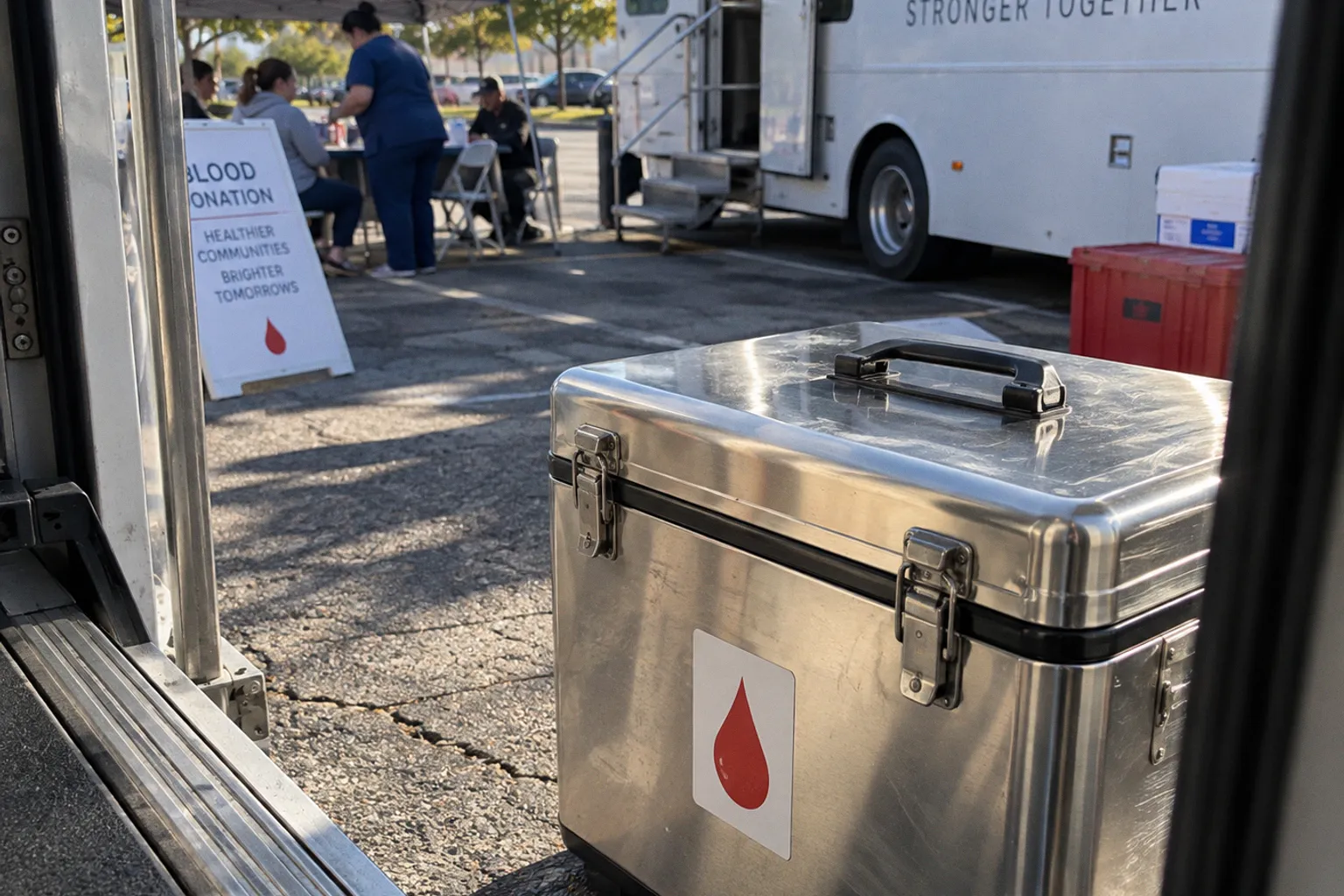
The same issue applies to blood donation and community health initiatives. A field event requires collection equipment, trained personnel, transport, temperature-controlled storage, scheduling, donor communication, and a receiving infrastructure capable of processing the collected blood. The event is mobile; the system supporting it is not.
Funding mobile health clinics: what sustainability requires
The growth of community health center mobile clinics by 40% between 2019 and 2022 indicates expanding institutional interest in mobile delivery. Growth, however, does not establish financial sustainability. More units can enter operation while many remain dependent on short-term grants, restricted donations, or temporary public funding.
A sustainable funding model usually combines several sources rather than relying on one annual allocation. Potential sources include:
- Public health grants.
- Hospital community benefit funding.
- Philanthropic support.
- Health center operating budgets.
- Government contracts.
- Insurance reimbursement where applicable.
- Local government or regional authority support.
- Corporate or foundation funding.
- In-kind contributions such as fuel, sites, equipment, or staff time.
The appropriate mix depends on the clinical service and the patient population. Programs focused on prevention, immunization, screening, or outreach may generate limited direct revenue even when they produce system-wide benefits. Programs that provide reimbursable primary care may recover part of their operating costs, but reimbursement rates and eligibility vary by setting and specialty.
No standardized international benchmark is available for mobile outreach operating costs in developing or lower-resource settings comparable to the structured U.S. cost data. That limits direct comparisons. Vehicle prices, staffing markets, fuel costs, reimbursement systems, and public health infrastructure differ substantially across countries.
The absence of a common benchmark does not make budgeting impossible. It means that programs should build their own cost base from operational units:
- Cost per deployment day.
- Cost per route.
- Cost per completed encounter.
- Cost per screening.
- Cost per referral completed.
- Cost per vaccination or preventive intervention.
- Cost per community served.
- Cost per emergency department visit plausibly avoided.
Each measure answers a different question. A funder may prioritize geographic coverage. A hospital may prioritize avoided emergency use. A public health agency may prioritize immunization or early detection. A community organization may prioritize continuity and local participation.
The budget should make these objectives explicit. Otherwise, a program can appear inefficient simply because it is being measured against the wrong outcome.
The three-to-five-year horizon
Over a short period, vehicle acquisition may dominate the financial picture. Over a three- to five-year horizon, recurring personnel and operational costs generally become more significant than the initial buildout.
This is the key distinction between launching a mobile clinic and sustaining one. A capital grant can purchase the platform. It cannot automatically fund the workforce required to operate it, the maintenance required to keep it moving, or the referral network required to convert encounters into health outcomes.
A realistic funding plan should therefore separate:
1. Launch capital. Vehicle, construction, equipment, technology, and initial setup.
2. First-year operating support. Staffing, fuel, supplies, insurance, training, and outreach.
3. Replacement and renewal reserves. Major repairs, equipment replacement, technology upgrades, and eventual vehicle replacement.
4. Program evaluation. Data collection, reporting, utilization analysis, and outcome measurement.
5. Contingency funding. Unexpected repairs, supply disruptions, staffing vacancies, or route changes.
Without reserves, the program is exposed to predictable failures. A vehicle does not need to be old to require substantial repair. Equipment reaches service limits. Staff turnover interrupts operations. Communities change. Demand patterns shift. A mobile unit should be managed as infrastructure, not as a temporary campaign.
What the new cost data indicates
The current data supports several conclusions.
First, mobile clinic operating costs are highly variable. The approximate $550,000 average annual cost for registered mobile clinics is useful as a planning reference, but it should not replace a service-specific budget. Annual expenses can range from roughly $300,000 to $2.5 million depending on clinical scope and delivery model.
Second, personnel is the primary recurring expense. The example of a program allocating 90% of its budget to staff shows why underfunding workforce capacity can neutralize a substantial vehicle investment.
Third, mobile care can achieve a lower cost per patient visit than fixed-site alternatives in some service models. Reported figures of $65 to $529 per visit demonstrate the possible range, not a guaranteed result. The outcome depends on route density, service complexity, patient volume, and coordination.
Fourth, rural delivery carries a distinct maintenance and transportation burden. Approximately 23% of annual costs attributed to vehicle operations in one rural analysis is large enough to affect route design and reserve planning.
Fifth, the strongest system-level return may arise through avoided emergency department spending. The reported 23:1 return on investment in a Southern California program indicates the potential magnitude, but not a universal ratio applicable to every community or service type.
Finally, mobile delivery is expanding. The 40% growth in community health center mobile clinics from 2019 to 2022 suggests that health systems increasingly view mobility as part of access infrastructure. Expansion will remain rational only if operating budgets, staffing pipelines, maintenance systems, and referral capacity grow at the same rate.
The projected outcome is therefore conditional. Mobile health units can reduce access deficits and shift some care away from emergency departments, but only when they are funded as complete operating systems. The next phase of community outreach will likely be determined less by the number of vehicles purchased than by whether institutions can maintain the labor, logistics, and data infrastructure required to use them consistently.