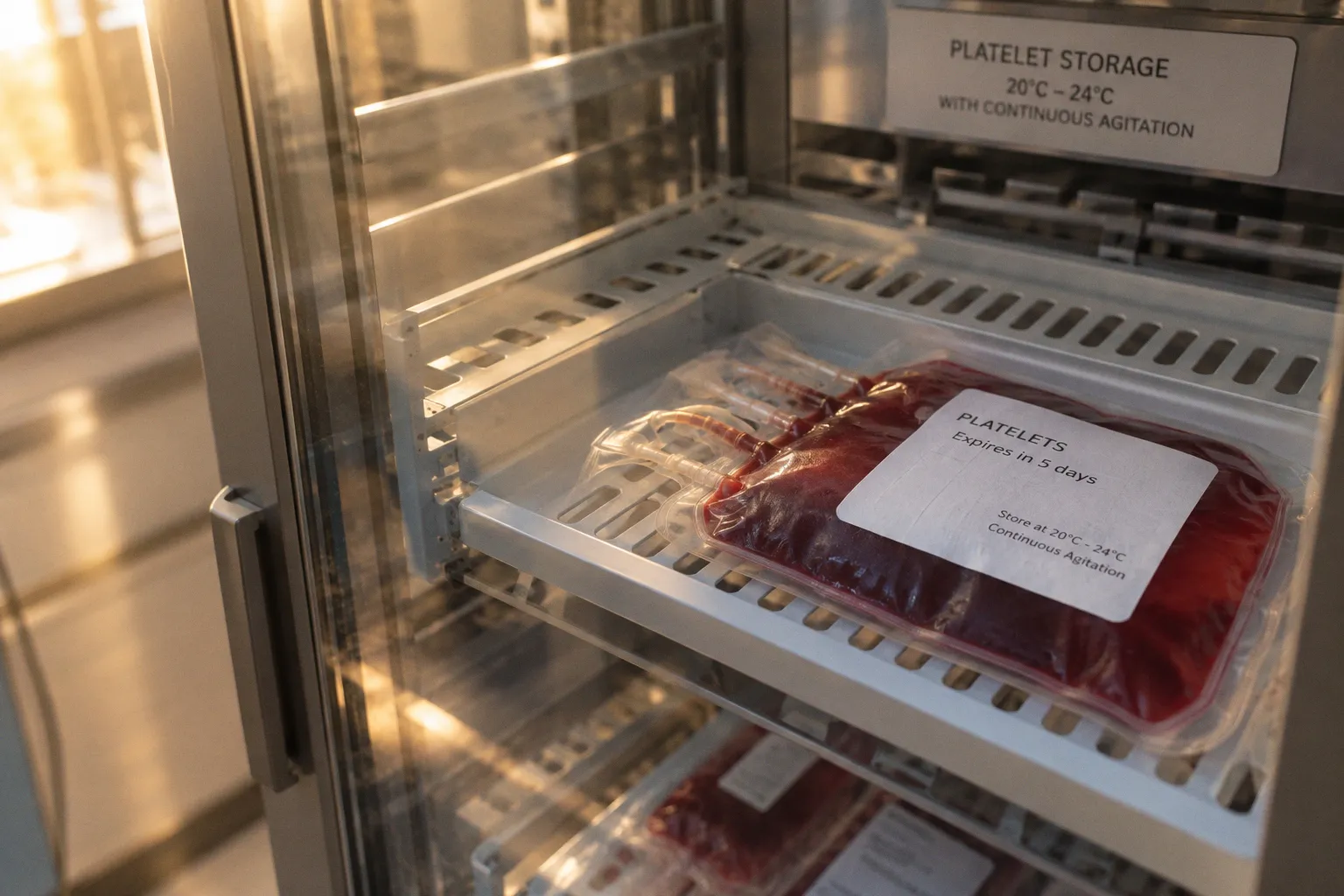
That environment preserves their function, but also creates the conditions in which bacteria can multiply.
The result is an uncomfortable contradiction in transfusion medicine: the component most urgently needed for bleeding patients cannot simply be placed in a refrigerator and held until demand appears. Conventional room-temperature platelet shelf life is limited to five days, with some systems reaching seven days only after validated bacterial risk-control measures. The supply chain therefore operates under a narrow expiry window in which a single quiet day can produce waste and a single trauma surge can produce a shortage.
The debate over platelet donation shelf life and storage requirements is not really about a date printed on a label. It is about which risks a hospital is willing to manage: bacterial contamination, reduced post-transfusion survival, emergency scarcity, or the financial and ethical cost of discarding a donated product.
The biological constraints of room-temperature storage
Platelets are small blood cells responsible for the first stages of clot formation. They adhere to damaged blood vessels, activate, and aggregate to help stop bleeding. That function depends on preserving a delicate cellular state. Platelets are not passive particles waiting on a shelf; they remain metabolically active after collection.
This is why storage conditions are so specific. Standard platelet concentrates are kept at approximately 20°C to 24°C and placed on continuous horizontal agitation. The movement helps maintain gas exchange and supports platelet function. A stationary container is not equivalent to a gently agitated one, even if both are held at the same temperature.
The arrangement creates a logistical trap:
- Room-temperature storage helps preserve platelet performance.
- Room temperature also permits bacterial growth.
- Continuous agitation requires dedicated equipment and monitored storage space.
- The product must be issued, transfused, tested, or discarded within a short period.
- Demand is difficult to predict because platelet use is tied to trauma, surgery, oncology treatment, transplantation, and sudden bleeding.
Red blood cells can be stored for far longer under refrigerated conditions. Platelets cannot be treated as a smaller version of the same inventory problem. Confusing the two is more than a technical mistake; it leads to the wrong assumptions about how blood banks should forecast demand.
The question hospitals face is not simply how long donated platelets can be stored. It is how long they can remain clinically useful while the risks associated with their storage environment stay within an acceptable threshold.
Platelets are not difficult to manage because hospitals lack refrigerators. They are difficult to manage because the storage conditions that preserve their function also protect their contamination risk.
Why the five-day limit matters
Under conventional room-temperature storage without an extended bacterial risk-control strategy, platelet concentrates generally have a maximum shelf life of five days. That window includes the time needed for collection, processing, testing, labeling, transport, and distribution—not merely the period after arrival at a hospital.
A hospital receiving a near-expiry unit does not receive five days of flexibility. It receives whatever remains after every preceding step has taken its share. The difference between a newly processed product and one approaching expiry can determine whether the unit is useful for planned care, reserved for a compatible patient, or likely to become waste.
This is where blood bank platelet inventory management stops looking like ordinary stock control. The product is not interchangeable in the same way as many commercial commodities. Platelet units may differ by blood group, compatibility requirements, patient-specific indications, and clinical urgency. A hospital may have a sufficient total number of platelet units and still face a shortage of the type required for a particular patient.
The numerical count is therefore an incomplete measure of security. A better inventory view includes:
- Remaining shelf life rather than total units alone.
- Blood group and compatibility constraints.
- Expected elective procedures and oncology treatment schedules.
- Trauma and emergency demand.
- Local collection capacity and transport time.
- Whether bacterial testing or pathogen reduction supports a seven-day expiry.
- The proportion of inventory already close to discard.
A unit that expires tomorrow is not equivalent to a unit that can support care for several more days. Any inventory dashboard that treats them as identical is technically tidy and operationally misleading.
Bacterial proliferation is the primary safety bottleneck
The central problem with room-temperature platelets is bacterial contamination. Platelets are collected from human donors, processed through multiple handling steps, and stored in an environment that can support bacterial proliferation. Even a low-level contamination event can become clinically significant over the storage period.
For transfusion services, this creates an unusual safety equation. The product must remain warm enough to preserve platelet function, but that warmth also gives bacteria an opportunity to multiply. The longer the product remains in storage, the more time there is for a small contamination event to become a dangerous bacterial load.
This is why platelet storage duration in blood banks cannot be set by convenience or by comparison with red-cell expiry dates. The short shelf life is a form of risk containment. It does not eliminate contamination. It limits the time available for contamination to develop before transfusion.
The risk is particularly serious because bacterial contamination of platelets can lead to post-transfusion sepsis. Symptoms may develop rapidly, and the clinical consequences can be severe. The blood bank therefore works with several layers of mitigation rather than a single definitive safeguard.
Those layers may include:
1. Donor screening and collection controls. The first line of protection is reducing the chance that contaminated material enters the system. This is necessary, but no screening process can convert biological collection into a sterile manufacturing process.
2. Process control. Collection, preparation, storage, and transport all create potential points of failure. Compliance is not a one-time certification; it is a chain of handling decisions.
3. Bacterial detection. Testing strategies can identify evidence of bacterial growth before transfusion. Their value depends on timing, sample volume, detection limits, and how much time remains before the product is issued.
4. Pathogen reduction. Certain technologies are designed to reduce the risk from pathogens in the component. They can support longer storage under validated regulatory conditions, but they are not an excuse to treat all risks as solved.
5. Expiry discipline. A product that reaches its approved limit must not be kept merely because demand is high or because discarding it appears financially uncomfortable.
That final point is often obscured by the language of efficiency. Waste is costly, but expired blood products are not an inventory problem that can be fixed by informal flexibility. The expiry rule exists because the risk profile changes over time. Extending storage requires a validated strategy, not managerial optimism.
Why bacterial testing is not a magic reset button
Testing is often described as though it creates a simple distinction between safe and unsafe units. Real laboratory controls are more conditional. A test samples a product at a particular time and under particular conditions. It may reduce uncertainty, but it does not erase the history of the unit or guarantee that every possible contaminant has been detected at every stage.
That is why the timing of bacterial risk control matters. A test performed early in storage may not provide the same assurance as a later sampling strategy. Large Volume Delayed Sampling, or LVDS, is one approach used to support an extended seven-day shelf life under applicable regulatory conditions. Pathogen reduction is another strategy. Each method changes the control system; neither makes storage independent of oversight.
Hospitals also need to manage the administrative consequences. A seven-day label requires more than changing a date in the blood bank information system. It requires validated procedures, documented compliance, staff training, equipment controls, quality monitoring, and a clear process for units that do not meet the relevant criteria.
The uncomfortable fact is that every additional day is purchased with more complexity. The supply chain gains flexibility, but the compliance burden grows with it.
Extending platelet shelf life from five to seven days
The move from a five-day to a seven-day shelf life can appear modest. In a blood bank, two days are not modest. They can determine whether a unit reaches a patient or becomes an expired product in a storage rack.
Research and operational experience indicate that extending shelf life from five to seven days can reduce platelet wastage by approximately 30 percent in blood service supply chains. The exact outcome depends on collection patterns, demand, transport, local protocols, and the proportion of units affected. Still, the direction is clear: a longer validated window gives the inventory system more room to absorb fluctuations.
That matters because platelet demand is uneven. Elective procedures may be scheduled, but emergency hemorrhage is not. A hospital can experience low utilization for several days and then require a large number of units in a short period. With a five-day shelf life, the buffer is extremely thin. Units collected for anticipated demand may expire before the event occurs, while a later emergency forces the hospital to seek additional supply elsewhere.
A seven-day system can reduce that mismatch, but it does not remove the underlying bottleneck. The product still has a short life. It still requires room-temperature storage and agitation. It still requires contamination controls. It simply gives the blood bank a slightly wider operating margin.
The difference between extension and exemption
A longer approved shelf life is sometimes misunderstood as permission to relax storage discipline. It is the opposite. The extension is conditional.
A platelet unit may qualify for seven-day storage only when the relevant bacterial risk-control strategy has been applied and the applicable requirements have been met. A unit that fails the process does not become eligible because the hospital is short on stock. Nor does a unit become acceptable merely because it looks normal. Platelets do not carry visible warning labels when their risk has changed.
This is a familiar pattern in medical logistics: efficiency depends on strict standardization, yet the public conversation often presents efficiency as flexibility. In practice, the system becomes more resilient by adding controls, not by quietly weakening them.
Hospitals adopting longer storage protocols must reconcile several systems at once:
| Operational area | Five-day conventional model | Seven-day extended model |
|---|---|---|
| Storage environment | Room temperature, typically 20°C to 24°C, with continuous agitation | Same basic storage environment, with additional validated bacterial risk control |
| Main safety concern | Bacterial proliferation during short storage window | Bacterial proliferation over a longer window |
| Inventory flexibility | Limited; expiry arrives quickly | Greater ability to absorb demand variation |
| Waste exposure | Higher risk when demand falls unexpectedly | Potentially lower wastage; approximately 30% reduction has been reported in some supply-chain estimates |
| Compliance burden | Standard collection, storage, testing, and expiry controls | Additional documentation, validation, testing or pathogen-reduction requirements |
| Clinical caveat | Conventional room-temperature use within the approved limit | Seven-day use only when the product and process meet the applicable criteria |
The table is not an argument that seven days is automatically superior in every setting. A hospital with limited testing capacity, inconsistent transport controls, or insufficient quality oversight may not gain real safety from a more ambitious expiry policy. The policy can be sound while its implementation is weak. That discrepancy is where risk enters.
Cold-stored platelets: longer life, different clinical behavior
Cold storage offers an apparently elegant answer. Platelets stored at 1°C to 6°C face less bacterial growth pressure and may be held for approximately 14 to 21 days in experimental or emergency-use contexts. That is a dramatic improvement compared with five or seven days.
But refrigeration changes platelet behavior. Cold-stored platelets are cleared from the patient’s circulation faster than platelets stored at room temperature. The product may provide useful hemostatic performance in some urgent situations, but it is not simply the same component with a better expiry date.
This distinction matters in clinical policy. A longer storage period can be valuable when the immediate objective is controlling active bleeding and maintaining a reliable emergency reserve. It may be less suitable when prolonged circulation of transfused platelets is clinically important. The correct choice depends on the patient, the indication, the available evidence, and the regulatory framework governing the product.
Cold storage therefore shifts the trade-off rather than eliminating it:
- Advantages: reduced bacterial contamination risk and a substantially longer potential storage period.
- Limitations: faster clearance from circulation and uncertainty about long-term clinical outcomes across all patient populations.
- Operational value: a possible emergency reserve for situations in which immediate hemostatic support matters more than prolonged platelet survival.
- System constraint: it requires protocols that distinguish cold-stored products from standard room-temperature platelets.
A hospital that treats cold storage as a universal replacement risks turning a clinical innovation into an inventory shortcut. The product may be easier to hold, but it is not interchangeable by default.
Refrigeration buys time by changing the biology. The question is whether the clinical situation can afford what that change costs.
Why cold storage does not solve routine supply
Routine platelet transfusion systems are built around established storage standards, validated equipment, and familiar clinical expectations. Cold-stored platelets may have a role in emergency medicine, military medicine, disaster response, or selected hospital protocols, but the existence of a longer storage window does not mean every blood bank can replace its standard inventory overnight.
There are practical reasons. Product labeling must be clear. Staff must know which component is being issued. Clinicians must understand the intended use. Inventory software must distinguish expiration rules. Transfusion committees must review the evidence and define the circumstances in which cold-stored units are appropriate.
The same administrative apparatus that can frustrate blood logistics is also what prevents a promising intervention from being used indiscriminately. The problem is not oversight itself. The problem is oversight that documents activity without measuring whether the system is actually reducing harm.
Inventory management is where supply shortages become visible
Blood shortages are often described as collection failures: too few donors, too few drives, too few units entering the system. That is only part of the story. Platelets expose a more complicated weakness. A hospital can have donors, collections, processing capacity, and a functioning distribution network—and still lose usable inventory because demand arrived on the wrong day.
The short expiry window amplifies every forecasting error. If a blood bank orders too aggressively, units may expire. If it orders too cautiously, the next emergency may expose a shortage. There is no neutral position. The institution is constantly choosing which type of risk to carry.
This is why voluntary blood donation and donor recruitment remain important but insufficient on their own. A successful blood donation drive increases supply at a particular time. It does not guarantee that platelet products will be available when a patient needs them several days later. Collection schedules, processing capacity, transport routes, blood-group distribution, and hospital demand all have to align.
Platelet donation awareness also needs more precision. Platelets can be collected through apheresis, and the product may be particularly valuable because the collection process can provide a concentrated platelet component from an individual donor. But donor recruitment campaigns often speak in broad terms about giving blood without explaining the distinct operational value and timing requirements of platelet donation.
A more credible public message would acknowledge the system’s constraints:
- Platelet demand is difficult to forecast because it includes emergencies.
- Platelets expire quickly compared with many other blood components.
- A donation may be clinically valuable even when the public never sees a dramatic story attached to it.
- The blood bank must maintain safety controls that can delay or restrict availability.
- Donor scheduling matters because platelet collection is tied to short inventory windows.
This is less emotionally convenient than treating donation as a simple act with a guaranteed immediate result. It is also closer to the truth.
The waste question is ethical, not merely financial
Discarded platelets are often discussed as a cost issue. The unit was collected, processed, tested, transported, stored, and then not transfused. That carries a financial burden. But the ethical dimension is sharper: a donor gave a biological product under the assumption that it would support another person’s care, while the system allowed it to expire.
That does not mean every discarded unit represents negligence. Some waste is unavoidable. Safety rules exist precisely because a product must be discarded when it no longer meets the conditions for clinical use. The ethical failure would be to disguise unavoidable waste as efficiency or to pressure staff to use a product beyond its approved limits.
The better question is whether the system has identified preventable waste. That requires examining:
1. Collection timing. Are platelet drives scheduled in ways that reflect actual hospital demand, or are they organized around calendar convenience?
2. Distribution delays. How much of the product’s shelf life is consumed before it reaches the facility that needs it?
3. Inventory rotation. Are older units being used appropriately before newer units, while preserving compatibility and clinical priorities?
4. Expiry visibility. Can clinicians and blood bank staff see remaining shelf life clearly, or is the information buried in a system designed for aggregate counts?
5. Emergency reserves. Is the hospital carrying a reserve that is clinically justified, or simply accepting predictable expiry as the price of appearing prepared?
6. Protocol performance. When a seven-day strategy is available, does it actually reduce waste without introducing gaps in testing, labeling, or documentation?
The word “waste” can become politically useful because it implies an easy fix. Better management may reduce avoidable losses, but it cannot abolish the biology of platelets or the uncertainty of emergency care.
The administrative assumption that more supply means more security
Hospitals are often judged by how much inventory they hold. That metric is attractive because it is easy to report. More units appear to mean more preparedness. For platelets, the relationship is unstable.
A large inventory can deteriorate quickly. A small inventory can be adequate if replenishment is reliable and demand is predictable. Neither condition is guaranteed. The real measure of resilience is whether the blood bank can convert donor material into safe, clinically appropriate products at the time of need.
That conversion depends on a chain of controls:
- donor registration and eligibility;
- collection and component separation;
- bacterial risk management;
- storage temperature and agitation;
- transport and receipt procedures;
- compatibility and allocation;
- timely transfusion;
- traceability and adverse-event monitoring.
A failure at any point can turn nominal supply into unavailable supply. The discrepancy between units listed in a database and units suitable for a patient is where many official narratives become vague. A press release may announce a successful collection campaign. It cannot, by itself, demonstrate that the resulting platelet inventory remained safe, compatible, and usable through the period of actual demand.
The same skepticism should apply to claims about new storage technologies. A pathogen-reduction system, delayed sampling method, or cold-storage protocol may improve the supply chain. But the relevant question is not whether the technology sounds advanced. It is whether the hospital can operate it consistently, measure its outcomes, and explain what happens when the process fails.
What a more resilient platelet system would look like
A resilient system would not promise that shortages and waste can be eliminated. It would make the trade-offs visible and manage them deliberately.
That means treating shelf life as a central clinical and operational variable, not as a footnote on a blood-bank label. It means forecasting demand by patient population and procedure type rather than relying only on historical averages. It means using expiry data to identify bottlenecks in collection and distribution. It means evaluating whether a seven-day strategy genuinely improves availability in a particular hospital, rather than assuming that every institution should adopt it in the same way.
It also means separating three questions that are often collapsed into one:
- Can the product be stored?
- Can the product remain safe under the storage protocol?
- Is the product the right clinical choice for this patient?
Room-temperature platelets may offer stronger post-transfusion persistence but face a short shelf life and bacterial risk. Cold-stored platelets may offer longer storage and lower bacterial proliferation risk but clear more quickly from circulation. Extended seven-day storage may reduce waste, but only when the additional controls are properly implemented.
There is no single technical adjustment that resolves all three questions. The supply chain remains a negotiation between biology, regulation, hospital demand, and the limits of prediction.
The expiry date is a policy decision expressed as a number
Platelet shelf life is often presented as a fixed scientific fact. It is more accurately understood as the outcome of biology, evidence, technology, and regulatory judgment.
Five days reflects the conventional limit imposed by the risks of room-temperature storage. Seven days becomes possible when validated bacterial risk-control strategies support the extension. Refrigerated storage may reach 14 to 21 days in selected emergency or experimental contexts, but the clinical behavior of the product changes with the temperature. Each number represents a different risk balance.
That balance should remain visible. If hospitals describe platelet storage as a simple logistics problem, they conceal the clinical trade-offs. If blood services describe every discarded unit as an avoidable failure, they invite pressure to weaken safety limits. If technology vendors present longer shelf life as a complete solution, they omit the compliance and clinical questions that determine whether the solution works.
The practical conclusion is narrower and less comforting: blood banks need more precise inventory management, stronger bacterial risk control, and storage strategies matched to the clinical purpose of the platelet product. Donor recruitment remains essential, but it cannot compensate for a system that loses usable inventory through poor timing or weak oversight.
Platelets expire quickly because their biology leaves little room for administrative error. The unresolved question is not whether the system can gain another day. It is whether hospitals will use that day to improve patient access—or merely postpone the same bottleneck until the next expiry report.