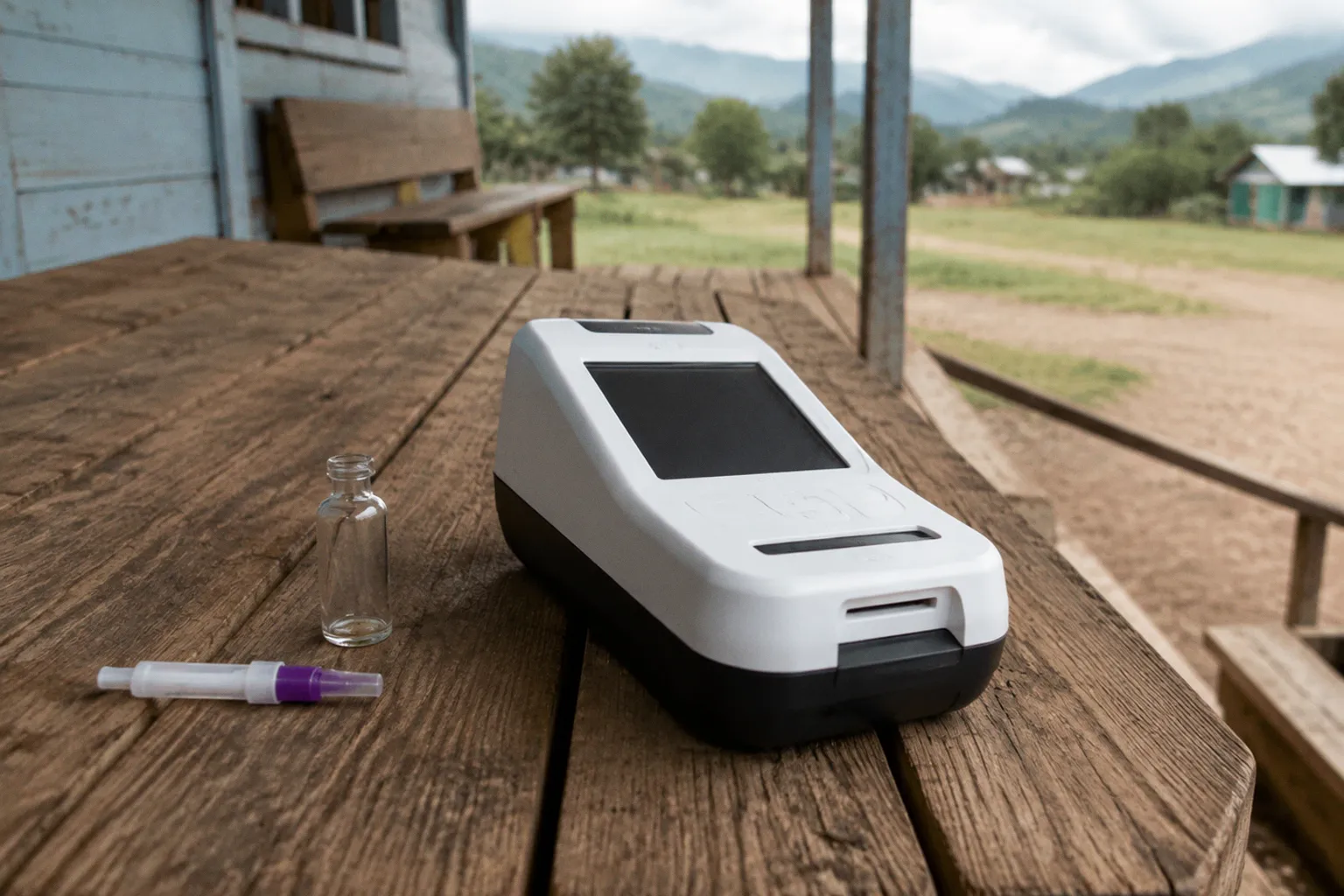
The gap is not primarily technological. It is logistical.
In rural healthcare, the choice between point-of-care testing and central laboratory diagnostics determines how quickly a clinician can act, how much travel a patient must absorb, and how efficiently a small facility uses limited staff and infrastructure. Point-of-care testing produces results within minutes at the site of care. Central laboratories provide greater analytical depth, lower unit costs at high volumes, and a wider test menu.
Neither model is sufficient on its own. The operational question is where each diagnostic function should sit within the rural care network.
The diagnostic divide: speed versus analytical depth
The contrast between POCT and central laboratory testing is often presented as a simple trade-off: speed against accuracy. That description is incomplete. The two systems are optimized for different constraints.
Point-of-care testing reduces the distance between specimen collection, result availability, and clinical action. A test performed in a remote clinic does not require physical transport to a distant laboratory. There is no courier schedule, no batch-processing delay, and no additional visit solely to receive a result. For conditions where treatment depends on a same-day decision, this changes the entire workflow.
Central laboratories are optimized for scale and analytical performance. They process large sample volumes with complex instrumentation, including platforms used for PCR and mass spectrometry. These systems can offer higher precision, sensitivity, and specificity than many point-of-care immunoassays. They also support a broader menu of tests than a small rural clinic can maintain locally.
The difference is therefore structural:
| Parameter | Point-of-care testing | Central laboratory testing |
|---|---|---|
| Result availability | Usually within minutes at the care site | Dependent on transport, batching, processing, and reporting |
| Specimen logistics | No transport of the physical specimen to a distant laboratory | Requires collection, labeling, transport, and laboratory accession |
| Analytical capacity | Limited by the device and its approved test menu | Broad menu with advanced platforms such as PCR or mass spectrometry |
| Analytical performance | Varies by assay; many rapid immunoassays have lower sensitivity or specificity than central methods | Generally higher precision, sensitivity, and specificity for complex testing |
| Cost per test | Typically higher for unit-use consumables | Lower at high volumes through automated processing |
| Infrastructure needs | Operator training, quality assurance, connectivity, maintenance, and supply continuity | Laboratory facility, transport network, technical staff, and centralized equipment |
| Best operational use | Immediate triage, treatment decisions, and screening near the patient | Confirmatory, complex, high-volume, or specialized diagnostics |
A remote clinic using POCT is not creating a miniature central laboratory. It is purchasing speed and local availability at the cost of narrower capacity and higher unit expenditure. A central laboratory is not merely slower. It provides a level of analytical control and test breadth that decentralized devices cannot consistently replicate.
In rural diagnostics, distance is part of the test result. A technically superior assay can have lower clinical utility when its output arrives after the treatment decision.
Turnaround time is a care variable
Laboratory turnaround time is usually recorded from specimen receipt to result release. Rural patients experience a longer interval. It begins with travel to the clinic, continues through specimen collection and transport, and may end with a second trip for treatment or interpretation.
This creates a distinction between laboratory turnaround time and patient-facing diagnostic time. A central laboratory may process a specimen rapidly after arrival, while the rural care pathway remains slow because the specimen has to cross a geographic and administrative network.
The problem is more severe when care depends on a narrow window. Suspected pneumonia, sexually transmitted infections, pregnancy-related complications, and acute infectious disease management may require a decision before the next courier run. A delayed result can lead to empirical treatment, deferred treatment, repeat visits, or referral to a higher-level facility.
Point-of-care testing compresses these intervals. It does not eliminate diagnostic uncertainty. It changes when uncertainty is addressed.
Quantifying the impact in remote clinics
The most useful comparison is not the device’s advertised processing time. It is the total time consumed by the care pathway.
A simulation of pneumonia testing in a rural clinic estimated 27.80 total lost productive hours for central laboratory testing, compared with 15.50 hours for POCT. The 12.30-hour difference represents time absorbed by travel, waiting, coordination, and follow-up requirements. It should not be interpreted as a universal result for every disease or facility. It demonstrates the scale of the logistical penalty that can accompany centralized testing.
The effect accumulates across several steps:
1. Initial travel to the clinic.
A patient may already spend substantial time reaching a rural facility. If a diagnostic decision cannot be completed during that visit, the travel burden becomes recurrent rather than one-time.
2. Specimen handling and dispatch.
The sample must be labeled, stored under appropriate conditions, packaged, and transferred. Each step creates potential delay and requires staff time.
3. Transport to the central laboratory.
Rural transport systems are often scheduled rather than continuous. A specimen that misses a dispatch window may wait until the next available route.
4. Laboratory processing and reporting.
Central laboratories gain efficiency through batching. That is an advantage at scale, but batching can create delays for low-volume or geographically distant sites.
5. Return of the result.
Electronic reporting can reduce the final interval, but connectivity and record-system integration are not uniform across remote facilities.
6. Clinical follow-up.
If the patient is not present when the result arrives, staff must contact the patient or arrange another encounter. The diagnostic process then becomes a separate episode of care.
POCT reduces or removes several of these steps. It does not remove registration, clinical assessment, quality control, or treatment documentation. Its productivity gain comes from shortening the path between the patient and the result.
This distinction is particularly relevant to rural diagnostic testing models serving populations with limited transportation, inflexible work schedules, or long distances to acute and obstetric hospitals. In some rural regions, travel to acute or obstetric care may exceed 30 minutes and can extend beyond an hour. A local result cannot replace referral capacity, but it can improve the decision about whether referral is necessary and how urgently it should occur.
Productivity is not the same as clinical benefit
Reduced lost time has operational value. It can also produce clinical value when the result changes management during the same encounter. But the two outcomes should be measured separately.
A clinic may shorten diagnostic time without improving treatment if the test has poor sensitivity, if positive results are not linked to medication availability, or if referral pathways remain unavailable. Conversely, a central laboratory result may be analytically superior but arrive too late to alter the immediate decision.
A serious evaluation should track at least four outcomes:
- time from specimen collection to result availability;
- time from patient arrival to treatment or referral decision;
- proportion of patients requiring a repeat visit;
- rate of discordant or unresolved results requiring central confirmation.
This prevents productivity gains from being treated as a substitute for diagnostic quality.
Economic realities of decentralized diagnostic models
The financial comparison is less intuitive than the time comparison. POCT usually carries a higher cost per individual test because its consumables are designed for unit use. Central laboratories use automated reagents and equipment across high sample volumes, reducing the marginal cost of each processed specimen.
That advantage depends on volume and transport efficiency. A low-volume rural clinic may pay more per test for local capacity, while a central laboratory may incur greater system-level costs through courier operations, specimen loss, delayed reporting, and repeat patient encounters.
The relevant unit of analysis is not always the test. It may be the completed episode of care.
A decentralized model can generate value when it:
- prevents a second patient journey;
- supports treatment during the initial encounter;
- reduces unnecessary referral;
- identifies patients who need urgent transfer;
- improves screening coverage in communities that rarely access laboratory services;
- allows clinicians to manage more cases within the local facility.
A central model can generate value when it:
- consolidates high-volume testing;
- supports complex assays unavailable locally;
- maintains strong analytical quality systems;
- avoids duplication of expensive equipment;
- provides confirmatory testing for ambiguous or high-consequence results.
The economic decision therefore depends on the distribution of tests across the network. High-volume routine assays may be more efficient in a central laboratory. Low-volume, time-sensitive tests may justify local POCT even when the per-test price is higher.
Revenue and resource allocation
Rural hospitals and community clinics often operate with narrow financial margins. A POCT program requires more than procurement. The resource allocation includes consumables, device maintenance, competency assessment, quality assurance, connectivity, data management, and replacement planning.
Partnerships between laboratories and decentralized testing sites may expand laboratory revenue by extending the testing network. Some analyses have identified a potential laboratory revenue increase of 5% to 10% through expanded POCT hub partnerships. This figure should be treated as a model-dependent possibility rather than a general market result. The outcome depends on reimbursement, test volume, contractual structure, and whether local testing creates new utilization or merely shifts existing volume from the central laboratory.
Without a defined operating model, POCT can become a fragmented expense. Devices may be purchased through separate programs, consumables may be incompatible, and results may remain outside the electronic medical record. The result is duplicated infrastructure rather than distributed access.
Operational hurdles: training, integration, and quality assurance
The central laboratory concentrates technical expertise. POCT distributes testing across nurses, medical assistants, community health workers, or other non-laboratory personnel. That distribution changes the risk profile.
The device may be simple to operate. The diagnostic system is not.
A remote clinic needs clear controls for:
- operator training and certification;
- lot verification and expiration management;
- internal and external quality assurance;
- calibration and maintenance;
- temperature and storage conditions;
- result documentation;
- connectivity with the electronic medical record;
- escalation when a result is inconsistent with the clinical presentation;
- confirmation of selected results through a central laboratory.
The unknown rate of operator error across remote settings should not be replaced with an invented average. Performance varies by device, workload, staffing model, supervision, and training continuity. A clinic performing a small number of tests each month may have a different error profile from a high-volume community health center with dedicated oversight.
Training is a recurrent cost
Certification at program launch does not establish permanent competence. Rural facilities experience staff turnover, role changes, leave gaps, and periodic shortages. A POCT program must therefore budget for retraining and reassessment.
The relevant question is not whether staff can complete the manufacturer’s procedure once. It is whether the network can sustain correct practice during routine service pressure.
Common failure points include:
- incorrect specimen collection;
- inadequate sample volume;
- failure to record lot numbers;
- use of expired or improperly stored consumables;
- incomplete quality-control documentation;
- transcription errors when results are entered manually;
- failure to repeat or confirm an unexpected result.
These failures are not arguments against POCT. They are arguments against treating POCT as an appliance rather than as a clinical service.
IT integration determines whether the result travels
A rapid result that remains on a paper strip or isolated device has limited system value. It may inform the immediate clinician but fail to reach the patient’s longitudinal record, referral team, disease surveillance system, or public health reporting channel.
Electronic medical record integration should be designed before deployment. The system needs to capture the patient identifier, test type, result, time of testing, operator, device, and relevant quality-control status. Where connectivity is unreliable, the fallback process must preserve data integrity without creating duplicate records.
This is a practical boundary between a networked POCT program and a collection of independent devices. The former produces usable clinical information. The latter produces local readings that may be difficult to audit.
What POCT can and cannot replace
Point-of-care testing should be assigned to decisions where speed has a clear clinical or operational effect. It should not be selected merely because a device is available.
Rapid testing can support:
- same-visit infectious disease screening;
- immediate triage of patients who may require referral;
- selected pregnancy-related assessments;
- chronic disease monitoring where local results change management;
- early identification of conditions requiring confirmatory testing;
- outreach services operating far from laboratory infrastructure.
Central laboratories remain necessary for complex diagnostic questions, broad panels, confirmatory testing, and assays where analytical sensitivity and specificity determine safety. Many rapid immunoassays do not match the performance of PCR, mass spectrometry, or other advanced platforms. Device-specific verification is required before a rapid result is treated as equivalent to a central method.
The distinction is especially consequential in sexually transmitted infection testing. Desired performance targets for rapid tests may include sensitivity in the range of 90% to 99% and specificity near 99%, but a target is not the same as a demonstrated result for every device, population, or specimen type. Screening and confirmation should be linked by protocol rather than left to individual judgment.
POCT decentralizes the first decision. It does not decentralize every diagnostic responsibility.
A robust pathway uses local tests to determine immediate action and central laboratories to resolve complexity. This is a division of labor, not a competition for total control of the diagnostic process.
Building a hybrid diagnostic strategy for rural networks
The strongest rural diagnostic networks use a tiered model. The local clinic provides fast, limited testing. The central laboratory provides depth, confirmation, oversight, and high-volume processing. The referral hospital provides advanced clinical evaluation when diagnostic findings indicate escalation.
The design should begin with the clinical pathway rather than the device catalogue.
1. Map the time-sensitive decisions
The network should identify which results change treatment, isolation, referral, or monitoring during the same encounter. Those tests are candidates for POCT.
Tests with no immediate effect on management may remain centralized if transport and reporting are reliable. The objective is not to maximize the number of local assays. It is to place each assay where it produces the greatest clinical utility.
2. Segment the test menu
A practical menu separates testing into three groups:
- Local immediate tests: low-complexity assays that directly support same-visit decisions.
- Central routine tests: assays that benefit from automation, high volume, and standardized processing.
- Central specialized or confirmatory tests: complex assays requiring advanced instrumentation or higher analytical performance.
This segmentation reduces the risk of buying local capacity for tests that are rarely used or poorly suited to decentralized operation.
3. Establish a confirmation policy
Not every POCT result requires central confirmation. Some do. The policy should define which results are confirmed, under what clinical conditions, and how treatment proceeds while confirmation is pending.
Confirmation becomes particularly relevant when a false negative could delay urgent care or when a false positive could trigger unnecessary treatment, referral, or public health action.
4. Connect the result to supply and referral capacity
Diagnostic access is incomplete if the test result cannot produce an intervention. A rural clinic that identifies a condition but lacks medication, transport, obstetric referral, or follow-up capacity has improved detection without completing care.
POCT deployment should therefore be coordinated with:
- essential medicine availability;
- transport and referral agreements;
- teleconsultation or clinician support;
- patient follow-up procedures;
- emergency escalation protocols;
- public health reporting requirements.
The device is one component of the infrastructure. It cannot compensate for a deficit in the rest of the pathway.
5. Measure utilization, not procurement
A purchased device is not a successful program. Evaluation should include utilization rates, invalid-result rates, repeat-test rates, stock interruptions, operator competency, result transmission, and changes in referral patterns.
Low utilization can indicate several different problems: inadequate demand, poor placement, insufficient training, supply interruptions, or a test menu disconnected from local disease patterns. The response should depend on the cause.
High utilization also requires scrutiny. A busy device may be improving access, or it may be replacing more appropriate central testing without adequate confirmation. Volume is a service indicator, not a quality indicator by itself.
The policy outcome is a distributed laboratory system
The central laboratory and the rural clinic should not be treated as opposing institutions. They are different nodes in one diagnostic infrastructure.
Centralization provides analytical depth and economic efficiency at scale. Decentralization provides time, proximity, and continuity at the point where clinical decisions occur. Rural health equity depends on combining those advantages without allowing either model to absorb responsibilities it cannot safely perform.
The likely direction of rural diagnostic policy is therefore hybrid: more POCT for time-sensitive decisions, stronger laboratory oversight for distributed testing, and better digital integration between local facilities and central systems. The outcome will depend less on the number of devices deployed than on whether resource allocation follows the full patient pathway.
Where transport delays dominate, local testing can recover hours of lost productivity and reduce avoidable repeat encounters. Where analytical complexity dominates, central laboratories will remain indispensable. A rural network that recognizes both constraints will produce faster decisions without confusing speed with accuracy.